
What you need to know about Zambia ?
Zambia, officially known as the Republic of Zambia, is a landlocked country located in Southern Africa. It covers an area of 752,618 km² and has an estimated population of around 22 million inhabitants in 2026. Its capital and largest city is Lusaka. Formerly known as Northern Rhodesia during the British colonial period, Zambia gained its independence in 1964.
The official language spoken in the country is English. The country is part of several international organizations such as SADC, COMESA, AfDB, CIRGL, and CICIBA. The country’s telephone code is 260.
Colors of Zambia
The Zambian flag is a rectangular flag with a green background. On the fly side, there is a rectangle composed of 3 horizontal stripes in red, black, and orange. Above it, there is an orange eagle. The red represents the people’s struggle for sovereignty, the orange represents the country’s mineral wealth, and the black represents African roots.

Best places to visit in Zambia
Lusaka: The capital of the country is a very large urban area. You can enjoy various friendly cafes and bars as well as several beautiful places in the city. There is also a popular national park, museums containing ancient artifacts of the country.
Livingstone
It is a complex city with dusty streets, extravagant bars, and open markets. Tourists can mingle with the local population and enjoy top spots such as Victoria Falls, Maramba Market, and the Zambezi River for rafting.
Kitwe
This city is located in the northern section of the country. Tourists can choose from many lodges and accommodations. You will also discover the Mwekwera Falls, Mindolo Dam, Kumasamba Lodge, the Chembe Bird Sanctuary, and the Nkana mines.
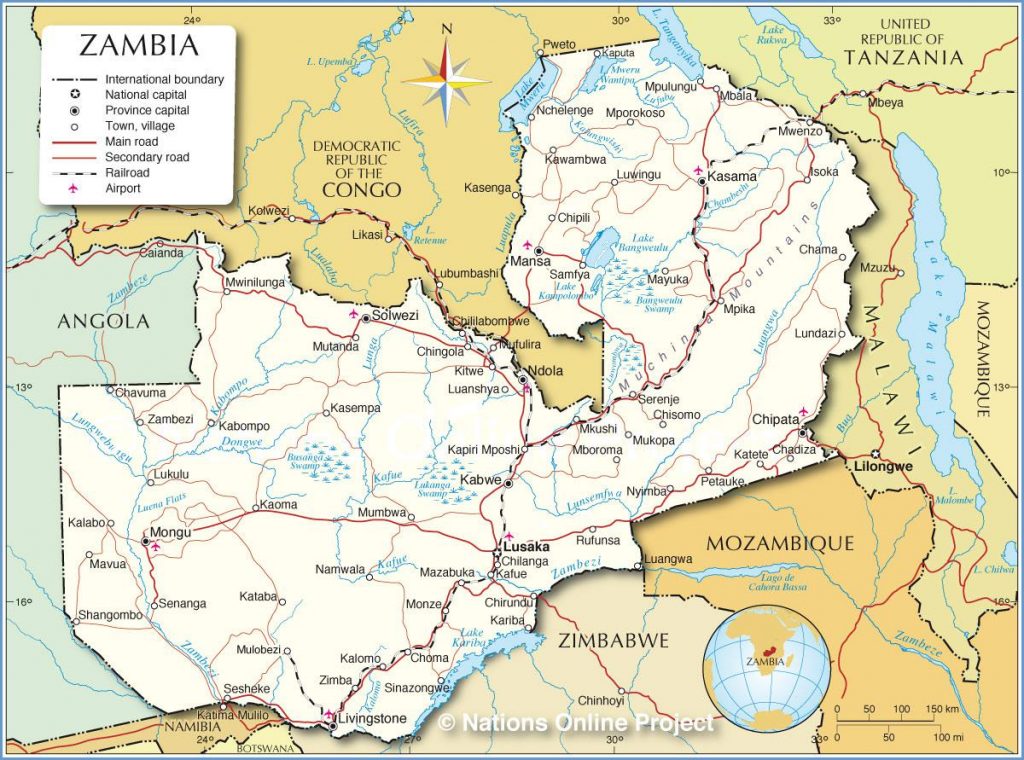
Where is Zambia located on the world map?
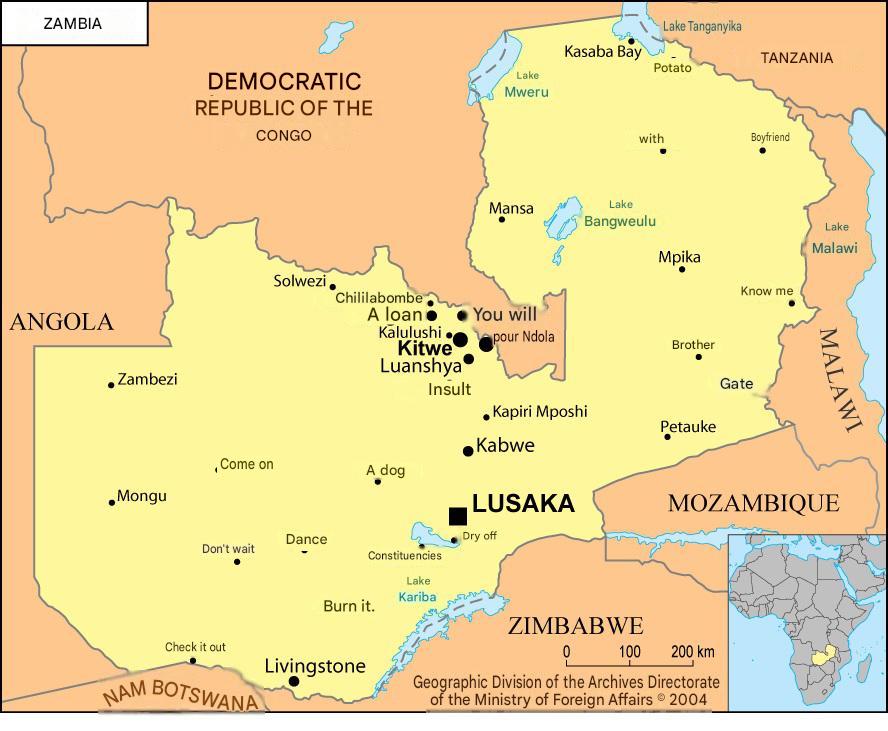
On the country map, Zambia is located in Africa, more precisely in the southern part of continental Africa. Its neighbors are the DRC, Tanzania, Malawi, Mozambique, Zimbabwe, Botswana, and Namibia.
Climate of Zambia
The climate of Zambia is tropical. Rain occurs for 5 months a year and appears as storms accompanied by heavy raindrops. Precipitation in the driest sections is around 800mm, in the humid zones precipitation is about 1,000 mm, and finally, the northeast zone shows precipitation of 1,400 mm annually.
Temperatures in the country are strongly influenced by the topography. The hottest part of the country is the Luangwa Valley and the southwest section. The coldest section is the northeast section and the Malawi border. Temperatures in the coldest areas reach 7°C in winter and 20°C in summer. In the warmer sections, temperatures range between 17 and 35°C.
Administrative division of Zambia
The Zambian territory is divided into 10 provinces which are further subdivided into 117 districts. Here are the provinces of the country:

- Central
- Copperbelt
- East
- Luapula
- Lusaka
- Muchinga
- North
- Northwest
- South
- Western
Economy of Zambia
The Zambian economy is often characterized as the economy of a developing country. However, the dynamism of this economy has made it one of the fastest growing economies in Southern Africa in terms of GDP. The economy is dominated by agriculture (85%) but also by the oil, energy, and textile industries.
- Current currency: Zambian Kwacha
- Nominal GDP: approximately USD 33 billion
- GDP at Purchasing Power Parity (PPP): approximately USD 92 billion
- Annual GDP growth rate: approximately 6.0%
- Nominal GDP per capita: approximately USD 1,500
- GDP per capita at Purchasing Power Parity (PPP): approximately USD 4,200
- Population living below the national poverty line: approximately 60%
Population and linguistic data of Zambia
Zambia has an estimated population of around 22 million inhabitants in 2026. Its annual population growth rate is approximately 2.8%, with a birth rate of about 35‰ and a death rate of around 6‰.
Life expectancy at birth is approximately 64 years, reflecting significant improvements in healthcare and the fight against infectious diseases.
FAQ – Zambia map: Geographic and demographic information
Zambia is a landlocked country located in Southern Africa. It shares borders with eight countries, including the Democratic Republic of the Congo, Tanzania, Malawi, Mozambique, and Zimbabwe.
Zambia has a population of approximately 22 million people in 2025. Most of the population lives in urban areas and along the country’s main economic development corridors.
Zambia covers an area of approximately 752,618 km². Its territory consists of high plateaus, valleys, and numerous rivers, including the Zambezi River.
