
What you need to know about Canada ?
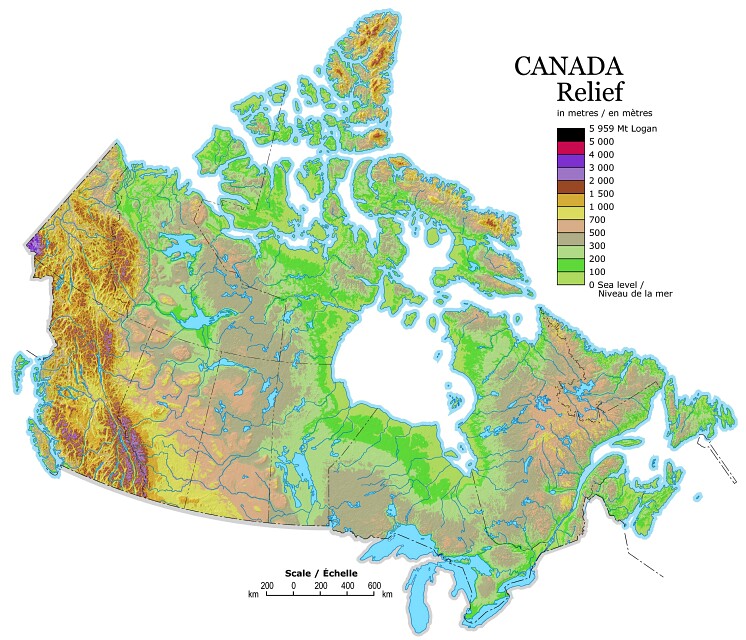
Canada is a federal parliamentary constitutional monarchy. It is a country in North America with a territory stretching from the Atlantic to the Pacific, and its northern part borders the Arctic Ocean. This territory measures 9.98 million km2, making Canada the second largest country in the world in terms of area.

Canada’s population is estimated at 41,528,680 inhabitants in 2025, making it the 38th most populous country in the world. Canada’s capital is Ottawa, while its largest cities are Toronto, Montreal, and Vancouver. The country’s two official languages are French and English. Finally, Canada’s international calling code is +1.
Where is Canada on the world map?
On the world map, Canada is a country located on the American continent. Specifically, it occupies the upper half of North America. Its southern and western sections share borders with the United States via 8,891 km of borders, which is the longest binational border in the world.

Colors of Canada and Their Meanings
The colors of Canada were adopted in 1868 under the informal name “Red Ensign.” It was only in 1945 that the flag was approved by legislation and in 1965 that it was officially proclaimed by Queen Elizabeth.
The Canadian flag appears as a rectangular banner composed of two red bands on the left and right of a white square which has at its center a red maple leaf with 11 points. This is where the flag’s nickname “Maple Leaf Flag” comes from.
The leaf has always been the Canadian symbol of the environment; however, the 11 points have no precise meaning to date. The two red bands on the outside symbolize the two oceans bordering Canadian territory, the Atlantic and the Pacific. On the other hand, the white square symbolizes the parts of the territory that are constantly snow-covered.

What are the best cities in Canada?


Vancouver
Vancouver is a city in the province of British Columbia, it is one of the most cosmopolitan cities in Canada and the one with the most cultural diversity. It is these cultures that have made Vancouver a city highly appreciated by culinary enthusiasts. Here, there are also booming microbreweries.
Moreover, Vancouver has an interesting aquarium and some beautiful parks including the famous Stanley and Queen Elizabeth parks. The New York Times once stated that this city looks like Manhattan, but with mountains.
It’s a nice description, but it forgets the fact that Vancouver is also a port city with 8 magnificent beaches, one of which overlooks a lake.
Québec City
It is a very old city dating back to 1608 and is the capital of the province of the same name. Québec City is a charming and picturesque city. It has an old town nicknamed Old Québec which will allow you to stroll through the cobbled streets leading in front of ancient buildings from the 17th and 18th centuries.
This city is the only one fortified north of Mexico. In fact, it houses several active museums and also the Citadel of Quebec, which is the largest British fortress ever erected in the northern part of the American continent.
Montréal
The city of Montréal is also located in Quebec. This city is especially known for its mix between the new and old French but also French and English.
Its picturesque neighborhood is Old Montréal which has several paved paths with old buildings dating from the 17th century, making it one of the oldest urban neighborhoods in North America. Montréal is also a modernized city with many skyscrapers, several places very lively at night, and an underground city.
The latter is a collection of buildings and offices; the underground city also features several hotels, residential and commercial buildings, all connected by tunnels very convenient during harsh winters.
Ottawa
The capital of Canada is located in the province of Ontario and has several tourist attractions such as the parliament buildings, as well as museums classified as world heritage sites.
The main tourist attraction in Ottawa is the Rideau Canal which is popular with boaters especially in winter, but in summer, it is a breathtaking destination. This place is one of the largest ice rinks in the world. Ottawa also offers outdoor activities: hiking, rafting on the Ottawa River which, by the way, attracts many tourists.
London
The city of London is the namesake of London, England, it is located in Ontario and also has a Thames. The best way to discover London in its entirety is to get on a vehicle designed to give you a two-hour tour of all the historical sites as well as the city’s museums.
If you stay in town, Fanshawe Pioneer Village is the best place to visit. It is an open-air museum that shows you the design of the city and the region during the years 1820 to 1920 while London City was being developed.
Halifax
The city of Halifax is a city that offers plenty of pleasures. Halifax is a city located in the province of Nova Scotia, it has more pubs and clubs than any other city in Canada.
In addition to drinking, there are several other attractions: among them is Fisherman’s Cove, which is an old fishing village about 200 years old, completely redeveloped.
There is also the Maritime Museum of the Atlantic. Halifax is quite close to Fundy, a bay considered one of the 7 natural wonders of America. It is also the one that has the highest tides in the world.
Where are the cities located on the map?

Vancouver
The city of Vancouver is a coastal port city in the territory of British Columbia. Vancouver is located on the western half of the Burrard Peninsula and is bounded to the north by English Bay and Burrard Inlet and to the south by the Fraser River.
Québec City
Québec, the capital of the province of Quebec, is located on the north shore of the Saint Lawrence River at the confluence of the Saint-Charles River, that is to say in the center of the province.
Montreal
Montreal is located in the southwest of the province of Quebec on the Island of Montreal at the convergence of the Saint Lawrence and Ottawa rivers.
Ottawa
Ottawa is located in the southeast of Ontario, that is in the easternmost part of the province.
London
London is located in the province of Ontario near Dorchester, St. Thomas, and Ingersoll.
Halifax
Halifax is a city located in the province of Nova Scotia, in the southeastern part of Canada. Halifax is situated on the south shore of Bedford Basin.
Population of Canada
Canada’s population is estimated at 41,528,680 inhabitants in 2025. Its annual population growth rate is approximately 2.0%. The fertility rate is about 1.26 children per woman, while the birth rate is approximately 10.2 births per 1,000 inhabitants and the death rate is approximately 8.8 deaths per 1,000 inhabitants.

Canada’s infant mortality rate is approximately 4.3 deaths per 1,000 live births. Life expectancy at birth is about 82.7 years, including 80.7 years for men and 84.7 years for women. The population sex ratio is approximately 98 men for every 100 women.
According to the latest estimates, Canada’s population is composed of approximately 68% people of European origin, 20% Asians, 4.3% Black people, 5% Indigenous peoples (First Nations, Métis, and Inuit), and 2.7% people of other or mixed origins.
Economic Information about Canada
Canada has one of the world’s largest economies. In 2025, it ranks 9th globally by nominal GDP, with a gross domestic product of approximately USD 2.33 trillion, and is among the top 18 economies in terms of Purchasing Power Parity (PPP). Canada also ranks among the countries with the lowest levels of corruption according to major international indexes. Thanks to its open and highly globalized economy, Canada is one of the world’s ten largest trading nations, particularly in the energy, mining, manufacturing, agri-food, and services sectors.


Canada’s economy is a mixed economy and much more so than that of the USA. However, the country’s economic freedom index is relatively low due to the disparity in average disposable income per capita.
Canada’s stock exchange (Toronto’s) is ranked in the top 10 (9th position) worldwide in terms of market capitalization with more than 1500 companies having a capitalization exceeding 2 million dollars.
The Canadian economy is mainly based on trade of goods and services, exports, and several mining and manufacturing sectors.
Here are some economic data about Canada:
- Currency: Canadian dollar
- Nominal GDP: approximately USD 2.33 trillion
- Annual GDP growth: approximately 1.5% (2025)
- GDP per capita (nominal): approximately USD 56,100
- GDP per capita (PPP): approximately USD 64,800
- Inflation rate: approximately 2.1%
- Population living below the poverty line: approximately 9.9%
- Human Development Index (HDI): 0.935
- Unemployment rate: approximately 6.8% of the labour force
- Labour force: approximately 22.3 million people
- Exports of goods: approximately USD 569 billion
- Imports of goods: approximately USD 571 billion
Climate information on Canada
Canada’s climate varies from one region to another. That is why winter and summer temperatures vary. Throughout almost the entire Canadian territory, winters are very cold especially in inland provinces.
These areas experience a continental climate and temperatures average around -15°C and can reach -40°C during wind chills. Other non-coastal areas can experience heavy snowfall covering the ground for more than 6 months a year. Some northern zones, however, experience frequent snowfalls throughout the year.
Coastal areas including British Columbia have a temperate climate. This climate is characterized by mild winters with high precipitation. Western and eastern coastal areas show minimum temperatures around 20 °C and maximum temperatures can vary between 25 and 30 °C or even exceed 40 °C.
The northern section of Canada is constantly covered with ice and permafrost which are melting due to global warming of 1.7 to 2.3 °C in various regions.
Administrative Subdivisions of Canada

Geographically, Canada is divided into 6 standardized geographic units which are the Atlantic, Quebec, Ontario, the Prairies, British Columbia, and the Territories. Administratively, the Canadian territory is split into 3 territories and 10 provinces, the provinces are then divided into 288 census divisions.
The three territories are the Northwest Territories, Nunavut, and Yukon.
Here are the 10 provinces of Canada:
- Alberta
- British Columbia
- Prince Edward Island
- Manitoba
- New Brunswick
- Nova Scotia
- Ontario
- Quebec
- Saskatchewan
- Newfoundland and Labrador
- Nunavut
- Northwest Territories
- Yukon
Canada’s linguistic demographic data
Compared to the total Canadian population, inhabitants whose mother tongue is English number 18.8 million, those speaking French amount to 6.5 million, and the rest have a mother tongue other than the official languages.

We therefore conclude that anglophones are the most dominant in the population, about 56.7%. However, this percentage decreases year by year in favor of allophones. Francophones, on the other hand, represent a quarter of the total population and continue to increase in number.
Among those whose mother tongue is neither French nor English, there are also Indigenous peoples. They represent more than 19% of non-anglophone and non-francophone speakers: these are the Allophones.
The latter are mainly composed of immigrants whose origins are Inuit, First Nations, and Métis. This ethnicity is spread throughout the Canadian territory, and their language families are:
- Akgonquian
- Eskimo-Aleut
- Athabaskan
- Siouan
- Salishan
- Tsimshian
- Iroquoian
- Wakashan
- Haida
- Kutenai
- Tlingit
- Beothuk (extinct)
The Indigenous population represents only a small part of the total Canadian population, about 1.6 million inhabitants or 3%. These inhabitants are composed of 58% First Nations, 35.1% Métis, and 3.9% Inuit.
Indigenous peoples mainly populate Ontario, British Columbia, Alberta, Manitoba, Saskatchewan, and Quebec with occupation percentages of 22.15%; 16.17%; 15.55%; 13.52%; 10.60%; and 10.79% respectively.
Canada is located in the northern part of North America, stretching from the Atlantic in the east to the Pacific Ocean in the west and north to the Arctic Ocean.
Canada shares the longest land border to the south with the United States and is bordered to the west by Alaska (United States). To the northeast, it faces Greenland (a territory of Denmark), and to the east, the French island of Saint Pierre and Miquelon is located near the Canadian coast.
Canada is located in North America
