
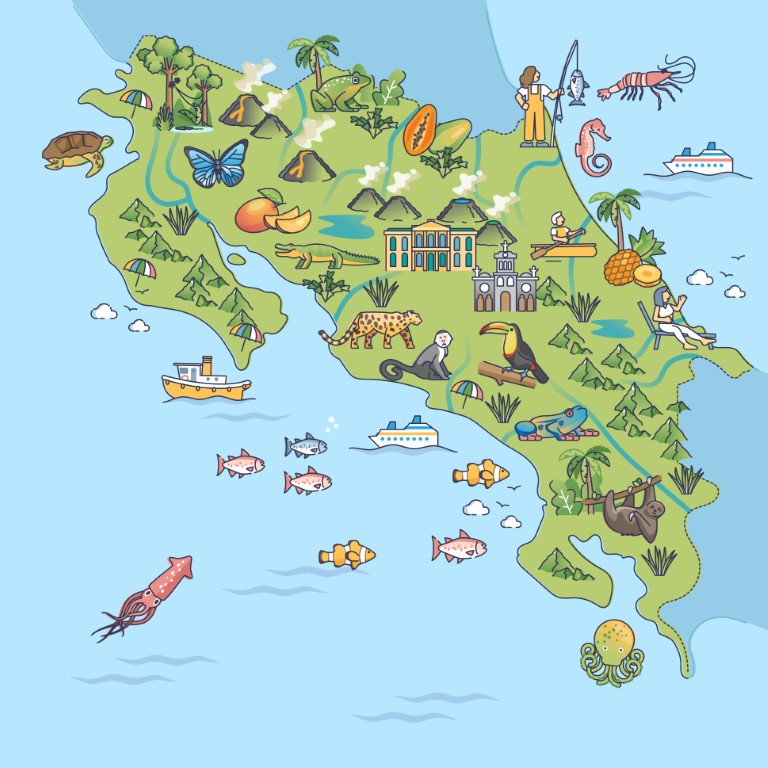
What you need to know about Costa Rica ?
We present to you here Costa Rica, a Central American country with a constitutional republican government. Its capital, which is also its largest city, is San José.
Costa Rica has adopted Spanish as its official language and means of communication, although English is widely taught and used in schools and tourist establishments.
Its territory covers 51,100 km² and its population is estimated at 5.2 million inhabitants in 2025, with a density of about 102 inhabitants/km². The country ranks 126th worldwide by area and 106th by population.
Costa Rica is recognized for its stable and exemplary democracy in Latin America, as well as for its high school enrollment rate. The official currency is the Costa Rican Colón (CRC) and the telephone code is +506.
Table – Costa Rica: Geographic and demographic information
| Element | Key Information |
|---|---|
| Total area | 51,100 km² |
| Capital | San José |
| Neighboring countries | Nicaragua, Panama |
| Coastline | ~1,290 km (Pacific and Caribbean Sea) |
| Estimated population | ~5.3 million inhabitants (2025) |
| Population density | ~104 inhabitants/km² |
| Relief | Central mountain range, volcanoes, coastal plains |
| Climate | Humid tropical, with dry and rainy seasons |
| Official language | Spanish |
| Economic resources | Tourism, agriculture (coffee, banana, pineapple), hydroelectricity |
| Special feature | Pioneer country in ecotourism, no army since 1949 |
Additional points on the map of Costa Rica

- Located in Central America, Costa Rica is bordered by the Caribbean Sea to the east and the Pacific Ocean to the west.
- The country shares its land borders with Nicaragua to the north and Panama to the south.
- Its physical map shows a chain of active volcanoes and tropical forests rich in biodiversity.
- The capital, San José, is located in the central valley.
- Costa Rica is globally recognized for its national parks and natural reserves.
Where is Costa Rica located on the world map?
On the World Atlas, Costa Rica is located on the American continent. Situated in the heart of Central America, it neighbors Nicaragua, Panama, and Ecuador.
Costa Rica has borders with the Caribbean Sea to the north-east, on the Pacific Ocean to the south-west, and to the south on the Cocos Islands.

The map of Costa Rica highlights a Central American country, bordered by Nicaragua to the north and Panama to the south. Open to two maritime fronts, the Pacific and the Caribbean, it is renowned for its ecotourism and volcanic landscapes.
Population of Costa Rica

The population of Costa Rica is estimated at 5.2 million inhabitants in 2025. The demographic growth rate is about 0.8% per year, showing a slowdown compared to previous decades. The fertility rate is 1.7 children per woman, which is below the replacement level.
Birth and death rates are respectively 13.5 ‰ and 5.3 ‰, while the infant mortality rate is relatively low for the region, at 6.5 ‰.
Life expectancy at birth is high: 80.2 years on average (77.5 years for men and 83 years for women). The median age of the population is 34.2 years, indicating a still relatively young but progressively aging population.
The sex ratio is about 100 men for 100 women, and the country experiences a low and slightly positive migration rate (+0.2 ‰).
Ethnic and religious composition
- Whites and mestizos: ~84%
- Afro-Costa Ricans: ~7%
- Indigenous peoples: ~2%
- Others (Asians, recent immigrants, etc.): ~7%
Regarding religion, Roman Catholicism remains the majority (57%), followed by Evangelical Protestantism (25%) and about 15% non-believers. Jehovah’s Witnesses and other religious minorities together represent less than 3%.
What are the colors of the country?

The colors of Costa Rica were adopted in 1948; it was only later that the national emblem or coat of arms was represented on the flag. The flag consists of 5 alternating horizontal stripes: blue, white, red, white, and blue. The central red stripe is twice the size of the other stripes. The national coat of arms is located on the red stripe but slightly offset to the left.
- The blue color represents determination, ideology, intellectual thoughts, and the sky.
- The white color represents peace, joy, intelligence, and freedom.
- The red color represents love, generosity, and the warm people.
What are the best cities to visit in Costa Rica?
San José
The capital and largest urban area of Costa Rica is located in the Central Valley. It is the ideal starting point to explore the country. San José charms with its historic monuments, its cultural museums (notably the Pre-Columbian Gold Museum and the National Museum of Costa Rica) and its lively local markets. It is also a convenient stopover for travelers before heading to the volcanoes or the beaches of the Pacific and the Caribbean.
Monteverde
Perched in the Puntarenas region, Monteverde is a prime destination for nature lovers. Its natural reserves and cloud forests shelter incredible biodiversity. It is a hotspot for ecotourism and hiking, appreciated for its hanging bridges, forest trails, and birdwatching of rare species like the quetzal.
Puerto Viejo & Cahuita
Located on the Caribbean coast, these towns offer a unique blend of cultures: indigenous, Afro-Caribbean, and Latino. Puerto Viejo is known for its festive and relaxed atmosphere, while Cahuita attracts with its national park and coral reef. The region is also known for its coconut-lined beaches and spicy Caribbean cuisine.
Liberia
Nicknamed the “gateway to gold”, Liberia is the capital of the Guanacaste province. Known for its whitewashed houses and colonial style, it is the ideal starting point to explore the North Pacific beaches (Tamarindo, Playa Conchal) and the volcanoes of Rincón de la Vieja National Park.
Alajuela
Close to San José, Alajuela is a warm city surrounded by coffee plantations and lush landscapes. It houses the Juan Santamaría Museum, a national hero, and provides easy access to the Poás volcano, one of the most impressive in the country. It is an ideal stop for those who want to combine culture, history, and exotic nature.
It is also a famous seaside resort with a past and cultural remains from indigenous, Latin, Afro-Caribbean, and Bribri peoples. There is also Cahuita National Park as well as the Gandoca-Manzanillo wildlife reserve.
Costa Rica climate map
Costa Rica’s main climate is a humid tropical climate. This results in consistent warmth throughout the year. In the north-central area and extending to the southeast, a typical forest climate is observed.

On the other hand, the [northwest and southeast] sections show a monsoon tropical climate. The rest of the country is then subdivided between tropical savannas in the western section and a strip of land located between the central section and the western tip: a temperate climate is observed. There are also mountain peaks also called the Alpine Zone.
What makes the big difference for all territories is the rainfall. For example, on the Pacific coast or in the central plateau: there are only two seasons: dry season and wet season. These occur respectively between December and April and between May and November.
The months of May and November are the wettest. On the other hand, the lateral plains and coasts display an equatorial climate with abundant rains. The wettest areas of the country are the eastern coast and the plain along the Caribbean Sea. Rainfall can even reach 3000mm. The hottest part of the country is the coast facing the Pacific. At night it is 30 to 32°C and during the day temperatures can even reach 37°C.
Costa Rica economic map

Costa Rica economy (2025)
General overview
- GDP (PPP): approximately 169 billion USD
- GDP per capita (PPP): approximately 31,460 USD
- Real GDP growth: +3.4%
- Inflation: 2.2%
- Estimated population: approximately 5.37 million inhabitants
Unemployment, poverty, and income
- Unemployment rate: approximately 9.5%
- Poverty rate: close to 10%, decreasing in recent years
- Economic status: high-income country
Energy and infrastructure
- Nearly 95% of electricity is produced from renewable sources (hydroelectric, geothermal, wind, solar, biomass).
- National goal: achieve carbon neutrality by 2050.
Key products and economic diversification
- Main exports: medical instruments, bananas, coffee, pineapples, rum, software, business services.
- Growing sectors: ecotourism, medical technologies, agri-food, high-tech devices, outsourced services.
- Attractiveness: preferred destination for foreign investments in services, health, and technology.
Administrative and demolinguistic data

Administrative subdivisions
Currently, the Costa Rican territory is divided into 7 provinces, which in turn are composed of 82 cantons. Each Canton is managed by a mayor who is elected by direct universal suffrage for a 4-year term for each Canton. The Cantons are further divided into 488 districts.
Here are the 7 provinces of Costa Rica
- Alajuela
- Cartago
- Guanacaste
- Heredia
- Limón
- Puntarenas
- San José
Here are the 82 cantons of Costa Rica
- San José
- Escazú
- Desamparados
- Puriscal
- Tarrazú
- Aserrí
- Mora
- Goicoechea
- Santa Ana
- Alajuelita
- Vázquez de Coronado
- Acosta
- Tibás
- Moravia
- Montes de Oca
- Turrubares
- Dota
- Curridabat
- Pérez Zeledón
- León Cortés Castro
- Alajuela
- San Ramón
- Grecia
- San Mateo
- Atenas
- Naranjo
- Palmares
- Poás
- Orotina
- San Carlos
- Zarcero
- Sarchí
- Upala
- Los Chiles
- Guatuso
- Río Cuarto
- Cartago
- Paraíso
- La Unión
- Jiménez
- Turrialba
- Alvarado
- Oreamuno
- El Guarco
- Heredia
- Barva
- San Domingo
- Santa Bárbara
- San Rafael
- San Isidro
- Belén
- Flores
- San Pablo
- Sarapiquí
- Libéria
- Nicoya
- Santa Cruz
- Bagaces
- Carrillo
- Cañas
- Abangares
- Tilarán
- Nandayure
- La Cruz
- Hojancha
- Puntarenas
- Esparza
- Buenos Aires
- Montes de Oro
- Osa
- Quepos
- Golfito
- Coto Brus
- Parrita
- Corredores
- Garabito
- Limón
- Pococí
- Siquirres
- Talamanca
- Matina
- Guácimo
Linguistic demo data
The estimated 4.3 million inhabitants are distributed among several ethnic groups: 83.6% white or Mestizos, 6.7% Mulattoes, 2.4% Native Americans, 1.1% black or Afro-Caribbeans.
- The Native Americans of the country represent 104,000 inhabitants, some of whom live in reserves and are composed of 8 ethnic groups:
- Quitirrisí
- Matambú or Chorotega
- Maleku (North Alajuela)
- Bribri (South Atlantic)
- Cabécar
- Guaymí (along the Panamanian borders)
- Boruca
- Térraba
There are also European Costa Ricans or descendants of Europeans. Most are Hispanic descendants or Italians, Germans, English, French, Portuguese, and Irish.
The primary Costa Rican language is Spanish with characteristic traits of the country and a form related to American Spanish. It is a language derived from 5 local indigenous languages whose descendants are the Maléku, Cabécar, Bribri, Guyami, and Bulgere.
The dominant dialectical variants are Bribri, Maléku, Cabécar, Ngabere which have thousands of speakers in Costa Rica, but there are also Teribe and Boruca which have more than 1000 speakers. There is also Creole English, Jamaican Patois spoken by Afro-Caribbeans.
FAQ – Costa Rica map
Costa Rica is in Central America, between Nicaragua and Panama, with coastlines on the Caribbean Sea and the Pacific Ocean.
The capital is San José, located in the center of the country.
A mountainous and volcanic territory, bordered by two tropical coastlines, with exceptional biodiversity.
