
What you need to know about Nicaragua ?
Nicaragua is a country in Central America and a presidential constitutional republic. Its multiethnic population is estimated at about 6.8 million inhabitants. The territory of Nicaragua covers 130,375 km², including a large coastline on the Pacific Ocean and an opening on the Caribbean Sea.

The country ranks 96th worldwide by area and 112th by population. The Nicaraguan population is composed of several ethnic groups, with a majority of mestizos, as well as indigenous and Afro-Caribbean populations. The official language is Spanish, but English and several indigenous languages are also spoken, especially on the Atlantic coast.
The capital and largest city is Managua. The telephone code for Nicaragua is +505.
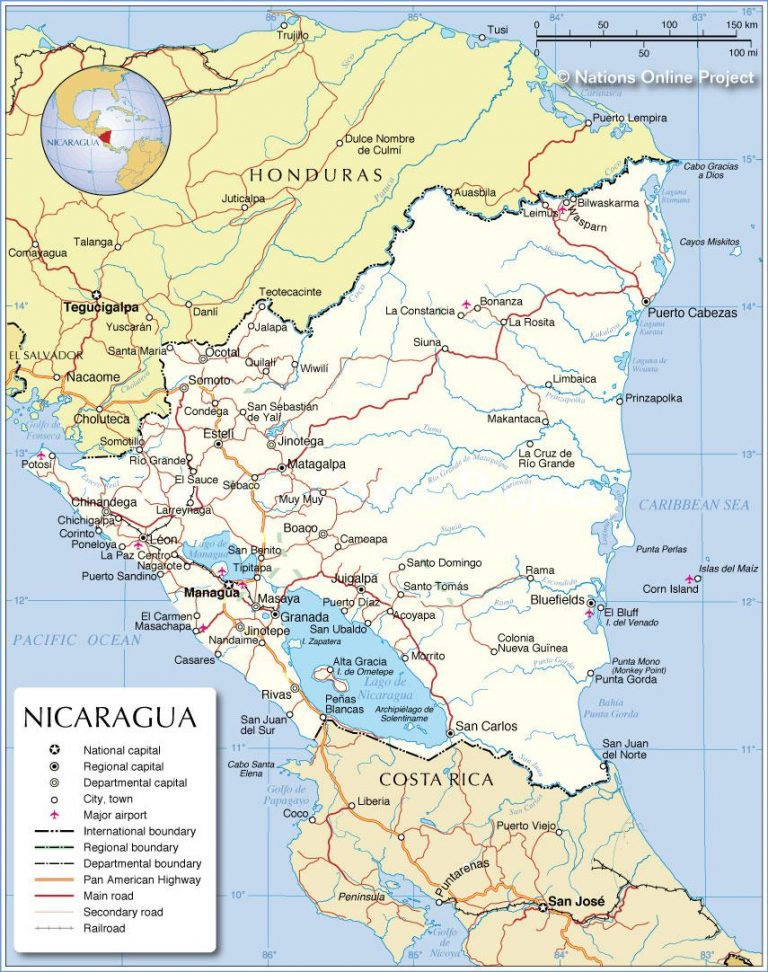
Where is Nicaragua on the Map?
On the world map, Nicaragua is a country in America located on the Central American isthmus. Its neighbors are Honduras bordering the country to the north and northwest, the Caribbean Sea to the east, and Costa Rica bordering it to the south and southwest. The country also faces the Pacific Ocean to the southwest.

Table – Nicaragua: Geographical and demographic information
| Element | Key Information |
|---|---|
| Total area | 130,373 km² |
| Capital | Managua |
| Neighboring countries | Honduras, Costa Rica |
| Coastline | ~910 km (Pacific Ocean and Caribbean Sea) |
| Estimated population | ~6.9 million inhabitants (2025) |
| Population density | ~53 inhabitants/km² |
| Relief | Volcanic chains in the west, coastal plains, tropical forests in the east |
| Climate | Humid tropical, dry season and rainy season |
| Official language | Spanish (English creole and indigenous languages on the Caribbean coast) |
| Economic resources | Coffee, sugarcane, gold, livestock, industrial free zones |
| Special feature | Country of large lakes (Managua and Nicaragua) and active volcanoes |
Additional points on the map of Nicaragua
- Located in Central America, Nicaragua is bordered by Honduras to the north and Costa Rica to the south.
- It has a dual maritime frontage: Pacific to the west and Caribbean to the east.
- Its physical map is marked by a chain of volcanoes and vast inland lakes, including Lake Nicaragua.
- The capital, Managua, is located near the lake of the same name.
- The country is nicknamed the “land of lakes and volcanoes”.
Colors of Nicaragua
The Nicaraguan flag is a rectangular flag composed of 3 horizontal bands of equal size: one white band and two bands bordering it at the top and bottom. In the center of the white band are the national coat of arms.

The blue bands symbolize the two oceans bordering the country, namely the Caribbean Sea and the Pacific Ocean. The white color represents peace and purity but according to other meanings: the white sand. The national coat of arms symbolize equality, peace, freedom, and the union among the Central American states.
What are the best cities in Nicaragua?
Ciudad Antigua
It is a very old tourist city in Nicaragua located in the northern section of Nicaragua on the border with Honduras. You can consult a road map before taking a bus to Esteli before going to Ciudad Antigua to visit an old church dating from the 17th century. Its architectures are still preserved and display ancient decorations, and some sites are listed as UNESCO World Heritage. The city is a relaxed place where you will enjoy life in the Nicaraguan countryside.
Granada
It is the best colonial city in Nicaragua, located on the shores of Lake Nicaragua. Formerly, Granada was the port used by Spanish colonists but also the location of their military base. Currently, it has been transformed into a very lively commercial city. You can hike in the areas surrounding the lake to connect with volcanic reliefs and the nearby national park. Here you will find must-visit restaurants with special gastronomy as well as several neighborhoods populated by foreign immigrants. The other colonial buildings you will see here are still in perfect condition.
San Rafael del Norte
It is a city in the northeast of Esteli nestled between the mountains of the Isabelia mountain range. It is an excellent place to visit for those who want to see a magnificent temple named Templo Parroquial San Rafael Arcángel, which is the starting point of every organized discovery trip in the city and is also listed as a world heritage site.
Population of Nicaragua
The population of Nicaragua amounts to 6,085,213 inhabitants and its demographic growth rate is 0.97%, one of the lowest in Latin America. The fertility rate of the Nicaraguan population is 1.87 births per woman. The birth and death rates are respectively 17.5 ‰ and 5.2 ‰. The life expectancy of the Nicaraguan population is 73.7 years, 71.5 years for men and 76.1 years for women. The median age is 26.2 years, indicating a young population. The male/female sex ratio is 95%.
Economic information about Nicaragua

The Nicaraguan economy is mainly based on the primary sector (31% of GDP) and the service sector (50% of GDP). The country, as it is, is a less developed country in the central section of America and the second poorest in the Americas in terms of nominal GDP. Nicaragua’s economic partners are the United States, El Salvador, Venezuela, Costa Rica, and Angola. The industrial sector represents only 18% of GDP.
Here are some economic data of Nicaragua:
- Official currency: Nicaraguan Córdoba
- Nominal GDP: 13.118 billion USD
- Purchasing power parity GDP: 35.276 billion USD
- GDP growth rate: -3.9% nominal and 0.7% in PPP
- Inflation rate: 4.965%
- Population below poverty line: 29.6%
- HDI: 0.651 USD
- Unemployment rate: 6.4%
- Exports: 3.819 billion USD
- Imports: 6.613 billion USD
Climate information on Nicaragua
The climate of Nicaragua is tropical and has two distinct seasons: a rainy season and a dry season. The dry season usually occurs between January and June, the rainy season begins in June or July. The rains only occur for a short period. Also note that the eastern section of the country is more humid than the western part.
There are 3 temperature zones in Nicaragua: the lowlands: Pacific and Atlantic coasts, temperatures range between 22 and 30°C and higher temperatures reach 38°C in May. The best plan is therefore to visit the country between March and May. The central section of the territory shows an average temperature of 5°C and in the mountainous sections, temperatures hover around 10°C.
Administrative subdivisions of Nicaragua
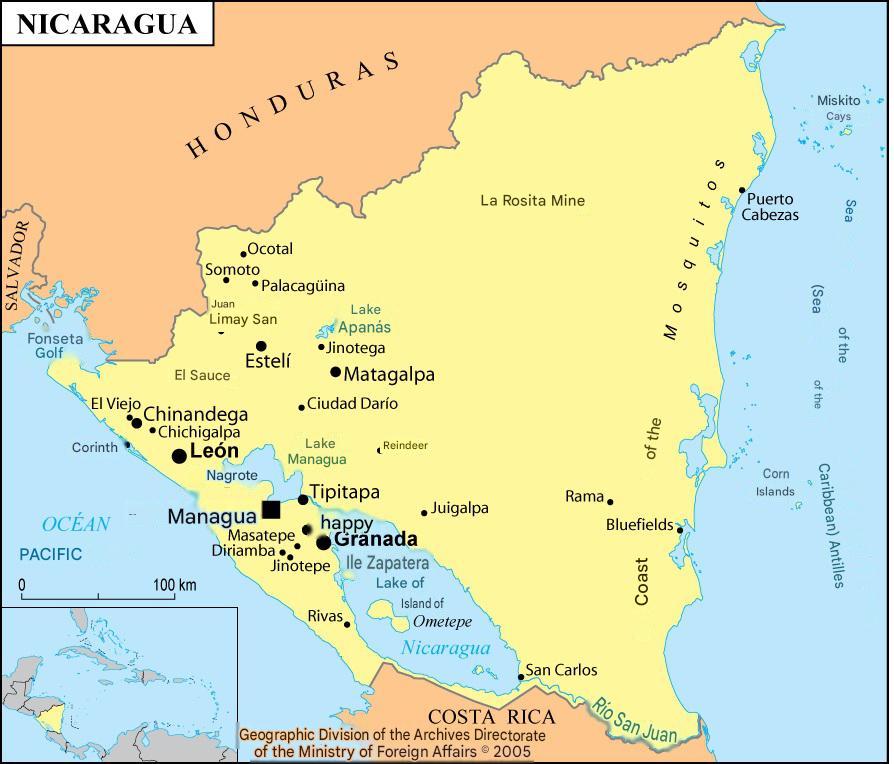
The Nicaraguan territory is divided into 15 departments and two autonomous regions. These departments are in turn divided into 153 municipalities (communes). Here are the 15 departments and the two autonomous regions:
- Rivas
- Río San Juan
- North Caribbean Coast*
- Granada
- Chontales
- Estelí
- Nueva Segovia
- Masaya
- Matagalpa
- Jinotega
- León
- Madriz
- Carazo
- Chinandega
- Nicaragua
- South Caribbean Coast*
- Managua
- Boaco
Demographic linguistic data of Nicaragua
Here is the ethnic distribution of Nicaragua:
| Ethnicities | Percentage |
| Mestizos | 77 % |
| Whites | 10 % |
| Amerindians | 4 % |
| Blacks | 9 % |
The mestizos come from Hispanic roots and Amerindian groups. In some cases, Mestizos could be of Amerindian origin. Mestizos are mainly (90%) concentrated on the Pacific coasts and 10% on the Atlantic coasts.
The Amerindians are also subdivided into 3 groups: Miskito, Sumo, Mayangnas, and Rama, which represent about 35%, 4%, and 1% of the Amerindians respectively.
Whites and mestizos are Spanish speakers and represent 90% of the population. The Amerindians are composed of sub-ethnic groups that have various dialects.
| Amerindian Sub-ethnic Group | Dialect | Speakers |
| Miskito | Tauira, Baldam, Wangki, Kabo | 154,000 inhabitants |
| Sumo | Sumoo, Woolwa, Sumo, Ulwa | 6,700 inhabitants |
There are also blacks, speakers of Garifuna, and Creoles, English speakers of Nicaragua.
FAQ – Nicaragua Map
Nicaragua is in Central America, between Honduras and Costa Rica, with dual maritime access.
The capital is Managua, on the shores of Lake Managua.
The country is marked by its volcanoes, large lakes, coastal plains, and tropical biodiversity.
