
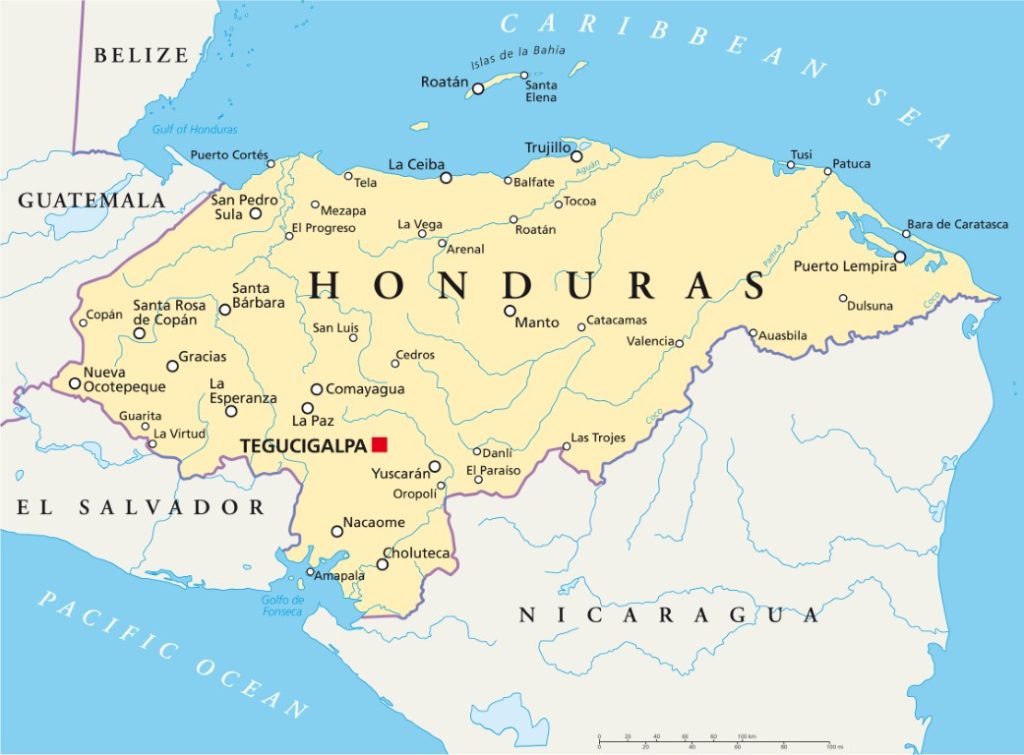
Essential information about Honduras
The State of Honduras is a country in Central America organized as a presidential republic.
- Area: 112,090 km²
- Population: approximately 9.18 million inhabitants
- Capital and largest city: Tegucigalpa
- Official language: Spanish
- Telephone code: +504 (00504)
Honduras shares its borders with Nicaragua, El Salvador, and Guatemala.
It is a member of several international organizations, including the UN, the WTO, and the OAS.
Population of Honduras
The population of Honduras is estimated at about 9.18 million inhabitants, with an average density of 82 inhabitants/km².
- Natural growth rate: 1.56%
- Birth rate: 22.2 ‰
- Mortality rate: 5.3 ‰
- Life expectancy: ~71.3 years
- Sex ratio: 101 men per 100 women
Ethnic Composition
- Mestizos: ~90%
- Amerindians: ~7%
- Black people: ~2%
- Whites: ~1%
Languages
- Spanish (official and majority language)
- Various Amerindian dialects in indigenous communities
Religions
Protestantism: ~3%
Catholicism: ~97%
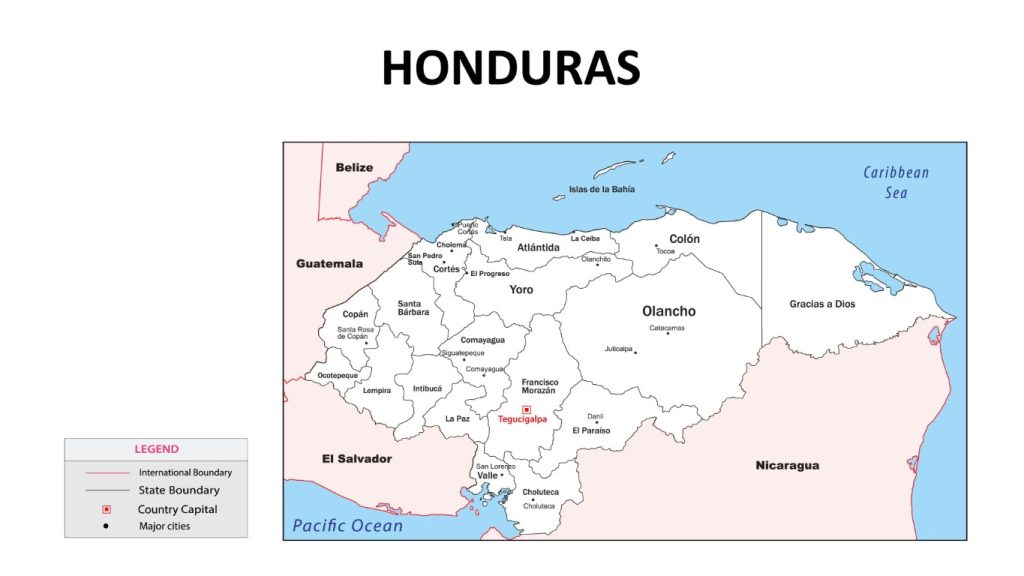
The map of Honduras highlights a Central American country bordered by Guatemala and El Salvador to the west, as well as Nicaragua to the southeast. Its Caribbean coast is home to the Bay Islands, while its access to the Pacific is limited to the Gulf of Fonseca.
Table – Honduras: Geographic and demographic information
| Element | Key Information |
|---|---|
| Total Area | 112,492 km² |
| Capital | Tegucigalpa |
| Bordering Countries | Guatemala, El Salvador, Nicaragua |
| Coastline | ~820 km (Caribbean Sea to the north, Pacific Ocean to the south via the Gulf of Fonseca) |
| Estimated Population | ~10.6 million inhabitants (2025) |
| Population Density | ~94 inhabitants/km² |
| Relief | Mountains, plateaus, coastal plains |
| Climate | Humid tropical on the Caribbean coast, more temperate in the highlands |
| Official Language | Spanish |
| Economic Resources | Coffee, banana, textile, fishing, minerals |
| Particularity | Key country in Central America, open to two maritime fronts |
Additional points on the map of Honduras
- Honduras is located in Central America, between the Caribbean Sea and the Pacific Ocean.
- The physical map shows a mostly mountainous country with fertile coastal plains.
- It shares its borders with Guatemala, El Salvador, and Nicaragua.
- The Caribbean coast is known for the Bay Islands, which are very touristic.
- The capital Tegucigalpa is located in a mountainous valley.
Climate of Honduras
The Honduran climate is tropical and in the mountains, it is more temperate with temperatures ranging between 16 and 20°C. The hottest area is the northern zone with high rainfall throughout the year. However, there are breezes that moderate the climate and the strong sunshine.
Honduran Colors

The Honduran colors are represented on the rectangular flag. Indeed, it is composed of 3 horizontal bands of equal size. Two blue bands on either side of a white band. In the middle of the latter stand 5 blue five-pointed stars. The two blue bands symbolize the Caribbean Sea and the Pacific Ocean and the white color symbolizes patriotism and peace. The stars, on the other hand, represent the 5 original provinces.
Which cities to visit in Honduras?
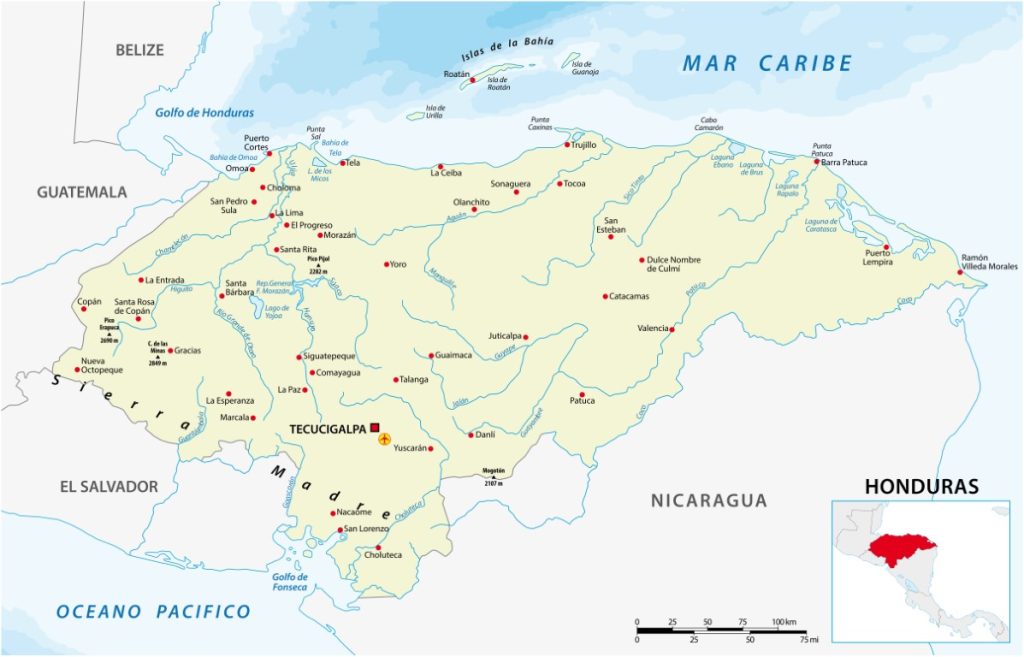
Tegucigalpa
It is a city bordering the Choluteca River. It is the cradle of the country’s energy sources and telecommunications. It is also where the 25 international embassies and 16 consulates are located. Therefore, it is a very important city.
San Pedro Sula
It is a very popular city in the country, located in the northwest section of the Sula Valley state. It has a large banana processing industry but is also crossed by several railways.
Choloma
Choloma is a city located between San Pedro Sula and Puerto Cortés. It borders the banks of the Balaliam or Choloma River. It is also an important industrial city due to its proximity to the international port and San Pedro Sula.
Economy of Honduras
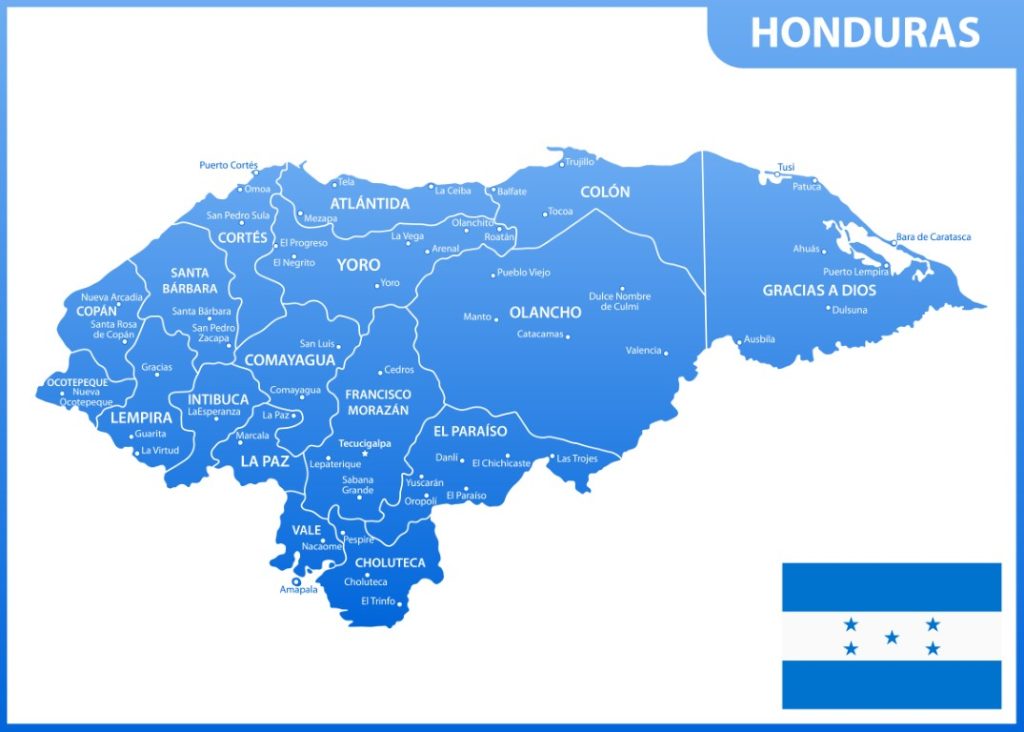
The economy of Honduras is mainly based on the agricultural sector, which still represents a significant share of the GDP (more than 14% of nominal GDP).
The main exports are coffee and bananas, but the country is also an important producer of farmed shrimp destined for international markets.
The textile industry (maquiladoras) and remittances sent by migrants also constitute pillars of the national economy.
Recent economic data
- Official currency: Honduran Lempira
- Nominal GDP: 23.8 billion USD
- GDP at purchasing power parity (PPP): 49.2 billion USD
- GDP growth rate: 2.7% (nominal); 3.7% (PPP)
- GDP per capita: 2,524 USD (nominal); 5,216 USD (PPP)
- Inflation rate: 4.34%
- Population living below the poverty line: 29.6%
- Human Development Index (HDI): 0.62
- Imports: 11.3 billion USD
- Exports: 8.7 billion USD
FAQ – Honduras map
Honduras is located in Central America, between Guatemala, El Salvador, and Nicaragua, with access to the Caribbean Sea and the Pacific Ocean.
The capital is Tegucigalpa, a mountain city located in the center of the country.
A mountainous country, it has tropical coasts, fertile valleys, and dual maritime access.
