
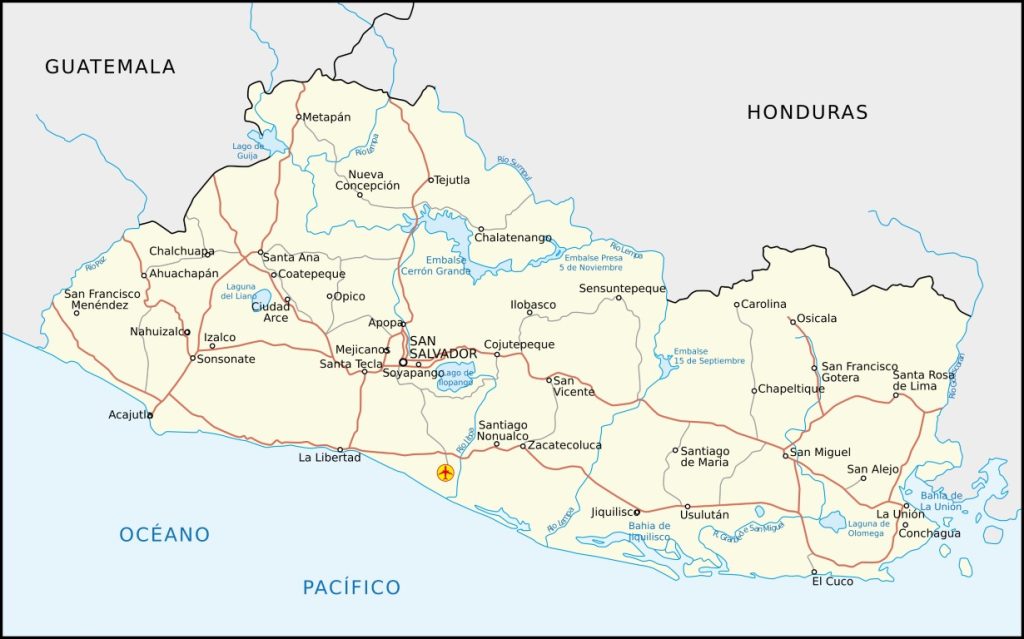
Small in size but rich in diversity, El Salvador intrigues as much as it fascinates. This Central American country, often lesser known compared to its neighbors, attracts curious minds and travelers seeking authenticity. Between wild beaches, cities steeped in history, and majestic volcanoes, this republic offers a range of surprising discoveries that leave no one indifferent.
Setting off for El Salvador means encountering a vibrant culture, marked by its Maya past and centuries of evolution. Bordered by Guatemala, Honduras, and the Pacific Ocean, this territory reveals a mosaic of landscapes where nature coexists with colonial remains. At the heart of the country, the capital San Salvador beats to the rhythm of lively traditions, supported by a warm population and a constantly renewed urban energy.
Table – El Salvador: Geographic and demographic information
| Element | Key Information |
|---|---|
| Total area | 21,041 km² |
| Capital | San Salvador |
| Neighboring countries | Guatemala, Honduras |
| Coastline | ~300 km on the Pacific Ocean |
| Estimated population | ~6.6 million inhabitants (2025) |
| Population density | ~314 inhabitants/km² (one of the highest in Latin America) |
| Relief | Volcanic chains, high plateaus, coastal plains |
| Climate | Tropical with dry and wet seasons |
| Official language | Spanish |
| Economic resources | Coffee, sugar, textiles, services |
| Particularity | Smallest country in Central America, but densely populated and highly urbanized |
Additional points on the map of El Salvador
- Located in Central America, El Salvador is the only country in the region without a Caribbean coastline.
- The physical map shows a strong presence of volcanoes and mountains.
- The country borders Guatemala to the west and Honduras to the north and east.
- The capital San Salvador is an important economic and cultural center.
- The Pacific coastline hosts many beaches renowned for surfing.
The map of El Salvador illustrates a Central American country bordered by Guatemala to the west and Honduras to the north and east. Its Pacific coastline, nearly 300 km long, is known for its beaches and surfing spots among the most renowned in Central America.
The geographic foundations of El Salvador
Located on the Pacific coast, El Salvador is the smallest continental state in Central America, but it ranks among the most densely populated. Traveling through its lands, one quickly understands why this country has so much to offer: mountainous reliefs, fertile agricultural zones, and a coastline bordered by warm waters shape its unique geographic identity.

The elongated shape of the territory is explained by its borders: to the west, Guatemala, to the east, Honduras, and at the very south, the Pacific Ocean which hosts some of the most renowned beaches in the region. This situation provides a great variety of microclimates and promotes a remarkable biodiversity, undoubtedly one of the country’s assets.
Administrative organization and political structure
Since its independence, El Salvador has displayed a particularly structured internal organization. The country is divided into administrative departments, each with its own history and local specificities. This distribution contributes to effective governance while valuing regional diversity.
Politically, the republic operates under a centralized presidential regime. The executive power concentrates a large part of the national authority, while the departments have limited administrative powers. The stability of this model attracts interest in a regional context marked by frequent political changes.
What are the main administrative departments of El Salvador?
In total, there are 14 administrative departments, each having its capital, symbols, and sometimes even its own traditional festivals. Departments like La Libertad or San Miguel stand out for their economic and cultural dynamism, while Santa Ana shines with its colonial architectural heritage.

Some territories are known for their intensive agriculture, especially in coffee, banana, or corn. Other departments specialize more in fishing or local crafts, making El Salvador an example of versatility on relatively small areas.
What is the role of the capital San Salvador within this whole?
Capital of El Salvador, San Salvador concentrates political, administrative, and economic power. Its urban area represents a significant part of the total population, accentuating the contrast between a modern city and countryside attached to traditions. Its lively neighborhoods reveal a flourishing artistic scene and an omnipresent commercial vitality.
A strategic place, San Salvador also plays a driving role in higher education, health, and new technologies. It benefits from its central position to radiate throughout the country and attract both investors and tourists, while remaining a hub of social innovation.
Demography and cultural identity
In terms of demography, El Salvador surprises with its high population density. With nearly 6.5 million inhabitants on a restricted territory, the country ranks among the top worldwide in this regard. Rapid urbanization is transforming the face of several cities but also preserves authentic rural communities.

This diverse composition reflects a young and dynamic society. Different generations coexist, perpetuating ancient rites and absorbing contemporary influences, thus linking past and future around a common identity.
- Majority mestizo population, the result of a historical mix between indigenous peoples and European settlers.
- Varied religious beliefs, with a Catholic predominance but also a strong rise of evangelical churches.
- National holidays widely celebrated, such as Holy Week or the “Día de la independencia” celebrations.
- Educational and health systems constantly modernizing despite challenges related to urban growth.
Official spanish language and linguistic influences
Spanish holds a prominent place as the official language, facilitating communication and integration within educational, media, and administrative institutions. But the linguistic background of El Salvador sometimes goes beyond the official framework. Many words come from indigenous languages, especially in toponymy or gastronomy.
Speaking Spanish here also means adopting expressions unique to the country, inherited from Nahuatl or Pipil cultures. In some rural regions, a few elders continue to pass on indigenous linguistic knowledge, enriching the identity palette of El Salvador and creating a strong sense of cultural continuity.
Breathtaking natural spaces
El Salvador, bordered by the Pacific Ocean, offers an impressive variety of landscapes. Active volcanoes, tropical forests, and vast lakes mark a route where every turn reveals spectacular panoramas. This natural wealth delights hikers, surfers, and biodiversity lovers.
In the north and west, proximity to Guatemala creates an ecological corridor crossed by many endemic species. To the east, the borders shared with Honduras reveal a less explored nature, still offering large virgin spaces suitable for hiking and wildlife observation.
Which natural sites to visit in El Salvador?
It is impossible to miss El Boquerón National Park, perched on the heights of the capital, or surf beaches like El Tunco and El Sunzal, internationally renowned. The inland also hides treasures such as the Ruta de Las Flores, an emblematic route linking artisanal villages and lush flower fields.
In the central valley, Lake Ilopango offers a peaceful atmosphere ideal for relaxation. For the adventurous, the ascent of Izalco volcano remains a highlight, rewarded by a breathtaking view over the entire republic.
How is biodiversity protected?
Ecological initiatives and conservation efforts are increasingly resonating. Many collaborative projects involve local and international NGOs, working together to preserve wildlife, restore mangroves, and sustainably manage marine resources.
The integration of agroecological practices into traditional farming promotes environmental balance without sacrificing agricultural productivity. This creates harmony between humans and their environment, an essential characteristic of Salvadoran life.
Economy, crafts, and future prospects
While the economy has historically relied on agriculture and textiles, new sectors are rapidly emerging. Tourism is gaining ground, fueled by natural beauties and the rise of sports activities such as surfing. At the same time, San Salvador asserts its role as a commercial and innovative hub for the entire region.
Artisans, small producers, and merchants play a key role in the local dynamic. Tradition and adaptation to modern markets go hand in hand, supporting jobs and the transmission of skills. Various public programs encourage professional training to anticipate the rapid evolution of economic needs.
- Internationally recognized coffee production, originating from the volcanic highlands.
- Textile industries exporting to the entire American continent.
- Development of the digital and technological sector around the capital.
- Tendency towards emigration, impacting both financial flows via remittances and social dynamics.
FAQ – El Salvador map
El Salvador is located in Central America, between Guatemala and Honduras, with a coastline on the Pacific.
The capital is San Salvador, the most populous city in the country.
It is a mountainous and volcanic country, with a Pacific coastline and a tropical climate.
