
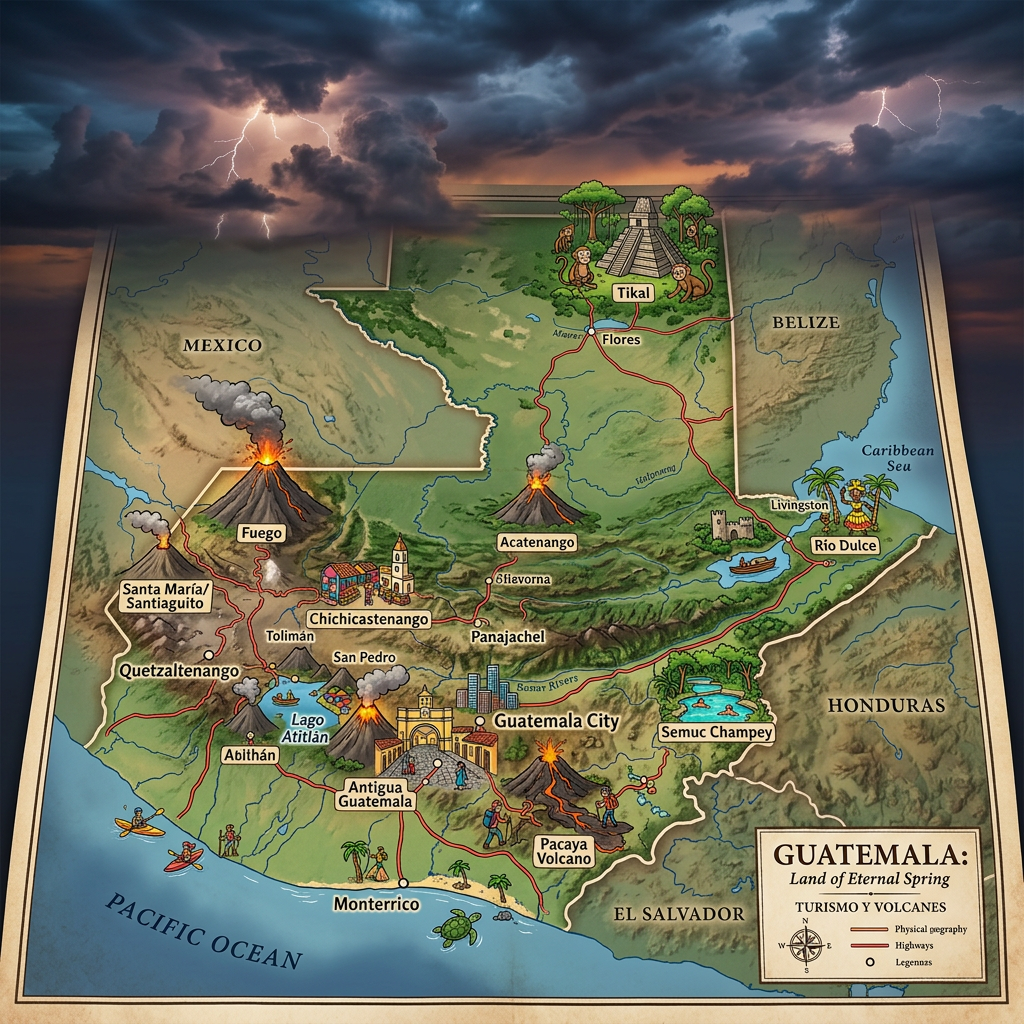
What you need to know about Guatemala ?
The State of Guatemala is a country in Latin America with a presidential system. Located in Central America, it covers an area of 108,889 km² and is home to an estimated population of 17.2 million inhabitants.
It ranks as the 105th largest country in the world and the 75th most populous.
The capital, Guatemala City, is also the largest urban area in the country and its main political, economic, and cultural center.
The official language is Spanish, although more than 20 Mayan languages are still spoken there.
The country’s telephone code is 502.
Table – Guatemala: Geographic and demographic information
| Item | Key Information |
|---|---|
| Total Area | 108,889 km² |
| Capital | Guatemala City |
| Bordering Countries | Mexico, Belize, Honduras, El Salvador |
| Coastline | ~400 km (Pacific and Caribbean Sea) |
| Estimated Population | ~18.3 million inhabitants (2025) |
| Population Density | ~168 inhabitants/km² |
| Relief | Volcanic ranges, highlands, tropical lowlands |
| Climate | Humid tropical, temperate in the highlands |
| Official Language | Spanish (22 recognized Mayan languages) |
| Economic Resources | Coffee, banana, sugar, textiles, minerals |
| Special Feature | Country with a strong Mayan culture, with major archaeological sites such as Tikal |
Additional points on the map of Guatemala

- Guatemala is located in Central America, with a coastline on the Pacific Ocean and the Caribbean Sea.
- Its physical map is dominated by a volcanic mountain range and highlands.
- The country shares its borders with Mexico, Belize, Honduras, and El Salvador.
- The capital, Guatemala City, is the largest metropolis in Central America.
- The region is rich in Mayan sites, including Tikal, a UNESCO World Heritage site.
Where is Guatemala on the map?

The map of Guatemala highlights a country in Central America, bordered by Mexico to the north and west, Belize to the northeast, Honduras to the east, and El Salvador to the southeast. Its dual maritime access to the Pacific and Caribbean Sea gives it great strategic importance.
Colors of Guatemala
The flag of Guatemala consists of three vertical color bands. From left to right: blue, white, and blue. In the center of the middle white band are the national coat of arms depicting the quetzal, a bird of the Mayan civilization.

The blue color symbolizes the two waters (Pacific Ocean and Atlantic Ocean), the white color inspires purity and peace. The coat of arms represents freedom.
What are the best cities in Guatemala?

Guatemala City
Capital and largest city of the country, Guatemala City will often be your starting point. The metropolis offers a combination of history and modernity. Among the attractions: the Central Square, the National Palace of Culture, the National Museum of Archaeology and Ethnology which displays Mayan artifacts, and the Metropolitan Cathedral, a legacy from the colonial era.
Antigua Guatemala
Listed as a UNESCO World Heritage Site, Antigua charms with its colorful colonial architecture and cobbled streets. The city is surrounded by three majestic volcanoes: Fuego, Agua, and Acatenango. It is an ideal place to discover local culture, stroll through artisan markets, and explore surrounding villages.
Panajachel
Located on the shores of Lake Atitlán, Panajachel is renowned for its spectacular landscapes surrounded by volcanoes. You can practice kayaking, hike to the Rostro Maya, or discover traditional Mayan villages like San Juan La Laguna.
Quetzaltenango (Xela)
The second largest city in the country, Quetzaltenango is nestled in the highlands. It is a popular destination for natural hot springs, volcanic hikes (notably Santa María), and its student atmosphere, as many foreigners come here to learn Spanish.
Flores
It is the gateway to one of the country’s greatest treasures: the archaeological site of Tikal, an ancient Mayan city in the heart of the jungle. Flores is a small picturesque town located on an island in Lake Petén Itzá, ideal for combining culture, nature, and relaxation.
Population of Guatemala (2025)
- Total population: 17.7 million inhabitants
- Population growth: 1.7%
- Fertility rate: 2.8 children/woman
- Birth rate / death rate: 23.6 ‰ vs 5.2 ‰
- Life expectancy: 72.3 years (men 70.1 – women 74.6)
- Median age: 23 years (young population)
- Sex ratio: 99 men per 100 women
- Ethnic groups: 60% Mestizos (Ladinos), 39% Mayas, 1% others
- Languages: Spanish (official) + 24 recognized Mayan languages
Economic Information (2025)
- Currency : Quetzal (GTQ)
- Nominal GDP : 95.2 billion USD
- GDP (PPP) : 190.3 billion USD
- Annual growth : 3.4% nominal, 3.9% PPP
- GDP per capita : 5,200 USD nominal, 10,400 USD PPP
- Inflation : 4.3%
- Population below poverty line : ~55%
- HDI : 0.663 (medium category)
- Official unemployment : 2.7% (but high underemployment)
- Exports : coffee, bananas, sugar, cardamom, textiles
- Key partners : United States, Mexico, EU
Climate information about Guatemala
Guatemala has a tropical climate with variations in rainfall and temperatures compared to tropical regions. Lowlands and coastal areas: high temperatures with an average of 27°C, April is the hottest month of the dry season with an average of 38°C. The cities of Guatemala City and Antigua are located in this area
Temperatures tend to drop between November and February and the dry season runs from November to May. The rainy season runs from May to November with sunny mornings and stormy afternoons. October and September are the rainiest months. The Pacific areas are the wettest with 760 to 1500 mm of rain per year and the others are less rainy with 510 to 760 mm.
Administrative subdivisions of Guatemala
The Guatemalan territory is divided into 22 departments which are in turn divided into 340 municipalities.
Here are the 22 departments of Guatemala:
- Sacatepéquez
- Alta Verapaz
- Retalhuleu
- Guatemala
- Baja Verapaz
- El Progreso
- Escuintla
- Petén
- Quetzaltenango
- Quiche
- Huehuetenango
- Izabal
- Jalapa
- Jutiapa
- Chimaltenango
- Chiquimula
- San Marcos
- Suchitepéquez
- Totonicapán
- Santa Rosa
- Sololá
- Zacapa
Demolinguistic data of Guatemala

Ethnic composition of Guatemala
The Guatemalan population is mainly composed of mestizos (Ladinos) and Mayas, but several minorities are also present:
- Ladinos (mestizos of Hispano-Maya origin) represent the majority of the population.
- Mayas include many ethnic subgroups (K’iche’, Cakchiquel, Mam, Q’eqchi’, etc.).
- Xinca, a non-Maya indigenous people, mainly live in the south of the country.
- Garifunas, of African and Caribbean mixed descent, are settled on the Atlantic coast.
Estimated distribution:
- Whites and Mestizos: 59.4%
- K’iche’: 9.1%
- Cakchiquel: 8.4%
- Mam: 7.9%
- Q’eqchi’: 6.3%
- Other Mayas: 8.6%
- Garifunas: 2%
- Non-Maya Indians: 0.2%
National languages and dialects
- Spanish: official language, used in administration, education, and media.
- Mayan languages (more than 20 recognized):
- Kaqchikel: spoken east of Lake Atitlán
- K’iche’: in the northern and western areas of Lake Atitlán
- Q’eqchi’: in the mountainous regions and around Lake Izabal
- Mayan populations use Spanish as a second language but continue to practice their indigenous languages daily.
Religion in Guatemala
Religious syncretism: Maya communities preserve ancestral rituals mixed with Christianity.
Roman Catholicism: dominant religion, often tinged with pre-Columbian Maya traditions.
Protestantism: about 20% of the population, strongly growing since the 20th century.
FAQ – Guatemala map
In Central America, between Mexico, Belize, Honduras, and El Salvador, with a double maritime frontage.
The capital is Guatemala City, the largest city in Central America.
The country is marked by its volcanoes, high plateaus, tropical forests, and Mayan archaeological sites.
