
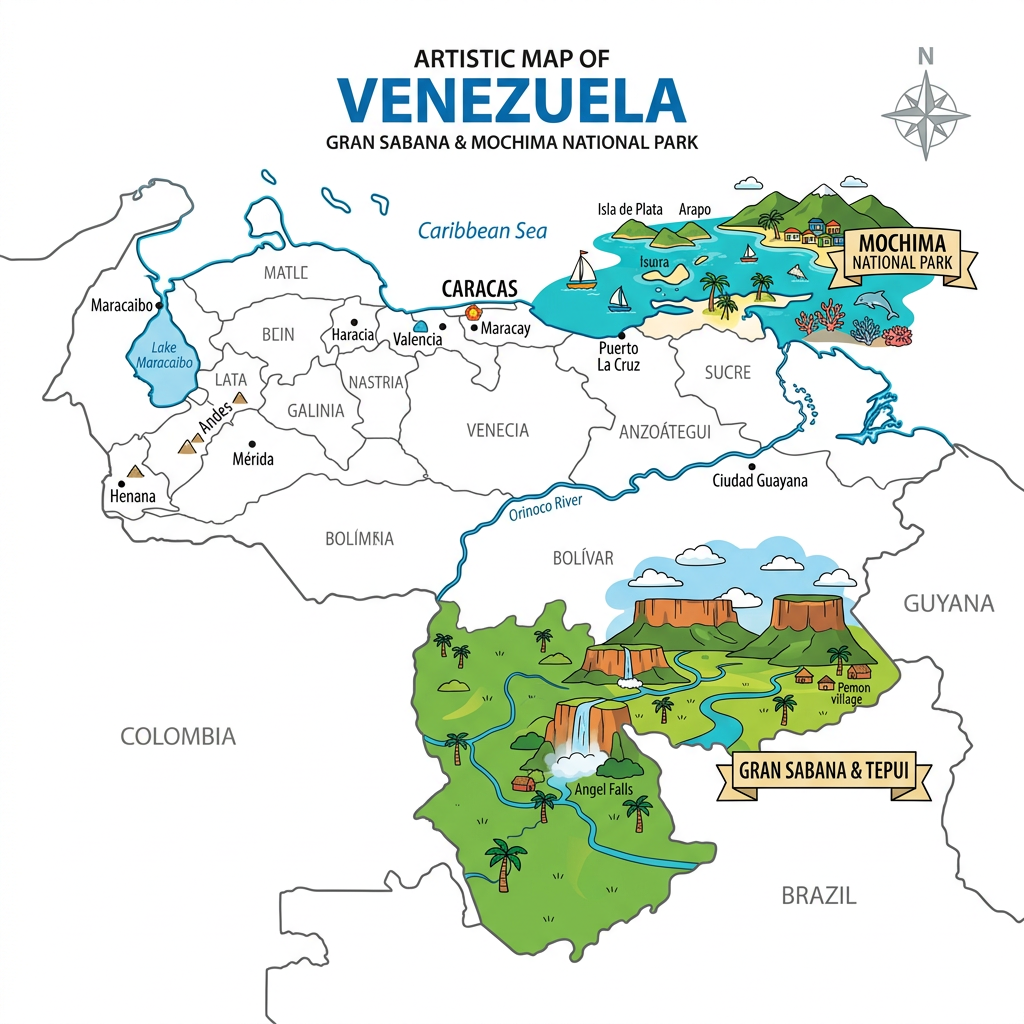
What you need to know about Venezuela ?
Venezuela is a country located in the northern part of South America, officially known as the Bolivarian Republic of Venezuela. It has a total area of approximately 916,445 km², and its population is estimated at around 28.8 million inhabitants in 2025.
It is a federal presidential republic with a unicameral parliament (the National Assembly). The capital is Caracas.
Countries bordering Venezuela
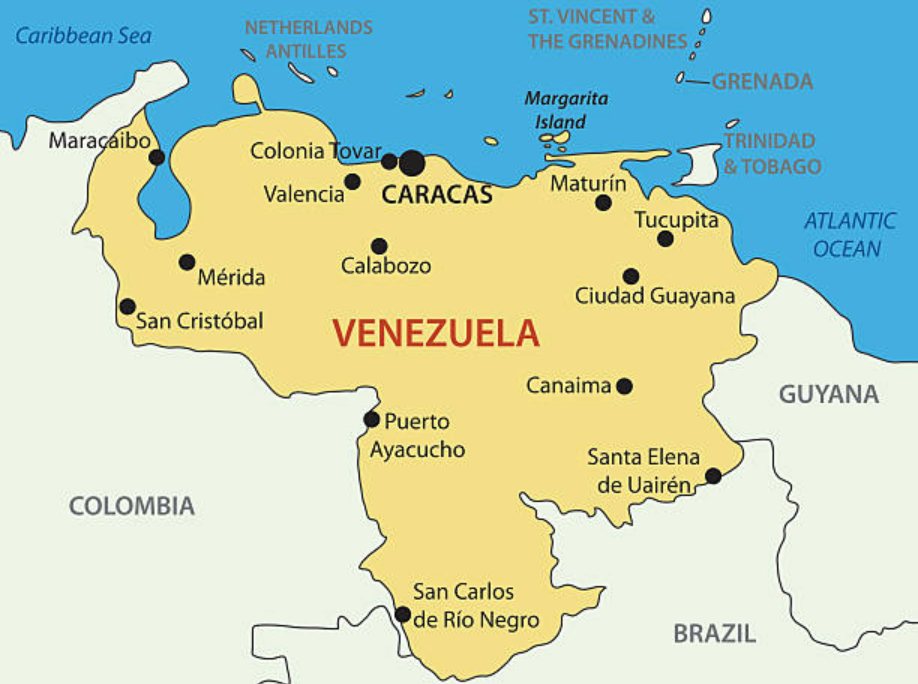
Venezuela is bordered by the Caribbean Sea and the Atlantic Ocean to the north, Guyana to the east, Brazil to the south, and Colombia to the southwest and west.
The colors of Venezuela

The Venezuelan flag is yellow, blue, and red with the national coat of arms in the upper left corner and a curve of eight white five-pointed stars in the blue band.
The Venezuelan flag highlights four tones. The foundation consists of a triband made up of yellow, blue, and red. Yellow is used to represent the abundance of gold, the country’s wealth, agriculture, and attributes of harmony and justice; it also symbolizes the sun. Blue has been used to signify mental strength. Red represents the country’s independence from Spain.
Despite these shades, the flag also includes white stars which are meant to represent the territories of Barcelona, Cumana, Caracas, Barinas, Mérida, Margarita, Trujillo, and Guayana.
Map of the best cities in Venezuela
Barquisimeto
This is a very old city, dating back to the year 1552; it is the fourth largest city in the country and also one of the oldest Venezuelan cities. It stands out for its location near Turbio, a river that gives it a cool and warm climate. There, you will see many buildings, remnants of Spanish colonial architecture, but there are also other modern infrastructures that populate the city. What you absolutely must not miss is the Barquisimeto Cathedral. Over time, many new architectures have made this city an immeasurable tourist destination. It is also here that you can admire the most beautiful sunsets in Venezuela.
Canaima
When we talk about this city, what immediately comes to mind is that inside it there is a world-renowned park of the same name. In fact, Canaima Park is a UNESCO World Heritage site. This is where you can go hiking, as well as explore the very vast national park. The most famous site to visit in the park is the waterfalls; in fact, the highest waterfall in the world is here. But don’t forget to also visit other tourist sites here such as the Carrao River and the lagoon, all of which can be seen from many pavilions in the city.
Caracas
As we told you earlier, it is the national capital, but it is also a very lively city. Since it is the capital, it is also the center of many Venezuelan stories, arts, and cultures.
Don’t forget to also visit the Avila mountains especially if you are hiking enthusiasts and want to see the city from up there. For those who want even more activities, there is the zoo to visit, various museums, and dining areas.
Financial map of Venezuela
Indeed, Venezuela’s economy is based on the exploitation of oil deposits and oil exports. But later, the country managed to diversify its activity and engage in other sectors such as mining. In fact, the country has deposits of nickel, iron, bauxite, aluminum, and coal. There are also other exploitations such as hydroelectric power which have all contributed to the growth of the Venezuelan economy. Here are some Venezuelan economic indicators.
- Official currency: Sovereign Bolivar
- Nominal GDP: approximately USD 90–100 billion (recent estimate)
- Annual GDP growth: around -2% to 1% (highly volatile economy)
- GDP per capita (PPP): approximately USD 7,000–8,000
- Inflation rate: extremely high and variable, often above 100% in recent years
- Population living below the poverty line: around 50–60% (varies by estimates)
- Human Development Index (HDI): around 0.72–0.75
- Labour force: approximately 14–15 million people
- Unemployment rate: around 30% or higher (high uncertainty depending on sources)
- Exports of goods: approximately USD 15–25 billion, mainly oil
- Imports of goods: approximately USD 10–15 billion
- Public debt: roughly 40–60% of GDP depending on estimates and periods
- Public finances: highly unstable, with persistent deficits and strong dependence on oil revenues
Climate map of Venezuela
The climate of Venezuela is characterized as tropical. The temperature hovers around 27°C. In Mérida in the Andes, temperatures are slightly cooler with an average of 19° and nights can be chilly. There are two seasons in the year: the dry season from November to April and the rainy season from May to October.
Demographic and administrative map of Venezuela
Demographics
The population of Venezuela is estimated at around 28.8 million inhabitants in 2025. The population growth rate is slightly negative, at about -0.2% to -0.3% per year. The fertility rate is approximately 2.1 children per woman.
The birth rate is around 17 per 1,000 inhabitants, while the death rate is about 6 per 1,000 inhabitants. Life expectancy at birth is estimated at 74–75 years, including 71–73 years for men and 77–79 years for women.
The median age of the population is about 29 years, reflecting a relatively young population despite recent migration trends. Finally, the sex ratio is close to balance, at around 98 to 99 men for every 100 women.
Administrative division
It is made up of 23 federated states (“estados federados”) and regions with special status, including a federal district (“Distrito Federal”) and federal dependencies (“Dependencias Federales”). The Venezuelan states are as follows: Amazonas, Anzoategui, Apure, Aragua, Barinas, Bolivar, Carabobo, Cojedes, Delta Amacuro, Federal District, Federal Dependencies, Falcon, Guarico, Lara, Merida, Miranda, Monagas, Nueva Esparta, Portuguesa, Sucre, Tachira, Trujillo, Vargas, Yaracuy, and Zulia.
Demolinguistic data of Venezuela
Population of Venezuela
According to the most recent estimates, the Indigenous population of Venezuela represents around 3 to 4% of the total population, or approximately 900,000 to 1.1 million people.
Indigenous peoples are mainly concentrated in border and Amazonian regions, particularly in the states of Amazonas, Bolívar, Zulia, Delta Amacuro, and Apure. A large share of Indigenous communities live in rural or remote forest areas, with a strong presence in the Amazon basin.
Among the main Indigenous groups are the Wayuu, Warao, Pemón, Yekuana, and Yanomami. The state of Amazonas remains one of the areas with the highest proportion of Indigenous population in the country.
Languages in Venezuela
It is an extremely phonetically homogeneous nation. In fact, 92% of residents communicate in Spanish (mostly called “Castilian”) as their first language. Only the inhabitants, who are quite often called “natives” in Venezuela, speak a main language that is not Spanish. There are more than thirty dialects spoken by not exactly a large portion of the 1,000,000 speakers. Only eight dialects, including their language groups, are spoken by more than 10,000 speakers: Wayuu, Warao, Pemon, Añu, Yanomami, Wotjuja, Jivi, and Karina.
FAQ – Venezuela map: 2 questions
The location map of Venezuela shows that Venezuela is situated in the northern part of the South American continent.
You can find a map of Venezuela in atlases, dictionaries, and on websites. You just have to type “map of Venezuela” into search engines and you will find what you need: blank map, political map, geographical map, administrative map.
