
What you need to know about Cambodia ?
Cambodia is a country in Southeast Asia located in the southern part of the Indochinese Peninsula. It is a constitutional monarchy, officially called the Kingdom of Cambodia, and a sovereign state.
The country’s population is estimated at just over 15 million inhabitants, of whom about 97% are Buddhists. The capital, Phnom Penh, is also the largest urban area in the country, once nicknamed “the Pearl of Asia”.
The population density is about 86 inhabitants per km². Besides the majority Khmers, the country has ethnic minorities such as Chinese, Chams, and Vietnamese. Cambodia’s telephone code is +855 (or 00855).
Table – Cambodia: Geographic and demographic information
| Item | Key Information |
|---|---|
| Total Area | 181,035 km² |
| Capital | Phnom Penh |
| Neighboring Countries | Thailand, Laos, Vietnam |
| Coastline | About 440 km on the Gulf of Thailand |
| Estimated Population | ~17.5 million inhabitants (2025) |
| Population Density | ~97 inhabitants/km² |
| Relief | Central plains, mountains (Cardamoms, Dangrêk), Mekong plateau |
| Climate | Monsoon tropical: dry season (Nov-Apr), rainy season (May-Oct) |
| Official Language | Khmer |
| Economic Resources | Rice, textiles, tourism (Angkor), fishing |
| Special Feature | Archaeological site of Angkor, UNESCO World Heritage |
Which countries border Cambodia?
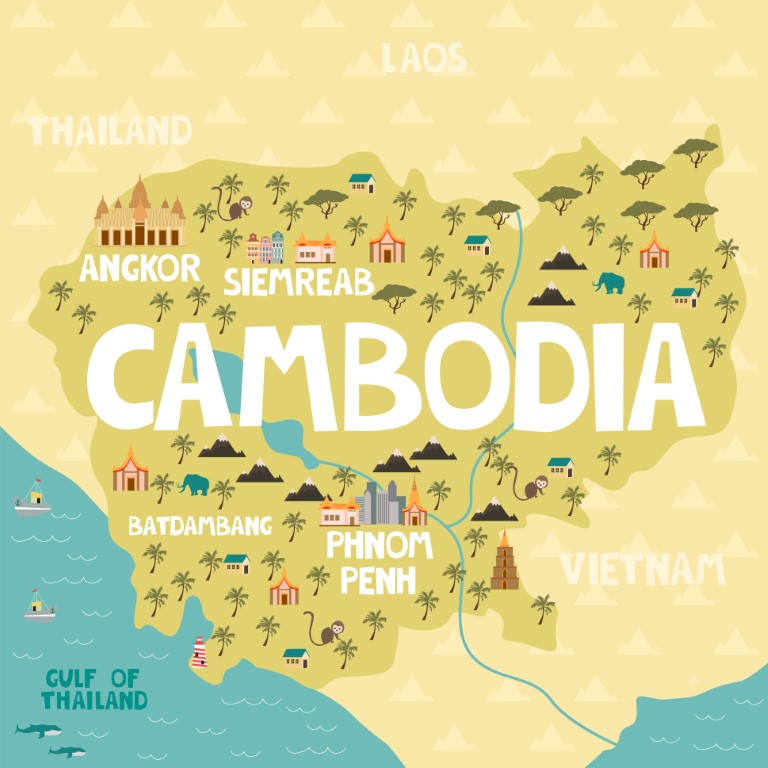
The map of Cambodia highlights a Southeast Asian country bordered by Thailand to the west and northwest, Laos to the north, and Vietnam to the east and southeast. Its territory is crossed by the Mekong River and is home to the famous Angkor temples, listed as a UNESCO World Heritage site.

Additional points on the map of Cambodia
- Cambodia is located in Southeast Asia, at the heart of the Indochinese Peninsula.
- The Mekong runs through the country from north to south and is a vital axis.
- The map shows a limited maritime opening on the Gulf of Thailand.
- The Angkor temples, near Siem Reap, are the country’s emblematic site.
- Its demographic map reveals a strong concentration around Phnom Penh and the Mekong.

Population of Cambodia
Currently, the population of Cambodia stands at nearly 17.9 million inhabitants, with an annual growth rate of about 1.2%. The country maintains a fertility rate around 2.5 children per woman, despite increased demand for family planning.
The birth rate remains high at ~22.5 ‰ while the mortality rate is lower, around 7.4 ‰. The life expectancy has significantly improved, now reaching nearly 70.9 years on average. The sex ratio stabilizes at about 96 men per 100 women.
Ethnically, the majority of Cambodians are Khmers (about 95%), followed by the Cham (~1.8%), the Chinese (~1.5%), and other communities, including a small Vietnamese minority and others (together about 1.3%).
What are the colors of the country?
The Cambodian flag consists of three stripes. The colors of the stripes are red and blue and are arranged as follows: two blue stripes at the top and bottom and a red stripe in between. At the center of the red stripe is the white depiction of the Angkor Wat temple.
Here are the meanings of the colors
- Red: represents the nation and its unity
- Blue: represents the royalty and its relationship with the people
- White: represents Cambodia’s religion, which is Buddhism.
What are the best cities to visit in Cambodia

Phnom Penh
Capital and largest city of Cambodia, Phnom Penh is often nicknamed the Pearl of Asia. A former city influenced by French colonization, it now combines colonial heritage and Asian modernity.
Among its must-see sites:
- the Royal Palace and the Silver Pagoda, symbols of Khmer royalty,
- the Phsar Reatrey night market, perfect for discovering local crafts and cuisine,
- the Tuol Sleng Genocide Museum and the Killing Fields, witnesses to the country’s tragic history.
Siem Reap
As the true gateway to the mythical Angkor site, Siem Reap is the most visited city in Cambodia. It charms with its lively atmosphere, its majestic temples, its night markets, and its varied restaurants. Accommodation ranges from affordable hostels to 5-star hotels. With its cultural and tourist dynamism, Siem Reap remains an essential stop.
Sihanoukville
Located on the Gulf of Thailand, Sihanoukville is the country’s flagship seaside resort. Its white sandy beaches and turquoise waters make it a highly sought-after destination. Nearby, the Ream National Park is home to more than 200 bird species. It is also a departure point to the Cambodian paradise islands such as Koh Rong and Koh Rong Samloem.
Kratie
Nestled on the banks of the Mekong, Kratie is renowned for its French colonial architecture and especially for the observation of the Irrawaddy dolphins, an endangered species. This small peaceful town is ideal for those who wish to discover an authentic and riverine Cambodia.
Koh Ker
Former Khmer capital in the 10th century, Koh Ker is today a fascinating archaeological site, lost in the heart of the jungle. It features temples and sculptures from the 9th century, including the spectacular Prasat Thom, a 30-meter-high pyramid. Although more difficult to access, this site attracts history enthusiasts and hikers seeking authenticity.
Battambang
The second largest city in Cambodia, Battambang is less known than Phnom Penh or Siem Reap, but it charms with its colonial charm, its ancient temples, and its traditional villages. One can have a unique experience with the bamboo train and discover the rural Khmer landscapes.
Kampot
In the south of the country, Kampot is famous for its pepper plantations, recognized worldwide, and for its peaceful atmosphere by a river. Nearby, the Bokor National Park offers exceptional panoramas and colonial remains.
Where the cities are located on the Cambodia map
Kratie
Located on the Mekong, the city of Kratie is situated inland in Cambodia. Geographic coordinates: 12° 29′ 40″ north, 106° 01′ 30″ east
Sihanoukville
On the Cambodia map, the city of Sihanoukville is located in the southeast section of the country. It is 239 km from the capital heading south. Geographic coordinates: 10° 38′ north, 103° 30′ east
Siem
Located in the center of Cambodia, the city of Siem Reap is shifted toward the coastline. It is 314 km from the capital heading north-northwest. Geographic coordinates: 13° 21′ 44″ north, 103° 51′ 35″ east.
Koh Ker
This former capital of Cambodia is located in the northeast half of the country. Geographic coordinates: 13° 47′ N, 104° 32′ E
Phnom Penh
On the Cambodia map, the capital Phnom Penh is located in the south-continental section of the country. Geographic coordinates: 11° 34′ 18″ north, 104° 55′ 23″ east
Cambodia climate map
Cambodia benefits from a tropical climate marked by two main seasons:
- The rainy season: from May to November, with heavy rainfall due to the monsoon.
- The dry season: from November to April, cooler and sunny, but sometimes very hot between February and May.
The annual rainfall varies according to the regions:
- Inland: between 1,300 and 1,800 mm.
- Coastal and forest areas: around 2,000 mm.
- Mountainous regions (Cardamom Mountains, Phnom Aural): up to 5,000 mm per year.
Phnom Penh
In the capital, average temperatures range between 30 °C and 35 °C, with peaks that can exceed 40 °C in April-May.
- Annual rainfall: around 1,400 mm.
- Sunniest season: from December to February.
- Rainfall mostly occurs in the afternoon during the wet season.
Economic map of Cambodia
Cambodia operates under a market economy, marked by strong growth over the past two decades. Despite a still low GDP per capita, the country is progressing rapidly thanks to two driving sectors:
- The textile industry: main source of exports, representing about 60–65% of the total.
- Tourism: the second pillar of the economy, supported by sites like Angkor Wat.
- Agriculture: less dominant in GDP (about 20%), but essential for the rural population.
The official currency is the Cambodian Riel (KHR).
Key economic data (2025)
- Nominal GDP: ~ 36 billion USD
- GDP (PPP): ~ 118 billion USD
- Annual GDP growth: ~ 5.5%
- GDP per capita (nominal): ~ 2,000 USD
- GDP per capita (PPP): ~ 6,400 USD
- Gini coefficient: ~ 32.5 (moderate inequality)
- Official unemployment rate: ~ 0.3% (but much informal underemployment)
- Global ranking of GDP per capita: ~ 145th nominal, ~ 138th PPP
Administrative and demolinguistic data
Administrative subdivisions
Currently, Cambodia’s administrative divisions number 2. The first subdivision is the province. There are 24 provinces in Cambodia with a special administrative unit which is the capital Phnom Penh. The second subdivision is the district. There are a total of 159 districts and 12 in the special unit of the capital.
Here are the 25 provinces of Cambodia:
- Banteay Meanchey
- Battambang
- Kampong Cham
- Kampong Chhnang
- Kampong Speu
- Kampong Thom
- Kampot
- Kandal
- Koh Kong
- Kratié
- Mondulkiri
- Phnom Penh
- Preah Vihear
- Prey Veng
- Pursat
- Ratanak Kiri
- Siem Reap
- Preah Sihanouk
- Stung Treng
- Svay Rieng
- Takéo
- Oddar Meanchey
- Kep
- Pailin
- Tboung Khmum
Demolinguistic Data
The official language spoken in Cambodia is Khmer, spoken by the majority of the people, about 89.5%. However, there are minority languages which are:
- Mnong
- Tampuan
- Lao
- Jarai
- Kru’ng
- Chong
- Stieng Bulo
- Somray
These languages are spoken by ethnic minorities including: Vietnamese, Cham, and Chinese.
FAQ – Cambodia map: 3 questions
Cambodia is located in Southeast Asia, between Thailand, Laos, and Vietnam, with access to the Gulf of Thailand.
The capital is Phnom Penh, located on the Mekong.
The country consists of fertile plains, mountains, and plateaus, crossed by the Mekong River and home to the Angkor site.
