
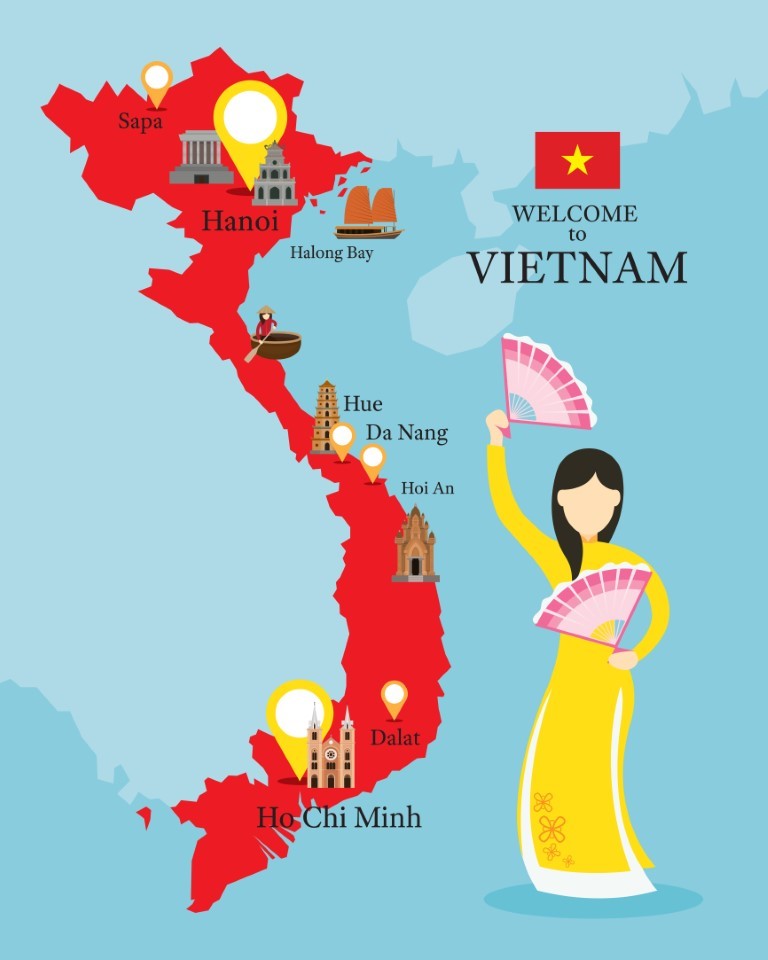
Vietnam, officially called the Socialist Republic of Vietnam, is located in Southeast Asia, at the eastern end of the Indochinese Peninsula. It shares its borders with China to the north, Laos and Cambodia to the west, and has a long coastline bordered by the South China Sea to the east.
The country covers an area of 331,212 km² and has about 96.2 million inhabitants, representing a population density of approximately 290 inhabitants per km². Its capital is Hanoi, while Ho Chi Minh City (formerly Saigon) is the largest city and the main economic center.
Vietnam is divided into three major regions: the North, the Center, and the South, each with its own geographical, climatic, and cultural specificities. The climate is mostly tropical, with subtropical variations in the north. The terrain is varied, alternating between mountains, high plateaus, plains, and fertile deltas, notably those of the Mekong and the Red River.
The country operates in the UTC+7 time zone and uses the Vietnamese dong (VND) as its national currency.
This places Vietnam in 15th position on the list of the most populous countries in the world. The largest city is its capital Hanoi, and its largest urban area is Ho Chi Minh City. The official currency of the country is đồng and the telephone code is 84 or 084 or +84.
Which countries border Vietnam?
Vietnam’s neighboring countries are China, Laos, and Cambodia. Across the sea, Vietnam’s neighbors are Thailand and the Philippines. The South China Sea also separates Vietnam from Indonesia and Malaysia.

Population of Vietnam
Currently, the population of Vietnam stands at 97,822,290 inhabitants according to the latest United Nations estimates. This figure represents about 1.25% of the world’s population. Indeed, the land area of 310,070 km² implies a density of 314 inhabitants per km².
This indicates that the population density is the 15th highest in the world. 37% of the Vietnamese population lives in large urban areas and the average age in the country is 32.5 years, which indicates a very young population.
| Category | Key Information |
|---|---|
| Official Name | Socialist Republic of Vietnam |
| Area | ~331,690 km² |
| Population | ~100 million inhabitants |
| Capital | Hanoi |
| Most Populated City | Ho Chi Minh City |
| Official Language | Vietnamese |
| Main Regions | North, Central, South |
| Bordering Countries | China, Laos, Cambodia |
| Coastline | About 3,260 km (bordered by the South China Sea) |
| Climate | Tropical in the south, subtropical in the north |
| Relief | Mountains, plateaus, deltas (Mekong, Red River) |
| Time Zone | UTC +7 |
| Currency | Vietnamese Dong (VND) |
What are the colors of the country?

The flag of Vietnam is a rectangular flag with a red background on which a yellow five-pointed star is drawn.
The red color symbolizes the people’s struggle for freedom or, according to other interpretations, symbolizes the blood shed. The yellow five-pointed star represents Vietnamese society including workers, peasants, soldiers, intellectuals, and businessmen.
What are the best cities to visit in Vietnam ?
Hanoi
Hanoi is the capital of Vietnam, it is also a city rich in baroque architecture and a city full of charm and history. If you go there, you will see ruins of the old city with vines dating back to the French colonial structure. Hanoi is also famous for its street stalls and street cooks.
Therefore, take a walk and enjoy tasting the best Vietnamese dishes and specialties. This city also abounds with various sites as well as museums, which combined with the dynamism of the streets are very pleasant. Enjoy your stay in the capital, do your shopping, and watch out for scooters.
Ho Chi Minh City
Ho Chi Minh City is also called Saigon by the locals, it is a former communist city that recalls the former great leader and the power of the Vietnamese military and the inherent social appearances.
It is a city that gathers many expatriates, tourists, as well as locals who are very active in the downtown alleys. Visit the military museum which will show you the extent of Vietnam’s strength. There is also the Independence Palace which is a mix of modern and old architecture.
Ho Chi Minh City is very active at night. Early in the evening, restaurants and bars are packed while backpackers and locals gather there.

Da Nang
This city is especially famous for its old colonial buildings that attract many people. The city is located between the largest urban area Ho Chi Minh and the capital. It is a dream destination for lovers of white sandy beaches.
Moreover, the most popular beach in the city remains My Khe Beach, which is an artificial coastline intended for water sports. Although the only issue is the crowding during the high season. If you want tranquility, do not hesitate to visit Lang Co beach, lined with trees and white waves crashing on the shore.
Dalat
Located on the central highlands of the country, it is a forested city with a more humid climate than other areas. You can go there to visit the old villas from the French colonial era. Previously, the construction project of the old Dalat aimed to create an exclusively French seaside resort.
Currently, the region has been transformed into a tourist destination for romantics and couples. The city still retains its French design with its streets populated by horse-drawn carriages and a pseudo-Eiffel Tower erected high above. Extreme sports enthusiasts will also find their match here, as it is a perfect place for mountain biking, motocross, and white-water rafting.
Teinte
Also called Hue, it was the former capital of the country and the cradle of the country’s leaders. It is famous for its palace which was once admirable but was destroyed after the American war. It is an excellent place appreciated by backpackers who stop there to visit the ruins. A small part of this historic castle is still preserved and that is what makes the charm of the city. Rent a bike to ride outside the city and visit the tombs formerly erected by the old Vietnamese emperors. In the evening, you can also dine on the banks of the Perfume River.
Where the cities are located on the map of Vietnam ?

Hanoi
On the map of Vietnam, Hanoi is located right in the center, in the delta plain and at the tributary of the Red River. Geographic coordinates: 21° 02′ north, 105° 51′ east
Ho Chi Minh City
Ho Chi Minh City is also called Saigon due to its location on the banks of the Saigon River. It is located inland in the southeastern section of the country. Geographic coordinates: 10° 46′ 01″ north, 106° 40′ 01″ east.
Da Nang
On the map of Vietnam, 600 km separate the city of Đà Nẵng from the capital. It is situated in the south-central zone of the country. Geographic coordinates: 16° 01′ 55″ north, 108° 13′ 14″ east.
Dalat
On the map of Vietnam, the city of Đà Lạt is located in the central highlands region of Vietnam. Geographic coordinates: 11° 56′ 30″ north, 108° 26′ 18″ east.
Teinte
On the map of Vietnam, the city of Teinte is located in the central section of the country near the coast. Geographic coordinates: 16° 28′ 10″ north, 107° 34′ 40″ east.
Vietnam climate map
The climate of Vietnam is divided into two distinct zones: the north and the south. The first type of climate is subtropical and the second tropical. Vietnam is strongly influenced by two monsoons, the first coming from the southwest and the second from the northeast. The first monsoon brings significant rainfall to the flat areas of the territory between May and October.
On the other hand, the second reduces relative humidity but also brings rain between October and December. Since the country’s interior territory is dominated by mountain ranges, the summer climate is less dry but the winter is harsher, especially in the northern areas. Annual rainfall in Vietnam ranges between 1500 and 2500mm. Temperatures in the northern areas range between 17.5°C and 20°C at the beginning of the year, which corresponds to winter. In summer, temperatures hover around 32°C.
Hanoi
Geographically, the city of Hanoi is located south of the coast, about 90km from it. As a result, winter is warmer than in the rest of the country. Temperatures range between 7 and 8°C and sometimes maximum temperatures reach 15°C.
In some areas of the capital, temperatures can average around 10°C. The cold periods are less sunny due to the monsoon breeze. However, spring and summer are warmer and therefore sunnier.
The annual sunshine duration is 1450 hours. The rainy season generally occurs between July and August with high rainfall of about 600 mm over the two months. Summer is very hot with maximum temperatures of 38°C and average temperatures around 33°C.
However, this heat is mitigated by the relative humidity.
Vietnam economic map
Currently, Vietnam’s economy is oriented towards socialism, that is, towards a collective market economy. Indeed, Vietnam’s GDP ranks 23rd on the list of the world’s most performing GDPs.
However, its economy is the 36th most performing in the world. The country is part of several international organizations, notably the Asia-Pacific Economic Cooperation, the Association of Southeast Asian Nations, and the WTO. The country’s economy is mainly based on the export of agricultural products and the industrial sector is dominated by SMEs.
Currently, more and more foreign companies are investing in Vietnam, especially in the clothing industries, food industries, and chemical products. There are also foreign hotel complexes dominating the city. Here are some economic indicators of the country:
- Official currency: đồng
- GDP in nominal terms: 341 billion USD
- GDP in purchasing power parity: 1 trillion USD
- Natural GDP growth rate: 7.1%.
- GDP per capita in nominal terms: 3,500 USD
- GDP per capita in PPP: 10,755 USD
- Inflation rate: 3.8%
- Unemployment rate as % of active population: 3.3%
Administrative subdivisions
First of all, Vietnam is divided into 8 administrative regions which are:
- The Northwest region
- The Northeast region
- The Greater Hanoi Delta
- The North Central Coast
- The south central coast
- The central highlands of the southeast
- The southwest region, in the Mekong delta
Vietnam is then subdivided into 58 provinces in addition to 5 autonomous municipalities related to major cities: Hanoi, Ho Chi Minh City, Can Tho, Da Nang, and Hai Phong.
Demolinguistic data
The people of Vietnam are essentially composed of Viets or Kinh according to the language. The Viets represent about 82% of the country’s population and are divided into more than 53 different ethnic groups. The most important ethnic groups are the Thai, Muong, Khmer, White Hmong, and Chinese.
The main language used is Kinh or Classical Vietnamese related to Chinese and belonging to the Austro-Asiatic family.
The dialectal subdivisions are
- Northern Vietnamese
- North-Central Vietnamese
- Central Vietnamese
- South-Central Vietnamese
- Southern Vietnamese
FAQ – Vietnam map: Geographic and demographic information
Vietnam is located in Southeast Asia, along the South China Sea, between China, Laos, and Cambodia. Its territory stretches for more than 1,600 kilometers from north to south and features an extensive coastline.
Vietnam has a population of over 100 million people, making it one of the most populous countries in Southeast Asia. Most of the population is concentrated in the Red River and Mekong deltas, as well as in the country’s major cities.
Vietnam is characterized by mountains, highlands, fertile plains, and a long coastline along the sea. This geographic diversity supports rich natural resources and extensive agricultural production, particularly rice cultivation.
