
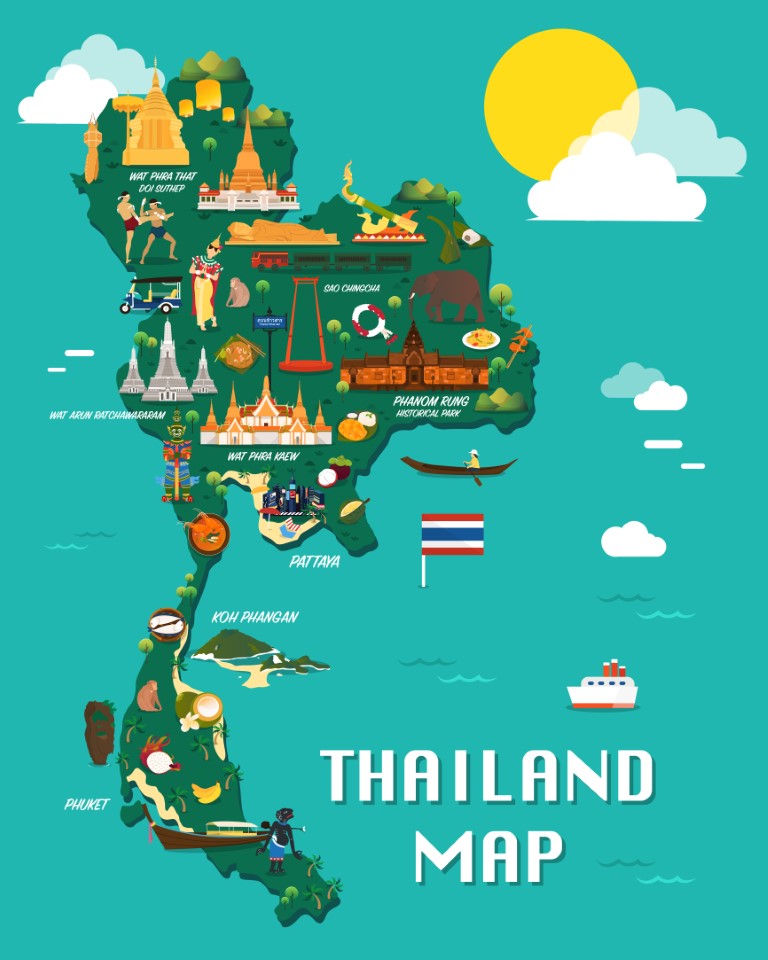
Thailand is a country in Asia located on the Indochina peninsula. It is a monarchy also called the Kingdom of Thailand. Its area amounts to 513,120 km2, placing it 50th on the list of the largest countries in the world.
Thailand is also the 22nd most populated country on Earth with its 66,558,935 inhabitants. The country’s density is then 132 inhabitants/km2. The largest urban area in the country is Bangkok. The telephone code in Thailand is 66, that is 0066 or +66.

Which countries border Thailand?
The countries bordering Thailand are Myanmar, Laos, Cambodia, and Malaysia. Thailand also has maritime neighbors which are Vietnam and Indonesia.
| Category | Key Information |
|---|---|
| Official name | Kingdom of Thailand |
| Area | ~513,120 km² |
| Population | ~70 million inhabitants |
| Capital | Bangkok |
| Most populous city | Bangkok |
| Official language | Thai |
| Bordering countries | Myanmar (Burma), Laos, Cambodia, Malaysia |
| Coastline | Andaman Sea (to the west) and Gulf of Thailand (to the east) |
| Climate | Tropical: dry season, rainy season, and hot season |
| Relief | Mountains in the north, central plains, plateaus and beaches in the south |
| Time zone | UTC+7 |
| Currency | Thai Baht (THB) |
Population of Thailand
Currently, the Thai population amounts to 69,896,632 inhabitants according to the latest UN estimates. Currently, this figure corresponds to 0.9% of the global population. Combined with the Thai territory area of 510,890 km2, the density is 354 inhabitants per km2, which means that Thailand is the 20th most populous country in the world. Just over half (51%) of Thais live in urban areas, numbering 35,698,325 inhabitants. Finally, the average age in the country is 40 years.
What are the colors of the country?

Among the oldest symbols in the world is the Thai flag. It is a national symbol also called Thong Trairong, explaining that the flag is Tricolor. In reality, the country’s flag has 5 stripes of three colors (red, white, blue) arranged as follows: From top to bottom: red, white, blue, white, red. The middle stripe (blue) is twice the thickness of the other red and white stripes.
Indeed, this flag represents the country’s religion; it also governs the customs and traditions of the Thai people.
- Red: representative of the blood of martyrs during the struggle for the country’s independence
- White: representative of the purity of the soul and the Buddhist religion
- Blue: symbol of royalty and respect for the Thai monarchy. This color also signifies that the country is united, supportive, and peaceful.
What are the best cities to visit in Thailand
Bangkok
Bangkok is the capital and the most populous city of Thailand. It stands out for its striking contrast between modern glass and metal skyscrapers and ancient cultural sites. Among the most emblematic places is the Wat Phra Kaew, or Temple of the Emerald Buddha, considered the most sacred sanctuary in the country and a major national symbol.

Just a few minutes away is the Wat Pho, famous for its impressive Reclining Buddha measuring 46 meters long, covered in gold leaf. Bangkok is also a leading commercial capital, with many modern shopping centers and the largest open-air market in the world, the Chatuchak market, which attracts thousands of visitors every week.
Ayutthaya
Ideal for a day trip, Ayutthaya is one of Thailand’s most remarkable historical destinations. Listed as a UNESCO World Heritage Site, the city is renowned for its ruined temples and monumental remains, witnesses to its prestigious past. The historic site covers about 289 hectares, in the heart of a territory surrounded by three rivers.
Former capital of the Kingdom of Siam for more than four centuries, Ayutthaya was largely destroyed during the Burmese invasion in the 18th century. Among the must-see sites are the Wat Chaiwatthanaram, a majestic temple surrounded by eight chapels, as well as the Wat Mahathat, famous for the Buddha head entwined in the roots of a tree.
Chiang Mai
Chiang Mai is particularly appreciated for its natural environment and peaceful atmosphere. Surrounded by mountain ranges, the city offers privileged access to waterfalls, tropical forests, and many ancient temples. It is an ideal starting point for trekking, a flagship activity of the region, especially in areas inhabited by hill tribes.
The city is also renowned for its ethical elephant sanctuaries, located in the surrounding mountains, where visitors can observe the animals in a respectful setting. Chiang Mai is also a major hub of Thai gastronomy, with many cooking schools. Among the major sites are the Wat Phra Singh and the Wat Phra That Doi Suthep, perched on the heights and offering a panoramic view of the city.
Phuket
Phuket is a highly sought-after destination for its spectacular beaches and vibrant atmosphere. The old town stands out with its unique architecture blending Chinese and Portuguese influences, featuring colorful houses and old shops dating back to the 19th century. This heritage richness gives Phuket an authentic charm, far from its solely seaside image.
The city is also lively with night markets, especially active on weekends, attracting shopping enthusiasts and lovers of local cuisine. There is a wide variety of products, ranging from handicrafts to electronic equipment. Phuket also has a strong Chinese cultural influence, visible through its temples, traditional pastries, and iconic places such as the Jui Tui sanctuary or the Thai Hua museum, dedicated to Sino-Thai history.
Where the cities are located on the map of Thailand ?
Bangkok
On the map of Thailand, the city of Bangkok is located in the central part of the country, on the banks of the Chao Phraya River. Geographic coordinates: 13° 45′ 08″ north, 100° 29′ 38″ east.
Ayutthaya
On the map of Thailand, the city of Ayutthaya is situated at the convergence of the Chao Phraya and Pa Sak rivers; the old town is identified by the river’s meandering, intersected by an aqueduct to form an islet. Geographic coordinates: 14° 20′ 52″ north, 100° 33′ 38″ east.
Chiang Mai
On the map of Thailand, the city of Chiang Mai is located inland in the northern part of the country. Geographic coordinates: 18° 47′ north, 98° 59′ east.
Phuket
On the map of Thailand, the city of Phuket is located in the southern part of the country. Geographic coordinates: 7° 53′ 17″ north, 98° 23′ 51″ east.
With its golden temples, idyllic beaches, and delicious cuisine, this Southeast Asian country has much to offer.
If you are looking to organize an unforgettable trip to Thailand, an excellent option is to use a specialized local agency. An agency such as voyagethailande.fr can help you plan every detail of your trip, from accommodation to guided tours, ensuring a stress-free and enriching experience.
Thailand climate map
The geographical location of Thailand allows its climate to feature a hot season, a rainy season, and a dry and rainy season. These three seasons are characteristic of a temperate tropical climate. However, the last season is very influential inland, while the opposite is observed along the coast and in the southern regions. Here are some climates of the city
Chiang Mai
The climate in this city is strongly influenced by cold waves coming from China. During winter, temperatures hover around 5°C and can sometimes drop suddenly. After that, there is summer; it is during this season that most of the precipitation occurs. However, summer temperatures are very hot and can reach 40°C during the day due to hours of sunshine. Annual rainfall amounts to approximately 1000 to 1500 mm.
Bangkok
Throughout the year, temperatures in the capital are quite warm in summer, reaching up to 32°C, while in winter the average temperature is 22°C. Temperatures between seasons range from 20 to 29°C with some areas warmer than others, mainly in the north. Areas closer to the coast are milder, while inland areas are warmer, especially in the old city. Summer is the rainiest season, with annual rainfall around 1450 mm, and the summer periods extend between September and October.
Thailand economic map
Thailand’s GDP is mainly based on exports of the country’s products to its neighbors. Indeed, these exports represent 30% of the Gross Domestic Product. According to the World Bank and the IMF, the country is a NIC (Newly Industrialized Country), ranked as the second most performing economy in Southeast Asia.
Recently, the country’s annual inflation rate is 1.06% and the annual GDP growth is 3.8%. The main sources of foreign currency for the country are: agriculture, trade, and communications or logistics.
They represent respectively 39.2%, 8.4%, and 13.4%. There is also a minority mining sector which accounts for 4.3% of Thailand’s GDP. The country’s development has marked Asian history but also sparked controversy regarding World Bank data. This international organization states that the Thai economy has experienced a rapid rise in recent years. However, the GNI or Gross National Income is low, amounting to 6,610 USD. The country’s unemployment rate is one of the lowest in the world at 1% of the active population.
Here are some economic indicators of the country:
- Official currency: Thai Baht
- GDP in nominal parity: 509.2 billion USD
- GDP in purchasing power parity: 1.261 trillion USD
- Annual GDP growth rate: 4.2%
- GDP per capita in nominal parity: 7,379 USD
- Unemployment rate as % of active population: 1.1%
- Foreign reserves: 266.09 billion USD

Administrative and demolinguistic data
Administrative Subdivisions
Thailand is currently subdivided into 76 autonomous provinces as well as a special regulatory zone which is the country’s capital. The provinces are then subdivided into districts (795). Here are the provinces:
- Bangkok (special administrative zone)
- Amnat Charoen
- Ang Thong
- Bueng Kan
- Buriram
- Chachoengsao
- Chai Nat
- Chaiyaphum
- Chanthaburi
- Chiang Mai
- Chiang Rai
- Chonburi
- Chumphon
- Kalasin
- Kamphaeng Phet
- Kanchanaburi
- Khon Kaen
- Krabi
- Lampang
- Lamphun
- Loei
- Lopburi
- Mae Hong Son
- Maha Sarakham
- Mukdahan
- Nakhon Nayok
- Nakhon Pathom
- Nakhon Phanom
- Nakhon Ratchasima
- Nakhon Sawan
- Nakhon Si Thammarat
- Nan
- Narathiwat
- Nong Bua Lamphu
- Nong Khai
- Nonthaburi
- Pathum Thani
- Pattani
- Phang Nga
- Phatthalung
- Phayao
- Phetchabun
- Phetchaburi
- Phichit
- Phitsanulok
- Phra Nakhon Si Ayutthaya
- Phrae
- Phuket
- Prachinburi
- Prachuap Khiri Khan
- Ranong
- Ratchaburi
- Rayong
- Roi Et
- Sa Kaeo
- Sakon Nakhon
- Samut Prakan
- Samut Sakhon
- Samut Songkhram
- Saraburi
- Satun
- Chanter Buri
- Sisaket
- Songkhla
- Sukhothai
- Suphan Buri
- Surat Thani
- Surin
- Tak
- Trang
- Trat
- Ubon Ratchathani
- Udon Thani
- Uthai Thani
- Uttaradit
- Yala
- Yasothon
Demolinguistic data
The official language of the country is the Thai language. This language is spoken by the majority of the population (74.5%). This language is called Thai-Kadai. On the other hand, there are minority languages spoken by non-Thai ethnic minorities which are Austroasiatic, Austronesian, Hmong-Mien, Sino-Tibetan languages or other foreign languages.
Thailand is ideally located between Myanmar, Laos, Cambodia, and Malaysia, with direct access to the Gulf of Thailand to the east and the Andaman Sea to the west. On a map, it forms an inverted “T” shape whose southern part stretches into a long peninsula, adjoining popular tourist areas like Phuket or Krabi.
With over 70 million inhabitants, Thailand is densely populated around Bangkok, the capital. The north is more rural and mountainous, while Isan (northeast), although vast, is economically less developed. The south, very touristy, has a more variable density, concentrated around coastal areas.
A detailed map reveals mountains in the north (Daen Lao range), a vast central plain crossed by the Chao Phraya River, and a very indented southern coast with many islands. The relief directly influences lifestyles: rice paddies in the plain, terraced farming in the north, fishing and tourism in the south.
