
What you need to know about Israel ?
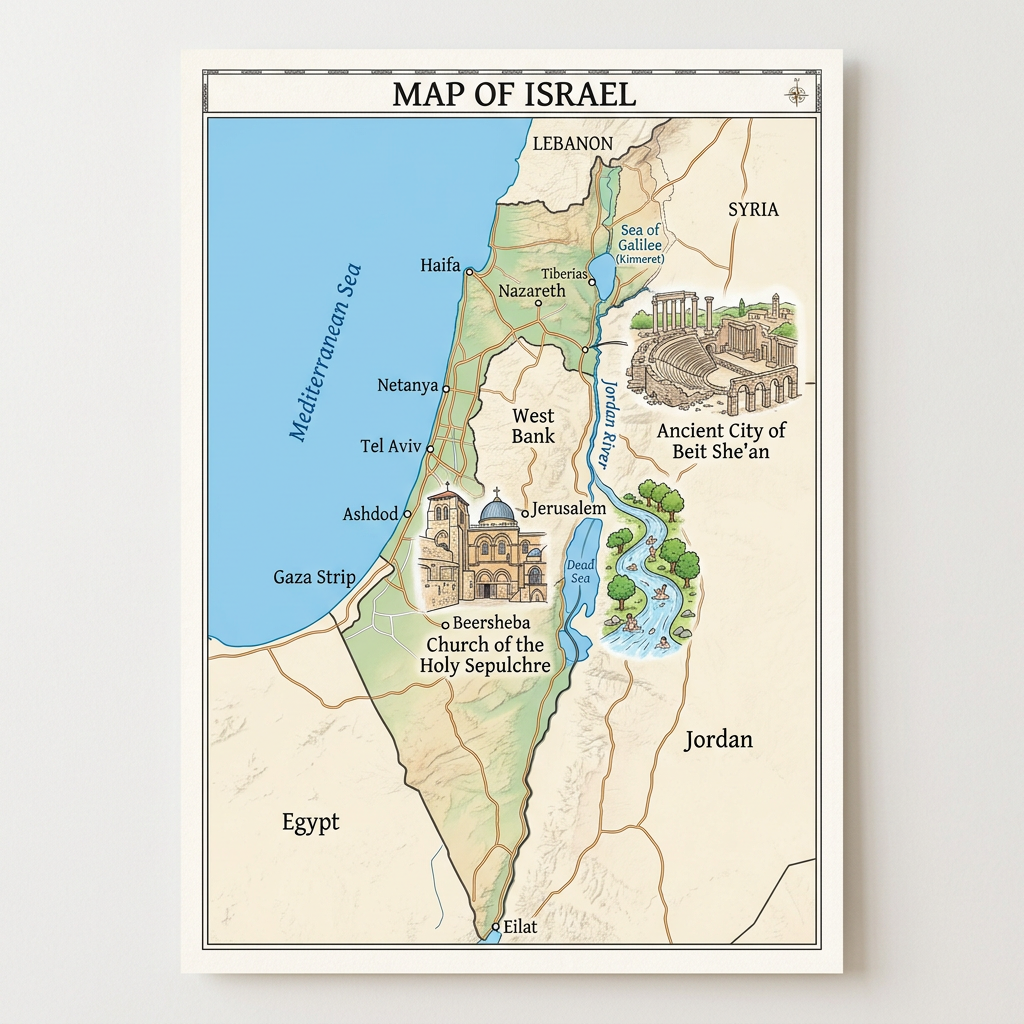
Israel is an Asian country located in the Middle East, bordered by the Mediterranean Sea to its west.
Israel, officially known as the State of Israel, has Jerusalem as its capital. The country covers an area of about 22,000 km² and has nearly 10 million inhabitants in 2025.
Israel is one of the world’s more densely populated countries, with a population density of about 450 inhabitants per km². Its international dialing code is +972.
Which countries border it?
The neighboring countries of Israel are: Lebanon, Syria, Jordan and Egypt. Israel is also bordered by 3 seas including the Mediterranean Sea to the west, the Dead Sea to the east, and the Red Sea to the south.
Population of Israel
Israel’s population is estimated at nearly 10 million people in 2025, with an annual population growth rate of about 1.4%. The country’s fertility rate is around 2.9 children per woman, one of the highest among developed countries.
The birth rate remains well above the death rate, while life expectancy is about 83 years. The sex ratio is close to balanced, with a slight male majority. The population consists mainly of Jews (around 73%), Arabs (around 21%), and other groups (around 6%).
What are the colors of the country?

The Israeli flag is a rectangular flag with a white background. It has two horizontal blue stripes. Between the stripes stands a six-pointed star, also blue. Israelis call it the Star of David.
The colors of the flag originate from a Jewish prayer shawl. The star represents the country’s religion: Judaism.
The best places to visit in Israel

Jerusalem
Jerusalem, besides being a holy city for Jews, Christians, and Muslims, is one of the most popular cities in the world. It is built on hills and was once the cradle of many wars, histories, and civilizations that have succeeded each other over time.
Despite the long history and the events for which Jerusalem was the cradle, many monuments are still preserved. This is what makes the city unique and one of the world’s must-see places.
The old city is made up of 4 sections according to religions. Thus, there is the Jewish quarter, the Christian quarter, the Armenian quarter, and the Muslim quarter. You will also see monuments in the old city expressing the history of Jesus. There is also the Wailing Wall of Jeremiah. The perfectly preserved buildings include the Church of the Holy Sepulchre, the Dome of the Rock, and the Al-Aqsa Mosque. You can also visit the city’s botanical garden and the biblical zoo.
Masada
The city of Massada is located in the southern part of Israel overlooking the Dead Sea. Formerly, it was the last Jewish city to fall to the Romans after the war between the two countries. The city thus encompasses the history of both Jewish and Roman civilizations. In the old city, you will see symbols of ancient Israel as well as the remains of Roman civilization. You can take the cable car to overlook the ancient Roman fortifications and reach the hill that offers a 360° view of the region.
Eilat
The city of Eilat is a very old city located on the shores of the Red Sea. It was once a port city during the reign of Solomon, a biblical king. You will see several beautiful beaches there as well as a warm and dry climate almost all year round. It is also a seaside resort and a true cradle of diving sites.
These sites are absolutely not to be missed due to the marine diversity and coral reefs. Once in Eilat, you will have the opportunity to visit a theme park illustrating biblical stories. This city is also a transit point for those who want to migrate between Europe and Africa. Finally, don’t forget to visit Timna Valley Park where you will see Solomon’s pillars and the oldest copper mine in the world.
Tel Aviv
Tel Aviv is the second largest Israeli urban area, and it is also the cradle of the country’s economy. This does not mean that the city lacks interesting places for backpackers. It is a very lively city especially at night because you can enjoy the frequent festivities held there.
This city also has a national opera and a symphony orchestra. It is also a place for lovers of beautiful beaches overlooking the Mediterranean; it is one of the most beautiful beaches in the world. You will also see exceptional museums such as Beth Hatefutsoth which traces the history of Jewish oppression through the ages.
Where the cities are located on the map of Israel ?
Jerusalem
On the map of Israel, the city of Jerusalem is located in the center of the country halfway between the Mediterranean Sea and the Dead Sea. Geographic coordinates: 31° 47′ 00″ north, 35° 13′ 00″ east.
Massada
The city of Massada is located in the eastern section of Israel, overlooking the Dead Sea. Geographic coordinates: 31°18′56″N 35°21′14″E
Eilat
On the map of Israel, the city of Eilat is located in the southern section of the country in the gulf of the same name. Geographic coordinates: 29° 33′ 22″ north, 34° 57′ 03″ east
Tel Aviv
On the map of Israel, the city of Tel Aviv is located on the Mediterranean coastlines, that is in the western part of the country. Geographic coordinates: 32°4′N 34°47′E
Climate map of Israel
The climate in Israel is somewhat peculiar, meaning its summers are very hot with frequent sunshine and the winters are short. The hot periods occur mainly between May and September. There is also a rainy season that mainly takes place between November and March.
The Mediterranean coast
In this part of Israeli territory, the climate is strongly influenced by the sea (Mediterranean climate). This results in moderately cold winters and very hot summers with frequent sunshine.
The ambient humidity is high due to the sea breeze. The cities concerned are Tel Aviv, Haifa, and Netanya. In Tel Aviv, winter temperatures hover around 14°C, and autumn temperatures hover around 26.5°C.
On the other hand, the summer is extremely hot with higher temperatures that can exceed 40°C, especially along the coast. The annual rainfall in the city amounts to 580 mm, with the heaviest precipitation occurring between December and February. Sunshine in Tel Aviv is frequent and long throughout the day, even during the winter periods.
The central section of Israel
Inland, the climate is drier, defined as a continental climate. Notably, the city of Jerusalem is located in this part of the country. In this central zone, winter temperatures are milder.
However, this season could be influenced by cold winds coming from Russian territory. As a result, winter could be snowy. Summer, on the other hand, is hot and dry with warm winds coming from the Egyptian desert territory.
Summer temperatures hover around 29 to 30°C, while winter temperatures can be negative during brief periods of intense cold but average around 9°C. The annual rainfall in this central zone of Israel is about 550 mm and is mainly concentrated in the cold seasons.
Economic map of Israel
The IMF ranks Israel as the 22nd most performing country in the world in terms of economy. This economy focuses on a free market and available exchanges with partner countries as well as a barter of knowledge and know-how.
According to the UN, Israel is an extremely developed country. This development owes its success to the sophistication of infrastructures and the high number of technological industries in the country. Moreover, many developed countries have relocated their firms to Israel.

Israel’s economy is mainly driven by high technology, services, manufacturing, and a strong start-up ecosystem. The country is also internationally recognized for its expertise in cybersecurity, biotechnology, and innovation.
Israel remains an important player in the diamond trade and processing industry, although this sector is less significant than in the past. Today, high-tech industries and services are the main drivers of the country’s economic growth.
Here are some economic indicators:
- Official currency: Israeli Shekel
- GDP at nominal parity: approximately US$550 billion
- GDP at purchasing power parity: approximately US$650 billion
- Annual GDP growth rate: around 3–4%
- GDP per capita at nominal parity: approximately US$54,000
- GDP per capita at PPP:approximately US$64,000
- Inflation (CPI): around 3%
- Unemployment rate as % of active population: about 3%
Administrative and demolinguistic data
Administrative subdivisions
Israel is divided into 6 administrative regions which are respectively:
- North
- Haifa
- Tel Aviv
- Center
- Jerusalem
These regions are then subdivided into subregions also called local authorities, numbering 256.
These local authorities consist of
- 75 municipal councils
- 126 local councils
- 53 regional councils
Demolinguistic data
According to the data received, the Israeli population is mainly composed of Jews at 80.5%, the rest being composed of Arabs at 17.8% and undefined ethnicities at 1.5%
Here are the subdivisions:
- Israeli Jews: 80.5%
- Israeli Arabs: 17.8%
- Muslim Arabs 14.4%
- Christian Arabs 1.7%
- Druze 1.6%
- Others
- Non-Arab Christians 0.3%
- Undefined 1.1%
The official language of the country is Hebrew, this language is part of the Afro-Asiatic family. Speakers of this language represent 60% of the population. On the other hand, the other languages are:
- Russian (5.4%)
- Arabic (20%)
- Yiddish (3.2%)
- English (1.1%)
- Polish (1.4%)
- Amharic (0.8%)
- Spanish (0.5%)
- French (0.4%)
FAQ-Israel map: Geographical and demographic information
Israel is located in the Middle East, bordered by the Mediterranean Sea to the west, Lebanon to the north, Syria to the northeast, Jordan to the east, and Egypt to the southwest.
Israel shares its borders with Lebanon to the north, Syria to the northeast, Jordan to the east, and Egypt to the southwest.
Israel is located in Asia.
