
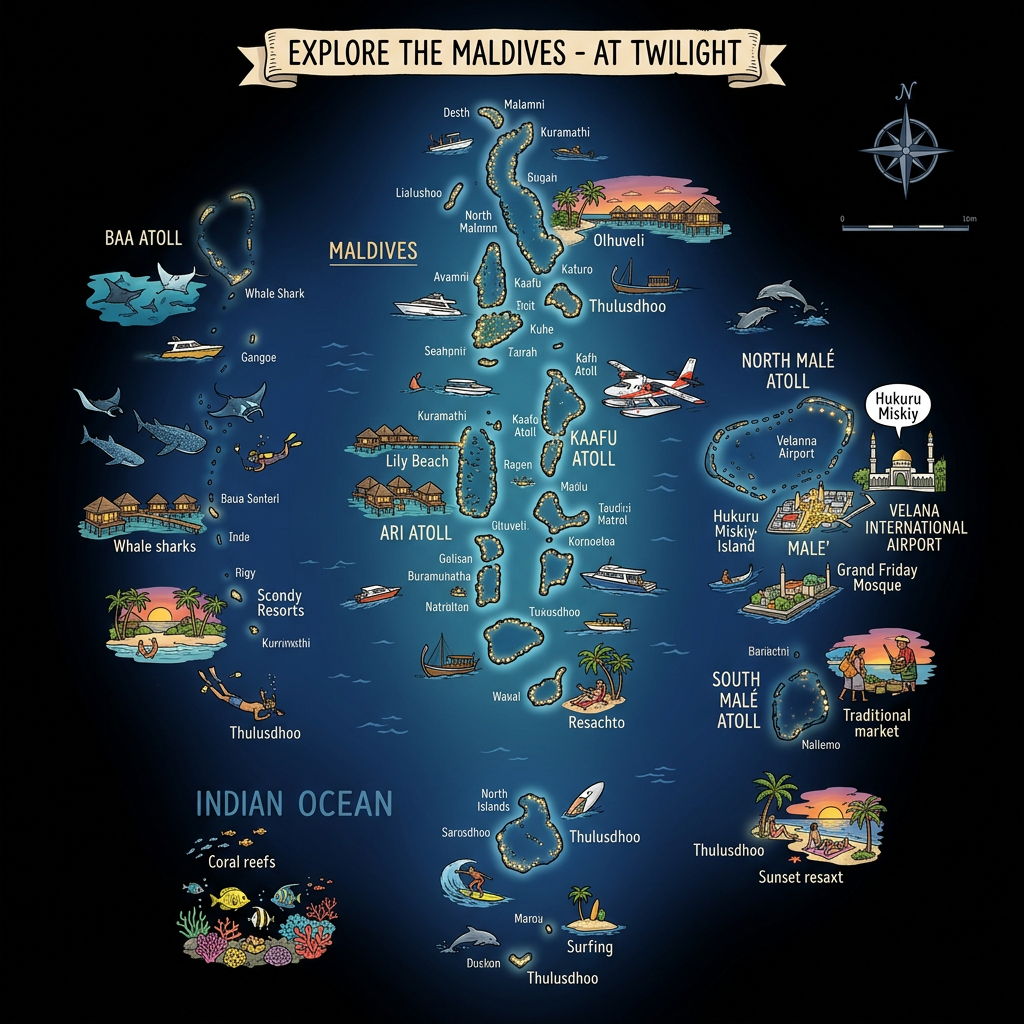
The Maldives, located in South Asia, are an island country made up of an archipelago of 1,199 islands, of which only 202 are inhabited. Officially called the Republic of Maldives, the country consists of 26 atolls and 3 isolated islands, divided into 20 administrative subdivisions. The capital and largest city is Malé.
What you need to know about the Maldives ?
With a total area of about 298 km², the Maldives are both the smallest country in Asia and one of the smallest in the world. The population is estimated at around 521,000 inhabitants in 2025, making it the 177th most populous country.
The Maldives are members of several international organizations, including the AIIB. The international dialing code is +960.
Table – Maldives: Geographic and demographic information
| Item | Key Information |
|---|---|
| Total area | ~298 km² (archipelago spread over 90,000 km² of ocean) |
| Capital | Malé |
| Neighboring countries | None (Island state in the Indian Ocean) |
| Archipelago | About 1,200 islands, of which 200 are inhabited |
| Estimated population | ~550,000 inhabitants (2025) |
| Population density | ~1,800 inhabitants/km² (highly concentrated in Malé) |
| Relief | Coral atolls, very low islands (max altitude ~2.4 m) |
| Climate | Tropical, hot and humid, monsoons |
| Official language | Dhivehi (Divehi), fluent English |
| Economic resources | Tourism, fishing, maritime transport |
| Particularity | Lowest country in the world, threatened by rising oceans |
Additional points on the Maldives map
- The archipelago is located in the Indian Ocean, southwest of India and Sri Lanka.
- The map shows more than 26 atolls, formed by coral reefs.
- The capital Malé is one of the most densely populated cities in the world.
- The islands are known for their turquoise lagoons and paradisiacal beaches.
- The very low geography makes the country vulnerable to climate change.
What are the neighboring countries?
The map of the Maldives highlights an archipelago in the Indian Ocean, located southwest of India and Sri Lanka. Composed of 26 atolls grouping about 1,200 islands, the country is renowned for its beaches, coral reefs, and high-end tourism.

Population of the Maldives
The population of the Maldives is estimated at around 392,500 inhabitants, with a slightly negative demographic growth (-0.06%). The fertility rate is 1.7 children per woman.
- Birth rate: ~16.1 ‰
- Mortality rate: ~4 ‰
- Median age: ~28.6 years (very young population)
- Sex ratio: about 104 men per 100 women
- Migration: negative rate (–12.7 ‰)
- Ethnic composition: mostly Maldivians of Indo-Aryan origin (from southern India and Sri Lanka), with Arab influences
- Religion: Sunni Islam is the official religion and practiced by the entire population
The colors of the Maldives flag
The flag of the Maldives is made up of:
- a green rectangle in the center,
- framed by a red background,
- with a white crescent moon placed in the middle.
Meanings:
- Green: Islam and serenity
- White (crescent moon): symbol of Islam and peace
- Red: the blood of martyrs shed for independence and sovereignty

The best places to visit in the Maldives
Malé
The capital, Malé, is a lively and densely populated city. You can discover there:
- the Friday Mosque (Hukuru Miskiy), an 18th-century monument,
- the Malé Market, where fruits, fish, and crafts intermingle,
- numerous local cafés and bazaars.
Malé remains the economic, cultural, and religious center of the country.
Hulhumalé Island
Located just next to Malé, Hulhumalé is a rapidly growing new town, connected to Velana International Airport. It has a very popular artificial beach, modern neighborhoods, and contemporary mosques. It is also the starting point to other islands and atolls.
Maafushi
Maafushi is known for its local guesthouses, palm-lined beaches, and tourist resorts. The town, rebuilt after the 2004 tsunami, is today a popular destination to discover the Maldives at a more affordable price than luxury resorts.
Utheemu
Located in the Haa Alif atoll in the north, Utheemu is a historic town, known as the birthplace of Maldivian independence. You can visit there:
- the house-museum Utheemu Ganduvaru, former home of the national hero Mohamed Thakurufaanu,
- beautiful white sand beaches,
- cultural sites classified as national heritage.
Where the cities are located on the Maldives map ?

Coordinates: 6° 50′ 4″ N, 73° 06′ 47″ E
Malé: located in the atoll of the same name, an administrative division of the country.
Coordinates: 4° 10′ 29″ N, 73° 30′ 35″ E
Hulhumalé: located in the south of Malé atoll, in the center of the country.
Coordinates: 4° 11′ N, 73° 32′ E
Maafushi: located in the Kaafu atoll (South Nilandhe), southwest of the capital.
Coordinates: 3° 56′ 25″ N, 73° 29′ 20″ E
Utheemu: located in the Haa Alif atoll, the northernmost area of the country.
Climate map of the Maldives
The climate of the Maldives is dry tropical, mainly due to its geographical location in the Indian Ocean and southwest of the Indochina peninsula. Almost the entire territory is subject to a monsoon breeze between April and September. This breeze is stronger in the northern part of the archipelago. It can even disturb the sea and increase the ambient air humidity as well as cloud cover.
There is also a second monsoon occurring between October and December, which, unlike the first, is less intense and brings only a few afternoon thunderstorms mainly in the southern section of the archipelago.
Temperatures in the Maldives are constant and average around 30°C during summer with a minimum of 25°C. Relative humidity remains steady throughout the year, ranging between 70 and 80% on average. However, temperatures slightly increase between February and May, especially in the northern sections, reaching between 31 and 32°C.
Annual rainfall in the Maldives ranges between 2,220 and 2,300 mm, with precipitation more frequent in the south. Conversely, the northern part is less rainy, with annual totals between 1,700 and 1,800 mm.
Rainfall in the capital amounts to 2,000 mm annually, with most precipitation concentrated between May and December.
Sunshine in the capital is more or less constant throughout the year. The hottest months are mainly between February and March, with about 7 hours of sunshine per day.
Economic map of the Maldives
Formerly, the Maldives were known for exporting cowries, coconut fiber ropes, and dried tuna, which were important sources of income. These traditional products, appreciated locally and by early travelers, long shaped the country’s reputation.
Today, the economy is mainly based on tourism and maritime activities (diving, fishing, water sports). It is described as a mixed economy, where tourism-related services dominate significantly.
- Tourism represents about 28% of GDP and generates more than 60% of foreign exchange earnings.
- Nearly 100% of government revenues come from import taxes and levies directly or indirectly related to the tourism sector.
- Fishing remains the second economic pillar, particularly the export of tuna.
- Agriculture and craftsmanship are marginal, limited by the lack of arable land and labor.
- The local industry is modest, focused on textiles, shipbuilding (traditional boats), and craftsmanship aimed at visitors.
Key economic indicators (2025)
- Official currency: Maldivian Rufiyaa (MVR)
- Nominal GDP: ~ 5.8 billion USD
- GDP (PPP): ~ 8.7 billion USD
- GDP growth rate: ~ 8.5%
- GDP per capita (nominal): ~ 15,560 USD
- GDP per capita (PPP): ~ 23,310 USD
- Employment rate: ~ 54% of the active population
Administrative and demolinguistic data
Administrative subdivisions
The Maldives are divided into 7 provinces, which are further subdivided into 20 atolls; in addition to the 20 atolls and provinces, there is the autonomous capital, Malé. Here are the provinces and atolls of the country:
- Ari Atoll, Rasdu Atoll, and Thoddoo
- Ari Atoll
- Goidhoo Atoll and South Maalhosmadulu Atoll
- South Nilandhe Atoll
- North Nilandhe Atoll
- Huvadhu Atoll
- Huvadhu Atoll
- Fuvammulah
- Ihavandippolhu Atoll and Thilandhunmathi Atoll
- Makunudhoo Atoll and Thilandhunmathi Atoll
- Gaafaru Atoll, North Malé Atoll (except Malé), South Malé Atoll, and Kaashidhoo
- Hadhdhunmathi Atoll
- Faadhippolhu Atoll
- Mulaku Atoll
- Miladummadulu Atoll
- North Maalhosmadulu Atoll and Alifushi Atoll
- Addu Atoll
- Miladummadulu Atoll
- Kolhumadulu Atoll
- Felidhu Atoll and Vattaru Reef
- Malé
Demolinguistic data
The population of the Maldives is composed mostly of Maldivians at 98%. The ethnic minorities are:
- Sinhala
- Gujaratis
- Malayali
- Tamils
- Arabs
- Malays
- British
The main and most widely used language is Maldivian; it belongs to the Indo-Iranian family and derives from Sinhala.
FAQ – Maldives map: 3 questions
The Maldives are located in the Indian Ocean, southwest of India and Sri Lanka.
The capital is Malé, a very densely populated island.
They are very low coral islands, organized into atolls, surrounded by lagoons and reefs.
