
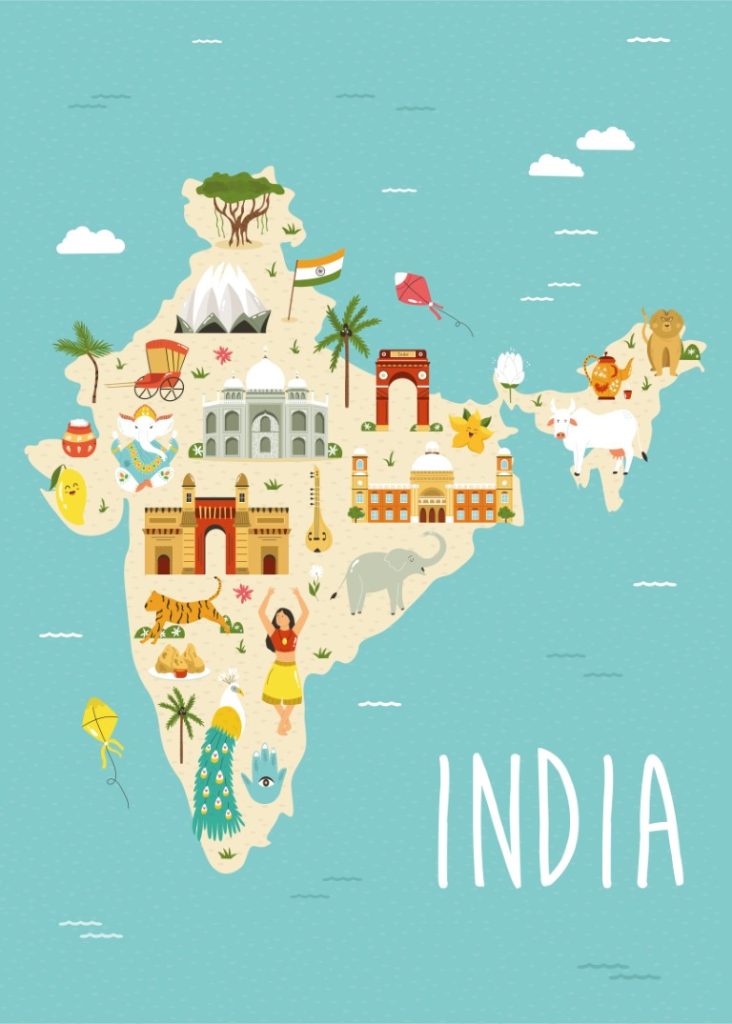
What you need to know about India ?
India is a country located in South Asia, officially called the Republic of India. Its area is 3,287,263 km², making it the 7th largest country in the world.
With an estimated population of about 1.43 billion inhabitants in 2025, India is now the most populous country in the world, ahead of China. The average density is about 435 inhabitants/km² (not 1,202, which was a calculation error in your initial text).
The capital is New Delhi, while the largest urban areas include Mumbai, Delhi, Bangalore, and Kolkata.
The official languages are Hindi and English, but the country recognizes 22 constitutional regional languages.
The international telephone code for India is +91.
Table – India: Geographical and demographic information
| Item | Key Information |
|---|---|
| Total area | 3,287,263 km² (7th largest country in the world) |
| Capital | New Delhi |
| Neighboring countries | Pakistan, China, Nepal, Bhutan, Bangladesh, Myanmar |
| Coastline | About 7,500 km on the Indian Ocean (Arabian Sea and Bay of Bengal) |
| Estimated population | ~1.45 billion inhabitants (2025) |
| Population density | ~440 inhabitants/km² |
| Relief | Himalayas in the north, fertile Ganges plains, Deccan plateau, Thar desert |
| Climate | Very varied: alpine, tropical, desert, monsoon |
| Official languages | Hindi, English (+ 21 recognized languages) |
| Economic resources | Agriculture, industry, digital services, mining, energy |
| Special feature | Largest democracy in the world and 2nd most populous country |

Additional points on the map of India
- India occupies a large part of South Asia, forming a peninsula on the Indian Ocean.
- The physical map shows the Himalayas to the north, where several peaks exceed 8,000 m.
- The country has two maritime fronts: the Arabian Sea to the west and the Bay of Bengal to the east.
- The demographic map reveals a very high population concentration in the Ganges plains.
- New Delhi is the political capital, but Mumbai, Bangalore, and Chennai are major economic centers.
Which countries border India?
The map of India highlights a vast South Asian country, bordered by Pakistan to the west, China, Nepal, and Bhutan to the north, as well as Bangladesh and Myanmar to the east. It has an extensive coastline on the Indian Ocean, shared between the Arabian Sea and the Bay of Bengal.
The Indian Peninsula is also separated by the Indian Ocean from Sri Lanka and the Maldives.

Population of India
In 2025, the population of India is estimated at about 1.43 billion inhabitants, making it now the most populous country in the world, ahead of China. This represents about 17% of the world population.
The average density is 435 inhabitants per km² (and not 1,202, which corresponded to a previous overestimation). More than 35% of Indians live in large urban areas, that is more than 500 million people. The median age is about 28 years, confirming that the Indian population remains very young.
The colors of the Indian flag
The national flag of India is a rectangle with three horizontal bands:
- Saffron (top): symbolizes strength, courage, and determination.
- White (center): embodies peace, sincerity, and truth.
- Green (bottom): represents fertility, prosperity, and the productivity of the land.
At the center of the white band is the Chakra of Dharma, a blue wheel with 24 spokes, symbolizing justice, continuity, and progress.
The best cities to visit in India
Agra
Iconic city, Agra is home to the Taj Mahal, one of the 7 wonders of the world and a symbol of eternal love. It also houses the Agra Fort and Fatehpur Sikri, both listed as UNESCO World Heritage sites. The city also preserves many mosques and Mughal monuments.
Manali
Nestled in the heart of the Himalayas, Manali is a popular destination for nature and adventure lovers. Its waterfalls, lush valleys, and alpine landscapes make it a unique place. Activities include skiing in winter, hiking, climbing, and rafting.
Bombay (Mumbai)
Formerly Bombay, Mumbai is the economic capital of India. Here you can discover the Gateway of India, the coastline with the Haji Ali Dargah, Juhu beach, as well as lively neighborhoods with colorful murals. The city is also the heart of Bollywood cinema and a major port.
Jaipur
Capital of Rajasthan, Jaipur is nicknamed the Pink City. It is a must-visit destination for its Amer Fort, its Hawa Mahal (Palace of Winds), its temples, and its lively markets. You can also explore its desert landscapes by hot air balloon or visit the Monkey Temple.
Delhi / New Delhi
The Indian capital is full of historical and cultural sites.
New Delhi features modern and symbolic buildings such as the Lotus Temple, the Akshardham complex, and the Gateway of India, erected in memory of Indian soldiers who died during the First World War.
Delhi houses the Red Fort, the Jama Masjid, one of the largest mosques in the country, and numerous Mughal galleries and monuments.
Where the cities are located on the India map

Agra
On the map of India, Agra is located in the northwest part of the country, in Uttar Pradesh.
- Geographical coordinates: 27° 11′ 24″ N, 78° 00′ 36″ E
Manali
Manali is located in the Kullu district, in northern India, in the heart of the Himalayas.
- Geographical coordinates: 32° 14′ 27″ N, 77° 11′ 30″ E
Mumbai (Bombay)
Capital of the Maharashtra state, Mumbai is located on the west coast of India, on the shores of the Arabian Sea.
- Geographical coordinates: 18° 55′ 55″ N, 72° 50′ 10″ E
Jaipur
Jaipur, capital of Rajasthan, is located in the northwest part of India, near the Thar Desert.
- Geographical coordinates: 26° 55′ 01″ N, 75° 49′ 01″ E
Delhi
Delhi, the capital of India, is located in the north of the country. It is about 238 km from Jaipur.
Geographical coordinates: 28° 37′ N, 77° 14′ E
India climate map
The Indian territory experiences several climatic variations due to its large area. Indeed, the climate differs according to the topography. However, the 4 seasons are always represented. Winter takes place between January and February; summer occurs between late February and mid-May. The rainy seasons are frequent between mid-June and late September, and the autumn season occurs at the end of the year, between October and December.
The presence of the Himalayas strongly influences the climate of India. Indeed, these mountain ranges form a barrier against cold winds coming from the north. Even in winter, therefore, temperatures are mild and the climate resembles tropical aspects.
Indeed, there are 7 climatic zones in India which are: the western desert, the alpine climate, the tundra climate, the icy climate of the northern section, the northeastern climate, the southern and southwestern climate, and the climate of the coastlines and archipelagos.
The Indian climate is often assimilated to a humid tropical climate or, in some areas, a moderate one. This is due to the influence of the monsoon and other climatic alterations. These alterations include, for example: floods, cyclones, depressions. This leads to unstable variations in the country’s temperatures and precipitation.
Economic map of India

Economy of India
According to data from the World Bank and the IMF, the Indian economy is ranked among the emerging economies with middle income, but with considerable global weight. India is today:
- the 5th largest economy in the world in terms of nominal GDP,
- the 3rd in GDP by purchasing power parity (PPP).
Growth is driven by progressive economic liberalization, structural reforms, and a young and large workforce. In recent years, GDP has experienced average growth between 6% and 7%, a pace higher than that of China during certain periods.
India has nearly 500 million active workers, making it one of the largest workforces in the world. However, economic inequalities are strong, with a significant share of wealth concentrated in the hands of a few billionaires.
Key economic data (2025)
- Official currency: Indian Rupee (INR)
- Nominal GDP: ~ 2,720 billion USD
- GDP per capita (nominal): ~ 2,010 USD
- Annual GDP growth rate: ~ 6.8%
- Gross national income per capita (PPP): ~ 7,680 USD
- Total gross national income (PPP): ~ 10,390 billion USD
Administrative and demolinguistic data

Administrative subdivisions
India is subdivided into zones and regions. In fact, there are 6 zones administered by the advisory council. Here are the zones:
- North Zone Council
- Northeast Council
- Central Zone Council
- East Zone Council
- West Zone Council
- South Zone Council
- Andaman and Nicobar Islands, Lakshadweep (these regions are not considered zone councils, but they are considered special guests)
The regions of India are
- Central India
- Eastern India
- Northern India
- Northeastern India
- Southern India
- Western India
In fact, there are 28 states that make up the Indian territory, and they are subdivided into 8 union territories. Here are the states:
- Andhra Pradesh
- Arunachal Pradesh
- Assam
- Bihar
- Chhattisgarh
- Goa
- Gujarat
- Haryana
- Himachal Pradesh
- Jharkhand
- Karnataka
- Kerala
- Madhya Pradesh
- Maharashtra
- Manipur
- Meghalaya
- Mizoram
- Nagaland
- Odisha
- Punjab
- Rajasthan
- Sikkim
- Tamil Nadu
- Telangana
- Tripura
- Uttar Pradesh
- Uttarakhand
- West Bengal
Demolinguistic Data
The official language used in education, administration, and for most states is Hindi. The English language is also understood by a portion of the population.
There are currently 270 variations of Hindi in the country, 122 of which are the most widely used today. According to legislation, 22 languages are recognized and here is the distribution:
- 77% of speakers speak Indo-Aryan
- 20% of speakers speak Dravidian languages
- 12% speak English.
FAQ – India map: 3 questions
India is located in South Asia, forming a large peninsula between the Arabian Sea and the Bay of Bengal.
The capital is New Delhi, in the north of the country, near the Ganges Valley.
The country includes the Himalayas to the north, the fertile plains of the Ganges, the Deccan Plateau, and an extensive coastline along the Indian Ocean.
