
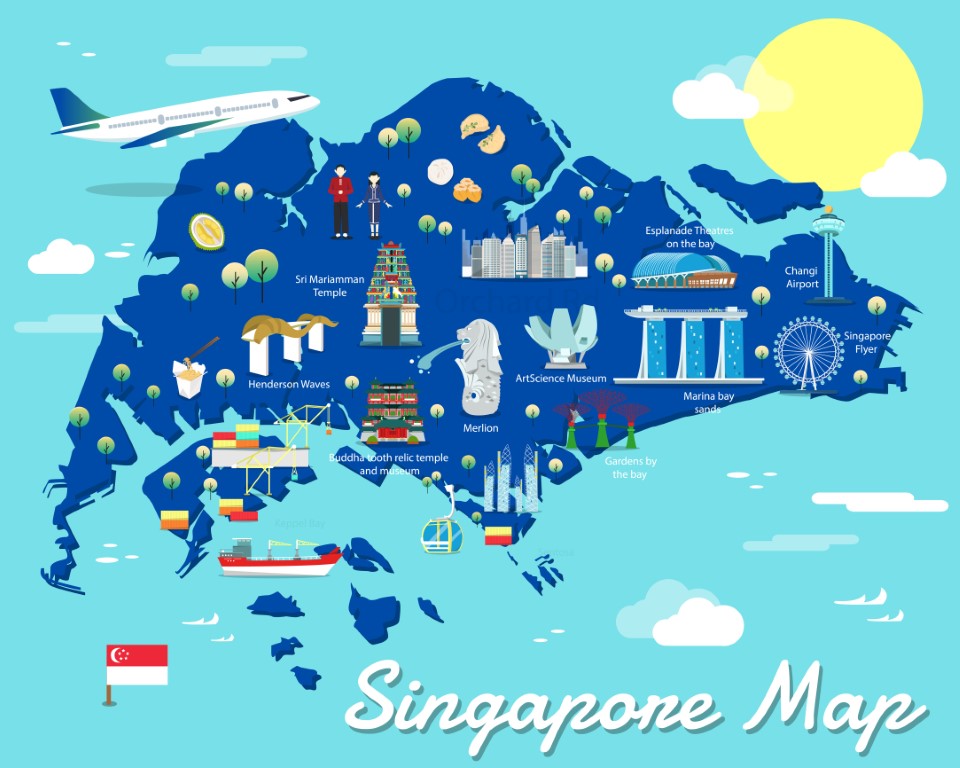
Singapore is an island country located in the Southeast section of Asia. The official name of the country is the Republic of Singapore. The country is an archipelago composed of 63 islands and one external islet.
| Category | Key Information |
|---|---|
| Official Name | Republic of Singapore |
| Area | ~728.6 km² |
| Population | ~5.9 million inhabitants |
| Capital | Singapore (city-state) |
| Official Languages | English, Mandarin, Malay, Tamil |
| Bordering Countries | Maritime borders – near Malaysia and Indonesia |
| Coastline | Bordered by the South China Sea |
| Climate | Equatorial: hot, humid, no real seasons |
| Relief | Mostly flat with some hills |
| Time Zone | UTC+8 |
| Currency | Singapore Dollar (SGD) |
The population of Singapore is estimated at about 5.87 million inhabitants in July 2025, spread over a territory of 728 km². This makes it one of the most densely populated countries in the world, with an average density of about 8,000 to 8,400 inhabitants per km². This level of urban concentration reflects the uniqueness of this city-state, where every square meter counts in an ultra-optimized urban space.
The capital and largest urban area of Singapore is Singapore, and the official language of the country is English with additional languages being Malay, Chinese, and Tamil. The country’s telephone code is 65, that is 0065 or +65.
Which countries border it?
According to geographic data, the country is located at the corner of Malaysia and the Strait of Malacca. Singapore also borders China to the east.

Population of Singapore
Currently, the population of Singapore stands at 5,875,647 inhabitants according to the latest United Nations data.
This population represents 0.08% of the global population. Furthermore, the population density of 21,646 inhabitants ranks Singapore as the 114th most populated country in the world. The entirety, that is 100%, of Singapore’s population is urban, and the average age in the country is 42.2 years.
What are the country’s colors?
The Singaporean flag is a flag composed of two colors: red and white. They are arranged in bands of equal size stacked one on top of the other. On the top red band is printed a crescent moon with five five-pointed stars to its right.

- The color red is synonymous with friendship and the fairness of the people.
- The color white represents the brightness and the value of the soul.
- The crescent moon indicates that the country is still young and the stars indicate that Singapore is faithful to moral values, peace, and justice.
What are the best cities to visit in Singapore ?
Singapore
When you visit the capital, you will see that it is a city of many colors. The first place to visit is Marina Bay Sands, which is a luxury hotel. You can also visit the botanical gardens Gardens by the Bay, which are famous for their gigantic trees.
The Garden City, that’s what Singapore is nicknamed because several gardens are scattered all over the city, about 400m from every residence. The city of Singapore is far from being just a cradle of skyscrapers; it is also a mix of old architecture, museums, and modernized buildings.
Among the green landscapes, there is the Singapore Botanic Garden which has more than 10,000 floral species, and there is also the Singapore Botanic Garden which is a garden that is part of the UNESCO World Heritage.
You can also visit Clarke Quay, which is a place outside the business district. There, you can see the fountains and old warehouses. The district is also very lively in the evening with several nightclubs, restaurants, and bars.
Finally, you can take a cruise along the bay. Also visit the Temple of the Tooth Relic, which is a monument dedicated to Buddha.
It is an old four-story building that houses several relics. Finally, there are other places to visit such as the Thian Hock Keng Temple, the Chinatown district, the Sri Mariamman Temple, and the Muslim quarter.
Jurong
The city of Jurong is known for being an interesting place and a cradle of various tourist attractions. You can see nature reserves, shopping centers, as well as botanical gardens and museums. First, visit the Westgate shopping center, which is a shopping mall and one of the tallest in the world (7 floors).
You can find everything you like there. There are even restaurants that will serve you the best dishes. Secondly, there is the Japanese garden located on Jurong Island, which is a beautiful place adorned with stones, bridges, and architectural arches.
You can also visit the science center, which is perfect for pseudo or amateur scientists. It is a branch of the national museum of the country, which is full of instruments, artifacts, and books.
There is also the Singapore Botanic Garden that you can explore in Jurong East, which is part of the country’s historic gardens.
Moreover, it is part of the UNESCO national heritage. Finally, there are other attractions not to be missed such as the torture museum, the bird park, and the Lee Kong Chian natural history museum.
Paya Lebar
Located in the eastern section of Singapore, the city of Paya Lebar has several attractions and offers visitors many things to do. First, the city is dedicated to fine alcohol enthusiasts.
For your tastings, go to Papa Shop and taste local beers as well as local wines. The city is also very lively at night and you can go to Tiong Bahru to visit the very old food store.
Also visit other places such as Coq and Balls and Lin Rooftop Bar. If you are picnic lovers, you can visit the Punggol botanical garden which is a place with a lake in the center. You can stay there or spend an evening camping.

Where the cities are located on the Singapore map ?
Singapore
On the country map, the city of Singapore is located in the southern section of Pulau Ujong island, the largest island of the country. Geographic coordinates: 1° 17′ North, 103° 51′ East.
Jurong
On the country map, the city of Jurong is located in the south-western section of the country on an artificial island of the same name. Geographic coordinates: 1° 16′ 00″ North, 103° 41′ 45″ East.
Paya Lebar
On the Singapore map, the city of Paya Lebar is located in the center of the largest island of the city, in the eastern half. Geographic coordinates: 01°21′37″North 103°54′34″East.
Singapore climate map
The country’s proximity to the equator turns Singapore’s territory into a cyclone-prone area and a place conducive to showers. The climate in the country is therefore designated as equatorial. It is a climate characterized by ambient humidity throughout the year. The entire territory displays more or less the same climate.
This climate is strongly influenced by two monsoons, the first coming from the northeast and the second from the southwest. Temperatures in Singapore are similar throughout the year, with variations somewhat observable between 23°C and 30°C.
During heatwaves, the maximum temperature is 32°C. Night temperatures are cooler, around 20°C, and on sunny days, temperatures rise gradually with the sunlight. The hottest periods are also the most humid.
Indeed, the average relative humidity observed is 70%. In coastal areas, the heat is mitigated by the sea breeze, while inland, the climate is strongly influenced by the northeast monsoon.
Currently, estimates and weather station data indicate that annual precipitation ranges between 2400mm and 2800mm across the entire territory. Indeed, rains are more frequent at the end and beginning of the year, namely November, December, and January.
Precipitation generally occurs in the afternoon when the sunshine weakens and clouds take over the blue sky. Sunshine hours in Singapore range between 5 to 6 hours daily, and the end and beginning of the year are the least sunny periods.
Singapore economic map
Singapore is a developed country with an economy based on the market and free trade (market economy). According to received data, the country’s economy is marked by the third lowest corruption rate in the world. The country’s taxes have the lowest rates in the world. In fact, they represent 14.2% of GDP.

In terms of economic indicators, Singapore’s Gross Domestic Product per capita is the third highest in the world according to purchasing power parity. The tertiary sector is mainly dominated by state-owned companies such as Temasek Holdings, Singapore Airlines, SingTel, ST Engineering, and Mediacorp.
Exports that Singapore conducts with its neighbors are dominated by electronics and chemical products. Conversely, the primary sector is dominated by agro-technological parks for the production of raw materials for the agri-food industry.
Here are some essential data concerning Singapore’s economy.
- Official currency: Singapore Dollar
- GDP at nominal parity: 337.451 billion USD
- GDP at purchasing power parity: 551.628 billion USD
- Inflation rate: -0.2%
- Unemployment rate (as % of active population): 2.5%
- Gross National Income: 69.45 billion USD
Administrative and demolinguistic data
Administrative subdivisions
Singapore is divided into 5 regions, which are:
- The Central Region
- The Eastern Region
- The Northern Region
- The North-Eastern Region
- The Western Region
Each region is called a CDC or Community Development Council. After this subdivision, there are electoral branches (constituencies) and municipalities or municipal councils.
Demolinguistic data
The Singaporeans living on the country’s archipelago are mainly composed of Chinese, Malays, and Indians, accounting for 76.8%, 13.9%, and 7.9% respectively. The rest of the population is not yet defined. The indigenous people of the country are the Malays, while the Chinese are immigrants who fled southern China to seek refuge in the country.
The languages used in the country are very diverse as none is truly dominant. As a result, the official languages are Mandarin, Malay, Tamil, and English, but English is the official language. Indeed, the speakers are divided as follows:
- Min Nan speakers: 34.5%
- Mandarin Chinese speakers: 24.8%
- Malay and Cantonese speakers: 7.6%
- Minority speakers represent the rest of the country (Tamil, Indonesian, Javanese, Bengali, English)
FAQ-Singapore map: Geographical and demographic information
Singapore is both a city, a country, and a sovereign state. It is what is called a city-state, independent since 1965, and one of the smallest countries in the world by area.
The climate being equatorial and humid all year round, the months from February to April are generally drier and more pleasant for outdoor activities.
For many countries (including France, Belgium, or Canada), no visa is required for a tourist stay of less than 90 days. A valid passport is however mandatory.
