
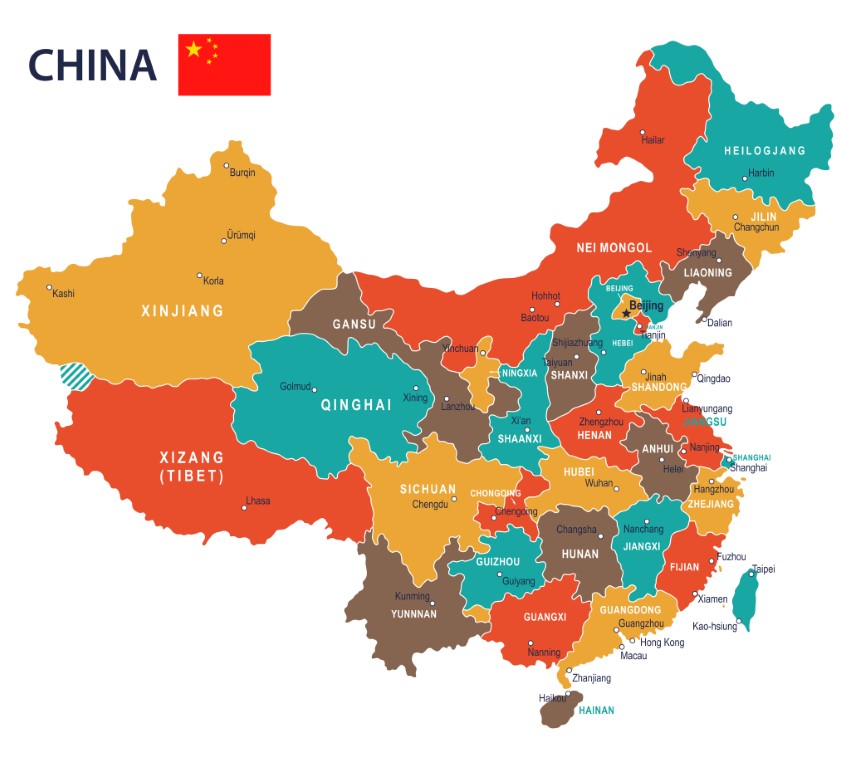
What you need to know about China ?
China is a country located in East Asia. Officially known as the People’s Republic of China, it is the fourth-largest country in the world by land area, covering approximately 9.6 million km². Its population is estimated at about 1.408 billion people in 2025, making it the second-most populous country in the world, after India.
This corresponds to a population density of approximately 147 inhabitants per km². With an area of about 9.6 million km², China is generally recognized as the fourth-largest country in the world. Its administrative divisions include 23 provinces (including Taiwan, which is claimed by the People’s Republic of China), 5 autonomous regions, 4 municipalities directly administered by the central government (Beijing, Shanghai, Tianjin, and Chongqing), and 2 Special Administrative Regions, Hong Kong and Macao.
The country’s capital is Beijing, while Shanghai is its largest city by population and its leading financial center. The international dialing codes are +86 for mainland China, +852 for Hong Kong, and +853 for Macao.
Which countries border it?

The neighboring countries of China are:
- The Democratic People’s Republic of North Korea
- Russia
- Mongolia
- Kazakhstan
- Kyrgyzstan
- Tajikistan
- Afghanistan
- Pakistan
- India
- Nepal
- Bhutan
- Myanmar
- Laos
- Vietnam
Its neighbors across the sea are
- The Republic of Korea
- Japan
- The Philippines
- Brunei
- Malaysia
- Indonesia
Population of China
China’s population is experiencing significant demographic aging, largely due to decades of low fertility following the implementation of the one-child policy between 1980 and 2015. In 2025, China’s population is estimated at about 1.408 billion people. After being the world’s most populous country for several decades, China is now the second-most populous country, behind India.
About 91% of the population belongs to the Han ethnic group, while the country’s 55 officially recognized ethnic minorities account for roughly 9% of the population. China is now experiencing negative population growth, with an annual growth rate of around -0.1%. The birth rate is approximately 6 births per 1,000 inhabitants, while the death rate is about 8 deaths per 1,000 inhabitants. Life expectancy at birth is estimated at around 78.6 years. The sex ratio remains slightly imbalanced, at about 104 males for every 100 females, although the gap has been gradually narrowing.
What are the colors of the country?

Adopted in 1949, the Chinese flag is one of the oldest in Asia. Indeed, it appears as follows:
A red background on which five stars are arranged. The largest star is bordered by the four smaller ones. The red signifies a united Chinese people or, according to some sources, represents the communist aspect of the country. The stars, on the other hand, represent the communist party.
What are the best cities to visit in China
Beijing
Capital and second most populous urban area in China, the city of Beijing is also a tourist destination. It is a unique city because of its fidelity to culture and as the Chinese economic center. Beijing became famous because of its imperial palace (Forbidden City). There is also, in the city center, the Temple of Heaven, Tian’anmen Square, and the public square. You can also visit the Beijing Observatory, still operational today.
What also makes Beijing unique is its national stadium, also called the “Bird’s Nest.” Beijing is also the place where many festivities and cultural and sporting events take place. It is also the starting point for exploring the Great Wall of China.
Hong Kong
Hong Kong is an impressive city and the busiest in China. It is the only city that combines ancient Chinese culture and the new. It is a modernized city with in the city center: banks, luxury hotels, and high-tech shops. There are also many restaurants that will allow you to taste the country’s specialties.
Tourists can board the Star Ferry for a tour on the city’s inland waters. You can also use the cable car to go up to Victoria Peak, from which you will have a panoramic view of all Hong Kong.
Shanghai
Shanghai is the largest urban area in the country and the most active city. Indeed, you will see several attractions such as popular museums and galleries. They are thus popular among tourists from around the world. Among these museums is the Shanghai China Art Museum. Shanghai also has several nature reserves, temples, and pagodas reflecting Chinese culture.
If you pass through the city, don’t forget to stroll along the Huangpujiang Riverbank, which will allow you to discover the famous European architectures. There is also the Garden of Happiness, surrounded by several buildings dating from World War II.
Finally, it is the only city in the world with a TV and radio tower reaching 468m. Moreover, there is the most famous science museum in the world called the Shanghai Science and Technology Museum.
Where are the cities located on the China map ?
Beijing
On the map of China, the capital is located in the Northeast section, alongside Hebei province and the municipality of Tianjin. Geographic coordinates: 39° 54′ 13″ north, 116° 23′ 15″ east.
Hong Kong
On the map of China, the city of Hong Kong is located right in the center of the continent. Geographic coordinates: 22° 17′ north, 114° 10′ east
Shanghai
On the map of China, the city of Shanghai is located in the eastern section of the country. Geographic coordinates: 31° 13′ 56″ north, 121° 28′ 09″ east
Climate map of China
The climate of China is very diverse due to its vast territory. Indeed, the regions each have a specific climate as we will see.
The northern section of the country: this area experiences very low temperatures dropping below 0°C during winter. This season is strongly influenced by cold waves coming from Siberia. On the other hand, summer is quite warm and influenced by southern winds bringing temperatures to exceed 30°C.

The Southern section of China: Cities located in this part of the country experience the monsoon in summer which brings significant afternoon rainfall but also heat waves. Rainfall during the summer months ranges between 233 and 276 mm.
The South section is also heavily influenced by the monsoon during summer and typhoons between May and December. Typhoons are winds that can reach up to 200 km/h; they can bring heavy rains and violent storms. Temperatures in the capital in summer hover around 40°C with nighttime temperatures around 20°C. This season generally occurs between July and August.
Western section: this part of the country is known for having very hot temperatures in summer and very harsh winters. In the middle of winter, temperatures hover around -11°C and between 30 and 35°C in summer. As altitude increases, especially in the Tibetan mountains, summer is rainy and winter is colder.
Economic map of China
China operates a socialist market economy, a system in which the state maintains a dominant role in strategic sectors while allowing significant room for private enterprise and foreign investment. Large state-owned enterprises continue to dominate industries such as energy, transportation, telecommunications, finance, and heavy manufacturing, while the private sector has become a key driver of economic growth, innovation, and employment.
China is the world’s second-largest economy by nominal GDP and the largest by purchasing power parity (PPP). State-owned enterprises continue to account for a substantial share of industrial assets and strategic industries, while private companies now generate more than 60% of GDP, over 70% of technological innovation, around 80% of urban employment, and more than 90% of new businesses. Following the slowdown caused by the COVID-19 pandemic, China’s economy has continued to shift toward higher value-added industries, particularly in high technology, artificial intelligence, electric vehicles, and renewable energy.

International trade, services, and foreign investment play a central role in China’s economy. China remains the world’s largest exporter of goods and one of the leading importers of goods and services. Its foreign trade amounts to several trillion U.S. dollars each year, making the country one of the world’s leading trading nations. Economic openness, foreign investment, and the global expansion of Chinese companies have been major drivers of the country’s development over the past decades.
With a nominal GDP exceeding US$19 trillion in 2025, China is the world’s second-largest economy, behind the United States. In terms of purchasing power parity (PPP), China already ranks as the largest economy in the world. Although its economic growth has slowed compared with previous decades, China remains one of the main engines of the global economy thanks to its manufacturing sector, exports, domestic market, and rapid development in high-technology industries. Below are some of China’s key economic indicators.
- Official currency: Renminbi Yuan (CN ¥)
- Nominal GDP: approximately US$19.5 trillion
- GDP (Purchasing Power Parity – PPP): approximately US$40.7 trillion
- GDP ranking: 2nd in the world by nominal GDP and 1st in the world by purchasing power parity (PPP)
- Annual GDP growth: approximately 4.8% (2025 estimate)
- GDP per capita (nominal): approximately US$13,800
- Annual inflation rate: approximately 0.2% (low inflation in 2025)
- Merchandise exports: approximately US$3.6 trillion per year, making China the world’s largest exporter of goods.
Administrative and demolinguistic data
Administrative subdivisions
China has administrative divisions arranged at three levels. The first being the province, the second: the county, and the last: the township. China is primarily divided into provinces, subsequently into autonomous regions, and finally into municipalities. These three levels are directly governed by the government, and the last level is divided into ethnic townships and villages.
Here is the list of provinces of China (34)
- Beijing Municipality
- Tianjin Municipality
- Shanghai Municipality
- Chongqing Municipality
- Inner Mongolia Autonomous Region
- Guangxi Autonomous Region
- Tibet Autonomous Region
- Ningxia Autonomous Region
- Xinjiang Autonomous Region
- Hong Kong Special Administrative Region
- Macao Special Administrative Region
- Anhui
- Fujian
- Gansu
- Guangdong
- Guizhou
- Hainan
- Hebei
- Heilongjiang
- Henan
- Hubei
- Hunan
- Jiangsu
- Jiangxi
- Jilin
- Liaoning
- Qinghai
- Shaanxi
- Shandong
- Shanxi
- Taiwan
- Sichuan
- Yunnan
- Zhejiang
Demolinguistic Data
The ethnic majority in China is the Han, who are a people native to Chinese territory since always. They are of two types and two different speech forms as follows:
- The Han who speak Mandarin Chinese (Putonghua) represent 67% of the country’s population.
- The Han who speak dialectal varieties and represent 27% of the population. Here are the dialects:
- Wu
- Cantonese
- Min
- Xiang
- Hakka
- Gan
There are also non-Han speakers, that is to say, those who do not speak Chinese and who represent 8% of the country’s population. However, there are also the Hui and the Jing who are ethnic minorities but Sinophone, that is to say, Chinese-speaking.
FAQ – China map: Practical information and country overview
China is located in East Asia and is one of the largest countries in the world. It shares borders with fourteen countries, giving it the highest number of land neighbors of any nation.
The capital of China is Beijing, which serves as the country’s political center. The city also plays a major role in culture, the economy, education, and diplomacy.
A map of China helps locate the country’s major cities, provinces, rivers, mountain ranges, and borders. It also provides a better understanding of China’s geographical diversity and the vast size of its territory.
