
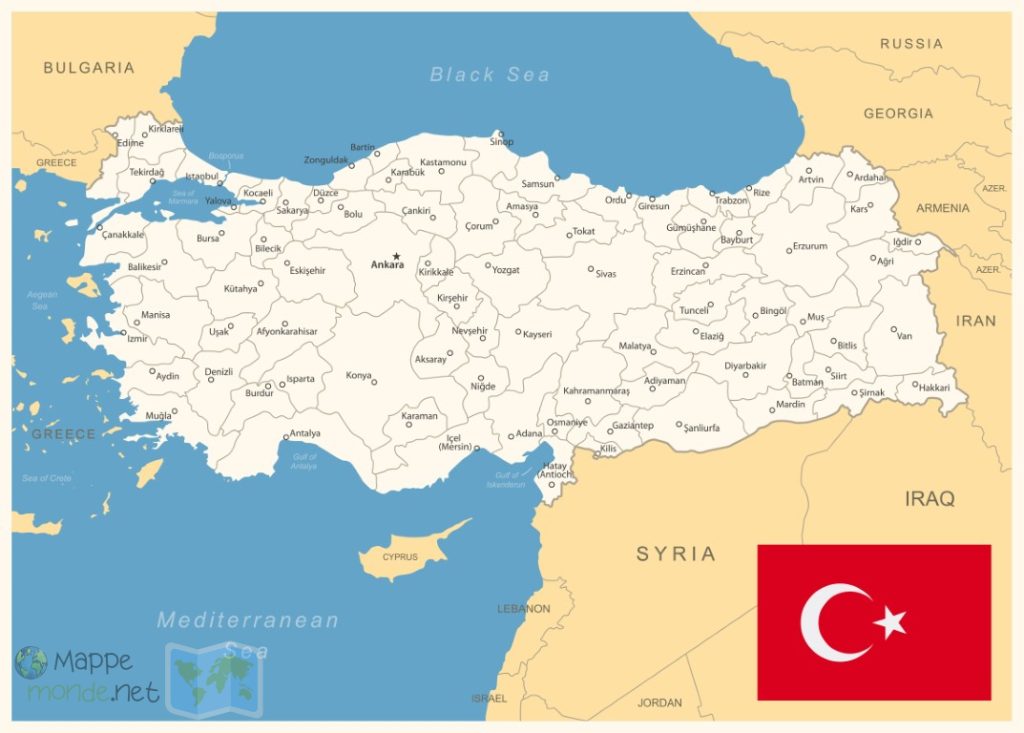
Turkey is a country straddling the Asian and European continents. The country is officially called the Republic of Turkey or Türkiye due to its semi-presidential administration.
The Turkish territory is partly located in Europe, with 3% of its lands in Eastern Thrace, the rest being situated between Asia and the Balkans.
The capital of Turkey is Ankara, but its largest urban area is Istanbul, which is actually more famous than the capital. The territory covers 783,562 km² in terms of area and is inhabited by 83,154,997 people. The telephone code in Turkey is 90, that is 0090 or +90.
Which countries border Turkey?
The countries bordering Turkey are Greece, Bulgaria, Georgia, Armenia, Azerbaijan, Iran, and Iraq as well as Syria. It is a country that has coasts on the Black Sea, the Aegean Sea, and the Mediterranean Sea respectively to the north, west, and southwest.
Population of Turkey
| Category | Key Information |
|---|---|
| Official Name | Republic of Turkey |
| Area | ~783,562 km² |
| Population | ~85 million inhabitants |
| Capital | Ankara |
| Most populated city | Istanbul |
| Official language | Turkish |
| Main regions | Anatolia (Asia), Eastern Thrace (Europe) |
| Bordering countries | Greece, Bulgaria, Georgia, Armenia, Iran, Iraq, Syria |
| Coastline | Bordered by the Aegean Sea, the Black Sea, and the Mediterranean |
| Climate | Mediterranean, continental, and oceanic depending on the region |
| Relief | Mountainous, high plateaus, river valleys |
| Time zone | UTC+3 (Istanbul time, no seasonal time change) |
| Currency | Turkish Lira (TRY) |
Currently, the population of Turkey is 84,834,756 according to the latest UN data. Indeed, this number represents about 1.08% of the global population. Moreover, Turkey holds the 17th place on the list of the most populous countries in the world due to its territory size of 769,630 km².
The population density of Turkey is therefore 284 inhabitants per km². Finally, most of the Turkish population, about 75.6%, live in large urban cities, totaling 63,803,445 inhabitants. The average age in the country is 31.5 years, which means the population is young.
What are the colors of the country?
The flag of Turkey is a rectangular flag with a red background on which a star and a crescent moon are both drawn in white. The red color represents blood, that is, the blood of the martyrs who gave their lives to save the people.
The stars and the crescent moon then represent the reflection that the moon and the sun would have on the blood. According to some beliefs, the crescent moon would represent Islam and the star would represent the freedom of the people.
What are the best cities to visit in Turkey ?

Istanbul
Received data states that Istanbul ranks among the top 10 most visited cities in the world. Moreover, it is the largest urban area in the country that attracts many tourists thanks to unique places as attractions. Among these, we have Sultanahmet which is a historic square.
There are also ancient buildings such as the Blue Mosque, the Topkapi Palace, as well as Hagia Sophia.
Most tourists come to Turkey to visit Istanbul. Above all, because it is a festive place that promotes Turkish culture as well as walks and periodic ceremonies. It is known that most interesting places are located in Europe but do not forget Kadikoy which is located in Asia.
Fethiye
It is the city with the oldest population in the country. The reason is that elderly retirees have settled there. Fethiye is not a large urban area but it is still the gateway to the Turkish Riviera. You can visit or even stay at Ece Marina which is a luxury lodging hosting yachts of wealthy people from all over the world.
Regarding historical monuments, you can visit the tomb of Amyntas located right in the city center as well as Paspature which is a crossroads of cobbled alleys and various original shops.
The atmosphere of the Riviera attracts many people thanks to its urban style as well as natural reserves such as the Blue Lagoon, the Butterfly Valley, and the Saklikent plateau. Beach lovers can enjoy Calis which is a thermal resort.
Finally, do not forget the ghost town of Kayakoy which is ideal for an afternoon visit.
Izmir
The third most populous city in the country, the city of Izmir only became popular very recently. Now, people go there in masses as many as they come to Istanbul. The reason for this is that people are looking for a new place with a festive atmosphere and the city of Izmir meets this criterion.
If you are lovers of culture and ancient history, visit the clock tower and enjoy good times with family or friends at the Asansor restaurant. The city of Izmir is a very famous commercial city known for the festivities that generally take place there.
Enjoy the country’s specialties as well as seafood carefully served in the most famous restaurants. You can also enjoy relaxing moments in Alacati, a thermal water source and a place where you can learn windsurfing.
Ankara
Ankara is the capital of Turkey while Istanbul has always made people think otherwise. Most visitors who prefer to find a mix of cultures and monuments will surely enjoy it. It is also a festive city and a commercial city that is continuously lively.
The oldest monument in the city of Ankara is Anitkabir, which is the mausoleum of Mustafa Kemal. The city also boasts several attractions such as art galleries, the green park, as well as the hall of honors.
Do not forget to visit Ankara Castle, which is a building highly appreciated by tourists and also offers a breathtaking view of the entire city.
Where are the cities located on the map of Turkey ?

Istanbul
The capital of Turkey is located at the center of the Bosphorus Strait, that is to say straddling the Asian and European continents. Geographic coordinates: 41° 00′ 44″ north, 28° 58′ 34″ east
Fethiye
On the map of Turkey, the city of Fethiye is located in the southwestern section of the country, just a few kilometers from Ölüdeniz. Geographic coordinates: 36° 39′ 05″ north, 29° 07′ 23″ east.
Izmir
On the map of Turkey, the city of Izmir is situated along the Aegean Sea coast in the southwestern part of the country. Geographic coordinates: 38° 26′ 00″ north, 27° 09′ 00″ east.
Ankara
On the map of Turkey, the city of Ankara, the capital, is located in central Anatolia, that is to say in the center of the country. Geographic coordinates: 39° 55′ 38″ north, 32° 51′ 52″ east.
Climate map of Turkey
The climate in Turkey varies according to the regions but also depending on the exposure of each section of the territory. Indeed, the coastline displays a mild and humid climate influenced by the marine breeze of the Mediterranean.
On the other hand, the inland areas experience cold winter and frequent snowfalls. However, summer is quite hot with sunny and dry days but nighttime temperatures are bearable.
In the rest of the Turkish territory, that is in the south-central regions and other sections, the seasons are drier especially between July and September.
Istanbul
Cold winds coming from Russia or the Balkans region influence Istanbul’s temperatures and cause them to drop. On average, winter temperatures hover around 6.5°C and sometimes there is snow during the harshest periods which last about 15 days.
Summer, on the other hand, is quite warm with temperatures around 24.5°C; it is also the rainy season. To the west of the coast, winter is less harsh but it is in this area that more precipitation occurs.
Ankara
The topography of the capital does not present many elevations, which is why the climate is homogeneous. Indeed, winter in Ankara is marked by significant snowfall with an average temperature of 0°C.
It is also during this season that cold winds from Russia unexpectedly drop temperatures down to -20°C.
Summer, on the other hand, is hot and the relative humidity is very low, with temperatures around 38 to 40°C. It is also the season most prone to precipitation, which amounts to 360 mm of annual rainfall.
Economic map of Turkey
The International Monetary Funds classify Turkey as an emerging country. That is to say, the country is now newly developed or NPI. The main reason for this is its GDP which has undergone several stages of natural growth.
Thus, Turkey’s nominal GDP is currently in 20th position on the list of countries and in 13th position in terms of purchasing power parity. Turkey trades with many of its neighbors and its main activities and imports are agricultural products, vehicles, textiles, and construction materials.
Here are some important data:
- Official currency: Turkish Lira
- GDP in nominal parity 649 billion USD
- GDP in purchasing power parity: 2.4 trillion USD.
- Annual GDP growth rate: 2.8%
- GDP per capita in nominal parity: 7,715 USD
- GDP per capita in purchasing power parity: 28,294 USD
- Annual inflation rate (CPI): 14%
- Population below poverty line 14.4%
- Unemployment rate: 12.7% of the active population
Administrative and demolinguistic data

Administrative subdivisions
Currently, Turkey is administratively divided into 81 provinces. These sectors are then subdivided into districts which number 973. Geographically and economically, the country is divided into regions then into subregions which are respectively 7 and 21 in number.
Here are the provinces of the country:
- Ankara
- Kırklareli
- Edirne
- Tekirdağ
- Çanakkale
- Balıkesir
- Bursa
- Yalova
- Istanbul
- Kocaeli
- Sakarya
- Düzce
- Zonguldak
- Bolu
- Bilecik
- Eskişehir
- Kütahya
- Manisa
- İzmir
- Aydın
- Muğla
- Denizli
- Burdur
- Uşak
- Afyonkarahisar
- Isparta
- Antalya
- Konya
- Mersin
- Karaman
- Aksaray
- Kırşehir
- Kırıkkale
- Çankırı
- Karabük
- Bartın
- Kastamonu
- Sinop
- Çorum
- Yozgat
- Nevşehir
- Niğde
- Adana
- Hatay
- Osmaniye
- Maraş
- Kayseri
- Sivas
- Tokat
- Amasya
- Samsun
- Ordu
- Giresun
- Erzincan
- Malatya
- Gaziantep
- Kilis
- Şanlıurfa
- Adıyaman
- Gümüşhane
- Trabzon
- Rize
- Bayburt
- Erzurum
- Artvin
- Ardahan
- Kars
- Ağrı
- Iğdır
- Tunceli
- Elâzığ
- Diyarbakır
- Mardin
- Batman
- Siirt
- Şırnak
- Bitlis
- Bingöl
- Muş
- Van
- Hakkâri
Demolinguistic data
The official language used in Administration and schooling is Turkish. It is also the language used by the majority of speakers. However, other languages are spoken by minority speakers, for example Ottoman Turkish which is a Western variation, but also foreign languages notably French and English.
Turkey is located at the junction of Europe and Asia, bordered by eight countries and framed by three seas: the Black Sea to the north, the Aegean Sea to the west, and the Mediterranean Sea to the south.
Turkey shares its borders with Greece and Bulgaria to the west, Georgia to the northeast, Armenia, Azerbaijan (Nakhichevan exclave), and Iran to the east, and Iraq and Syria to the south.
Although Turkey is situated across two continents, the majority of its territory is in Asia, with a small part in Europe.
