
What you need to know about Yemen ?
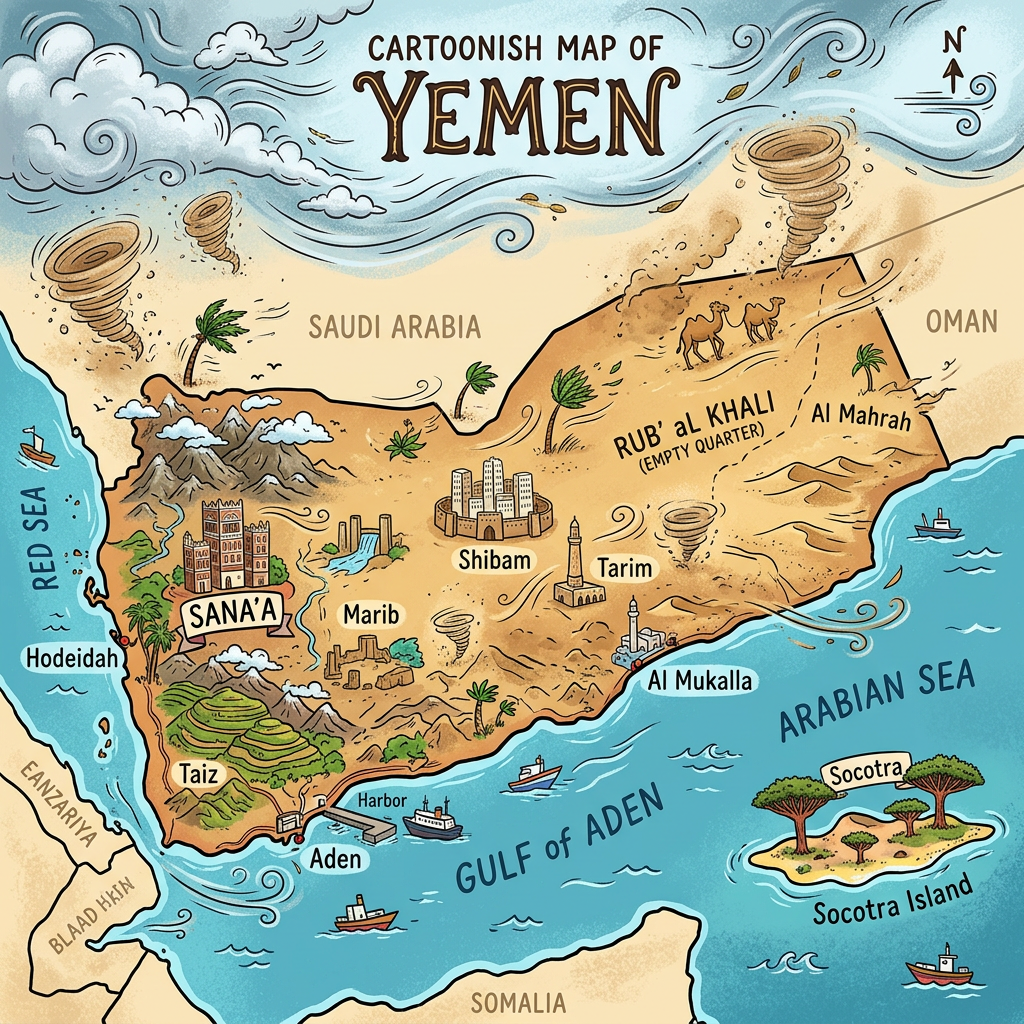
Yemen is a country located at the southwestern tip of the Arabian Peninsula. Officially called the Republic of Yemen, it is currently undergoing a complex political situation: the de jure capital is Sanaa, while the de facto capital is Aden.
- The area of the country is 527,968 km², making it the 49th largest country in the world.
- The population is estimated at about 34.5 million inhabitants in 2025, ranking Yemen 42nd worldwide.
- The average density is about 65 inhabitants per km².
The official currency is the Yemeni Rial and the international dialing code is +967 (00967).
Table – Yemen: Geographical and demographic information
| Item | Key Information |
|---|---|
| Total area | 527,968 km² |
| Capital | Sanaa (official) – Aden (provisional capital) |
| Neighboring countries | Saudi Arabia, Oman |
| Coastline | ~2,000 km on the Red Sea, Gulf of Aden, and Indian Ocean |
| Estimated population | ~34 million inhabitants (2025) |
| Population density | ~64 inhabitants/km² |
| Relief | Mountains in the northwest, plateaus, deserts, and coastal plains |
| Climate | Arid and semi-arid, milder at altitude |
| Official language | Arabic |
| Economic resources | Oil, gas, traditional agriculture |
| Special feature | Strategic control of the Bab-el-Mandeb strait |
Additional points on the map of Yemen

- Yemen is located at the southern tip of the Arabian Peninsula.
- It has a long coastline on the Red Sea and the Gulf of Aden.
- The country shares its land borders with Saudi Arabia to the north and Oman to the east.
- Its physical map highlights fertile mountainous areas contrasting with arid deserts.
- Yemen occupies a key geostrategic position thanks to the Bab-el-Mandeb strait, a major maritime passage.
Which countries border Yemen?
The map of Yemen shows a country located at the southern end of the Arabian Peninsula, bordered by Saudi Arabia to the north and by Oman to the east. Its coastline stretches along the Red Sea and the Gulf of Aden, making Yemen a strategic territory for global maritime trade.

Population of Yemen
The population of Yemen is estimated at around 34.5 million inhabitants in 2025. The country is experiencing strong demographic growth with an annual growth rate of about 2.1%.
- Fertility rate: ~3.5 children per woman
- Birth rate: ~28 ‰
- Mortality rate: ~6 ‰
- Life expectancy at birth: ~63 years (61 years for men, 65 years for women)
- Median age: ~19.8 years → very young population
- Sex ratio: ~102 men per 100 women (105% under 14 years, 103% between 15 and 24 years, 105% between 25 and 54 years, 84% over 65 years)
- Net migration rate: negative (~–0.1%), due to conflicts and instability.
Ethnic and cultural composition
The population is mainly composed of:
- Arabs (majority),
- Afro-Arabs (notably in coastal regions),
- minorities of South Asians (India, Pakistan) and Europeans.
The dominant religion is Islam (Sunni and Shia, mainly Zaidis).
What are the colors of the country?
The flag of the Republic of Yemen is a rectangular flag with three colors arranged in horizontal bands of equal size: red, white, and black from top to bottom.
- Red symbolizes the blood shed by the people during the struggle for sovereignty
- The white color symbolizes the country’s prosperous future
- The black color symbolizes the old hardships the country has faced.
The best places to visit in Yemen
Taiz
Taiz is the third largest city in Yemen, renowned for its history and heritage. Former capital of the country under the Rasoulid dynasty (13th century), it preserves architectural traces from several dynasties.
Must-see:
- the Al-Qahira Castle,
- the Shajarat Al-Ghareeb Fort,
- the Mudhaffar Mosque.
Near Taiz is the port of Mocha, once famous for its coffee exported worldwide.
Dhamar
Located south of Sanaa, between two mountain ranges (peaking at over 2,400 m), Dhamar is a historic and cultural city.
Points of interest:
- the municipal library, which preserves ancient manuscripts,
- the historical sites of Dawran ad Daydah, Dubah, Ma’bar, and Al-Mayfa’ah,
- its mountain atmosphere that attracts travelers curious about history and nature.
Sanaa
The historical and political capital of Yemen, Sanaa, is one of the oldest inhabited cities in the world, listed as a UNESCO World Heritage Site.
To discover:
- its old city with its brick houses decorated with geometric patterns,
- its numerous historic mosques,
- its traditional souks (including the Al-Milh souk),
- the nearby port of Hodeida, on the Red Sea, which remains an important commercial gateway.
Aden
Located in the south of the country, Aden is a historic port city built on an ancient volcanic crater. It was long a crossroads of maritime trade between India, Africa, and the Middle East.
To visit:
- the Shamsan volcanic crater,
- the Aden tanks (ancient millennium-old water reservoirs),
- the beaches of Gold Mohur and Elephant Bay.
Al-Mukalla
Capital of Hadramaut, Al-Mukalla is a port city bordered by the Indian Ocean. Less known than Sanaa or Aden, it charms with:
- its picturesque waterfront,
- its traditional Arab architecture,
- its lively markets. It is also a starting point to explore the interior of Hadramaut and its valleys.
Location of main cities on the map of Yemen
Al-Mukalla: southeast of the country, on the Hadramaut coast.
Coordinates: 14° 32′ 00″ N, 49° 08′ 00″ E
Taiz: southwest, inland.
Coordinates: 13° 34′ 44″ N, 44° 01′ 19″ E
Dhamar: west of the country, about 100 km from Sanaa.
Coordinates: 14° 33′ 00″ N, 44° 24′ 06″ E
Sanaa: center-west of the country, slightly shifted to the west.
Coordinates: 15° 21′ 11″ N, 44° 12′ 54″ E
Aden: south of the country, on the coast of the Arabian Sea.
Coordinates: 12° 47′ 00″ N, 45° 02′ 00″ E
Climate map of Yemen
The climate of Yemen varies according to its topography, geography, and territorial situation. In general, the Yemeni territory experiences humid winds coming from the southern coast. These humid winds, combined with cold air masses, can induce significant precipitation. The plateaus located at altitude have a mild and moderately warm climate throughout the year.
Temperatures during the summer periods hover around 30°C during the day, but temperatures are cold at night. The Yemeni territory has several natural areas, and especially after the rainy season, nature becomes more vibrant. Average winter temperatures hover around 20°C during the day. However, nighttime temperatures are quite cold, occasionally approaching 0°C.
The rainy season generally occurs between May and August. During this period, storms are violent but are alternated with maximum sunshine. Temperatures on the coast facing the Red Sea and the Indian Ocean hover around 35°C during the summer, and in winter temperatures are around 25°C. Furthermore, temperatures around the Mareb desert and Wadi Hadramaut are extremely hot. In this region, humidity is very low, which defines a dry and very sunny climate.
Economic map of Yemen
Yemen’s economy is one of the least performing in the world. The IMF therefore classifies the Yemeni state as a poor or less developed country. In the past, the territory was divided between North Yemen and South Yemen; these two territories were less developed and struggling during those times. Currently, the two territories are united, but the repercussions of the Gulf War are still felt in the country to this day.
Between 1990 and 1991, the Saudi state expelled several million Yemeni workers from its territory, and other countries also reduced funding to Yemen. Consequently, to boost its economy, the country sought multilateral aid.
The country’s financial resources are concentrated on oil and gas exploitation. The agricultural sector is equally important because Yemenis are major producers of coffee and khat crops. However, the country’s economy is among those with the lowest incomes in the world. Almost the entire population, about 80%, still lives below the poverty line. Added to this, more than 1,000 refugees from Somalia have increased the country’s unemployment rate to 40% of the active population. Here are some economic indicators of the country:
- Current currency: Yemeni Rial
- Trade organizations the country is a member of: WTO, GAFTA
- GDP at nominal parity: 27.591 billion USD
- GDP at purchasing power parity: 69.439 billion USD
- Annual GDP growth rate: 2.0%
- GDP per capita at nominal parity: 895 USD
- GDP per capita at purchasing power parity: 2,253 USD
- Population below the poverty line: 48.6%
- Unemployment rate as % of active population: 12.8%
Administrative and demolinguistic data

Administrative Subdivisions
The territory of Yemen is mainly subdivided into two levels. The first level is the governorates and the second level is the districts. There are currently 22 governorates including the capital and 333 districts.
The districts are further subdivided into 2,210 sub-districts, which in turn are composed of 38,284 villages.
Here are the governorates of Yemen
- Central Yemeni Arabs represent 36% of the population and speak Taizzi-Adeni Arabic
- Yemeni Arabs of Tihana represent 21.3% of the population and speak Sanaani Arabic
- Northern Yemeni Arabs represent 19.9% of the population and speak Sanaani Arabic
- Southern Yemeni Arabs represent 17% of the population and speak Hadrami Arabic
Minority ethnicities include Somalis who speak Somali, Sudanese Arabs, Jews who speak Hebrew, Omani Arabs who speak Arabic, Socotris who speak Sokotri, and the Mahra who speak Mehri.
FAQ – Yemen map: 3 questions
Yemen is located south of the Arabian Peninsula, between Saudi Arabia, Oman, and the Indian Ocean.
The official capital is Sanaa, but due to the conflict, Aden serves as the provisional capital.
The country has mountains, deserts, coastal plains, and a long strategic coastline on the Red Sea and the Gulf of Aden.
- Aden Governorate
- Amran Governorate
- Abyan Governorate
- Ad Dali’ Governorate
- Al Bayda’ Governorate
- Al-Hodeidah Governorate
- Al Jawf Governorate
- Al Mahra Governorate
- Al Mahwit Governorate
- City of Sanaa
- Dhamar Governorate
- Hadramaut Governorate
- Hajjah Governorate
- Lahij Governorate
- Ibb Governorate
- Ma’rib Governorate
- Raima Governorate
- Sa’dah Governorate
- Sanaa Governorate
- Shabwah Governorate
- Ta’izz Governorate
- Socotra Governorate
Demolinguistic Data
The Yemenis are composed of Arabs and other ethnicities.
Arab Ethnicities:
- Central Yemeni Arabs represent 36% of the population and speak Taizzi-Adeni Arabic
- Yemeni Arabs of Tihana represent 21.3% of the population and speak Sanaani Arabic
- Northern Yemeni Arabs represent 19.9% of the population and speak Sanaani Arabic
- Southern Yemeni Arabs represent 17% of the population and speak Hadrami Arabic
Minority ethnicities include Somalis who speak Somali, Sudanese Arabs, Jews who speak Hebrew, Omani Arabs who speak Arabic, Socotris who speak Sokotri, and the Mahra who speak Mehri.
FAQ – Yemen map: 3 questions
Yemen is located south of the Arabian Peninsula, between Saudi Arabia, Oman, and the Indian Ocean.
The official capital is Sanaa, but due to the conflict, Aden serves as the provisional capital.
The country has mountains, deserts, coastal plains, and a long strategic coastline on the Red Sea and the Gulf of Aden.
