
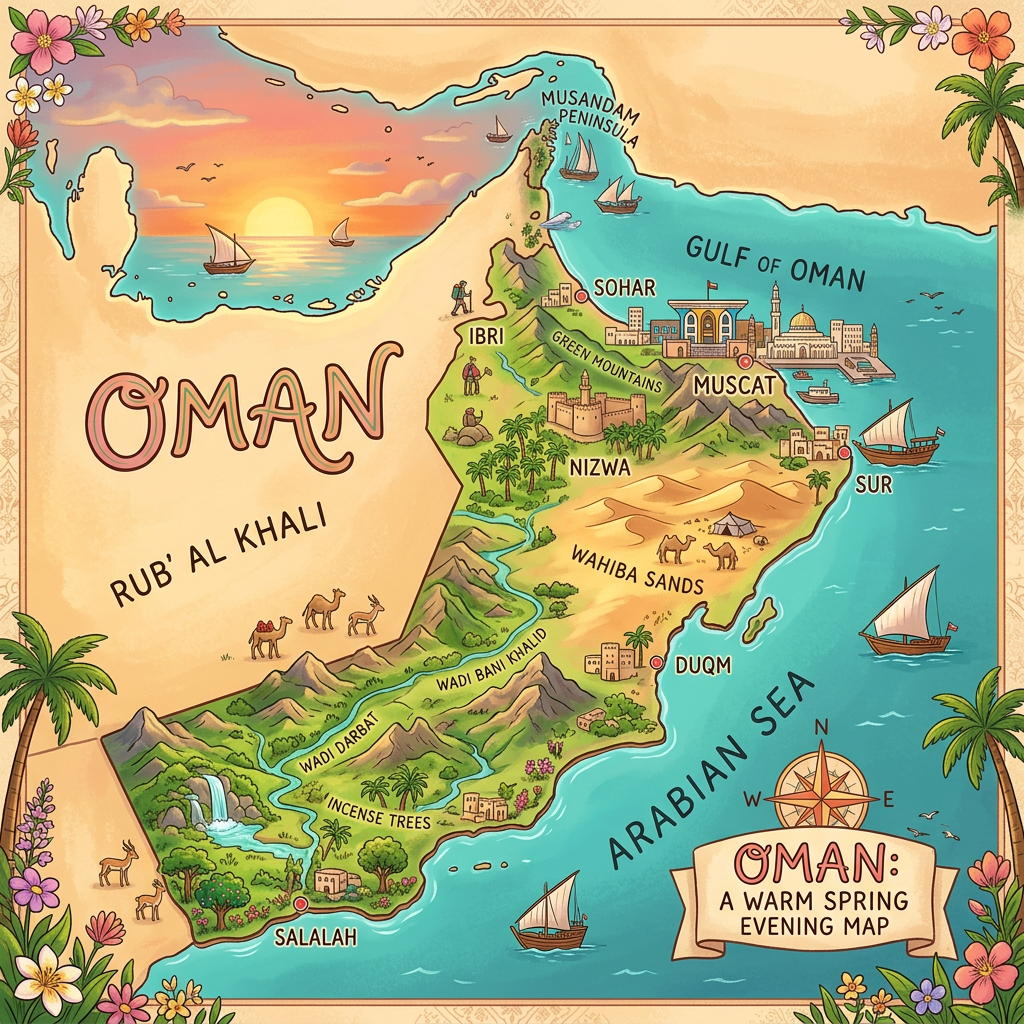
What you need to know about Oman ?
The Sultanate of Oman is an absolute monarchy located at the southeastern tip of the Arabian Peninsula.
- Its area is 309,500 km², making it the 82nd largest country in the world.
- Its population is estimated at about 4.6 million inhabitants in 2025, ranking it 125th worldwide.
- The capital is Muscat, while the largest urban area is Seeb (Sib), integrated into the Muscat metropolitan area.
Arabic is the official language of the country. Oman is a member of several international organizations, including the UN, the WTO, the Arab League, the AIIB, and the FPEG.
The international telephone code is +968.
Table – Oman: Geographic and demographic information
| Element | Key Information |
|---|---|
| Total Area | 309,500 km² |
| Capital | Muscat |
| Neighboring Countries | United Arab Emirates, Saudi Arabia, Yemen |
| Coastline | Arabian Sea and Gulf of Oman (about 2,100 km) |
| Estimated Population | ~5.7 million inhabitants (2025) |
| Population Density | ~18 inhabitants/km² |
| Relief | Mountains (Hajar), deserts (part of the Rub al-Khali), coastal plains |
| Climate | Arid and desert, more humid on the east coast |
| Official Language | Arabic |
| Economic Resources | Oil, gas, fishing, agriculture, tourism |
| Particularity | Country both desert and maritime, open to the Indian Ocean |
Colors of Oman

The Omani flag is a rectangular flag with 3 colors arranged in horizontal stripes: white, red, and green from top to bottom. On the left side, there is a vertical red stripe forming a T with the middle red stripe. At the top of the hoist side, there is a representation of the national emblem.
Best places to visit in Oman

Muscat: The capital is a famous city filled with palaces, museums, and markets ideal for tourist visits. You can also visit the port as well as the Royal Palace Qasr Al Alam. Other tourist attractions in the city include the twin forts of Al Jalali and Al Mirani, recently converted into museums.
Nizwa: It was formerly the capital of the country. You will see an ancient fort dating from the 17th century as well as a huge cylindrical tower called the Nizwa Fort. This fort is also a museum that traces all the stories of the city since the 17th century. Finally, there is an open-air market or goat market.
Wahiba Sands: It is an area located right in the middle of Omani territory. By its name, it is a semi-arid sandy desert area and at the same time a popular destination for tourists. You will see traditional nomads and their way of life. You can ride a camel and camp in the desert to watch the stars. To get to Wahiba Sands, you can choose the city of Ibra as a starting point.
Additional points on the map of Oman
- Oman is located at the southeastern tip of the Arabian Peninsula.
- Its physical map shows the Hajar Mountains in the northeast and the Rub al-Khali desert to the west.
- The country controls the Strait of Hormuz, a strategic global maritime passage.
- Muscat, the capital, is a major port on the Gulf of Oman.
- Oman is distinguished by a more neutral policy than its Gulf neighbors.

Where is Oman located ?
The map of Oman highlights a country located at the southeastern tip of the Arabian Peninsula. It shares its borders with Saudi Arabia and the United Arab Emirates to the northwest, and with Yemen to the southwest. Its vast coastline on the Arabian Sea and the Gulf of Oman makes it a strategic country for maritime trade.

Climate of Oman
The climate of Oman is categorized as desert or dry subtropical. This climate is characterized by low rainfall throughout the year. There are also high temperatures but also temperature differences between the coast and inland areas.
The summer season generally takes place between June and September and temperatures during this season hover around 40°C. The cold season, on the other hand, is mild and temperatures range between 25 and 35°C with nighttime temperatures ranging between 15 and 22°C. The Omani territory is also subject to a hot wind called Shamal which sometimes brings sandstorms.
Administrative division of Oman
The territory of Oman is divided into 11 governorates. They are then divided into wilayas which are equivalent to districts.
Here are the governorates of the country:
- Ad-Dākhilīyah
- Al-Buraimi
- Al-Wusta
- Adh-Dhahira
- Al-Batina North
- Al-Batina South
- Ash-Sharqiya South
- Ash-Sharqiya North
- Muscat
- Musandam Governorate
- Dhofar
Oman’s economy is mainly based on oil and gas extraction and export, which still represent a major part of its public revenues and exports, even though the country is gradually developing sectors such as logistics, tourism, and finance.
- Oil production: ~1 million barrels/day (2024, up from the previous 700,000)
- Currency: Omani Rial (OMR)
- Nominal GDP: ~111 billion USD (2024)
- GDP (PPP): ~250 billion USD (2024)
- GDP growth: ~1.5% (2024, slowdown after the post-Covid rebound)
- Inflation: ~2%
- Unemployment: ~7–8% (but higher among youth)
- Public debt: ~40% of GDP (down from the 2020 peaks)
- Population employed in public/private sectors: strong dependence on the public sector, but diversification underway

Population and language data of Oman
- Total population: ~4.6 million inhabitants (2025)
- Population growth: ~1.7%
- Birth rate: ~18 ‰
- Death rate: ~3.3 ‰
- Life expectancy: ~77 years
- Median age: ~26 years
- Sex ratio: ~115 men per 100 women (linked to the presence of a significant male immigrant workforce)
Languages
- Arabic (official)
- English (widely used in business and education)
- Balochi, Urdu, and various Indian dialects
Ethnicities
- Arabs majority
- Minorities: Baloch, South Asians (India, Pakistan, Bangladesh)
- Africans from the Swahili coast
Religions
Hindu and Christian minorities (mainly expatriates)
Islam majority: Ibadi (dominant branch), Sunni and Shia
FAQ – Oman map: 3 questions
Oman is located in the southeast of the Arabian Peninsula, between the United Arab Emirates, Saudi Arabia, and Yemen.
The capital is Muscat, a major port on the Gulf of Oman.
The country alternates between mountains, deserts, and coastal plains, with an arid climate but milder conditions along the maritime areas.
