
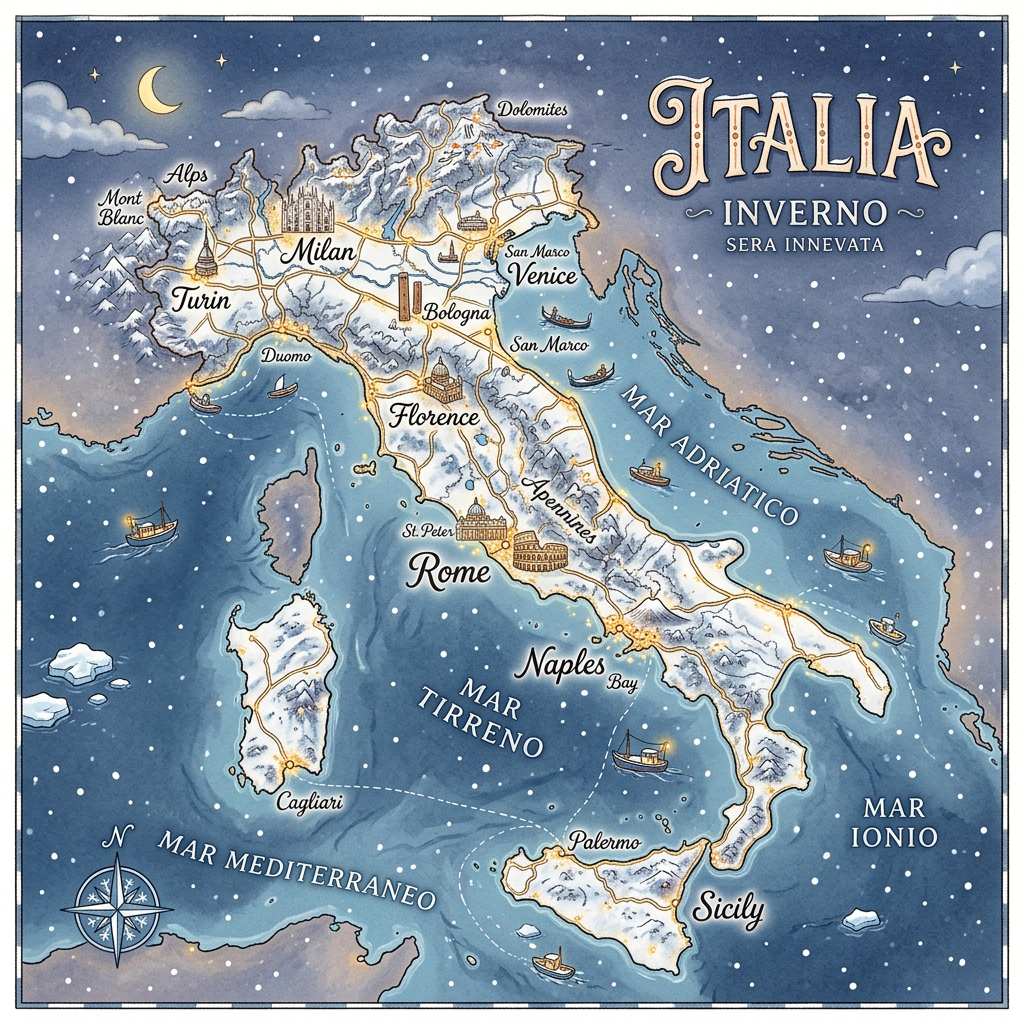
Italy is a European country located in the south, also called the Italian Peninsula or the Italian boot.
Italy geopolitical map
In addition to this peninsula, Italy includes many islands such as Sicily and Sardinia. Italy shares borders with Austria, France, the Holy See, San Marino, Slovenia, and Switzerland. Italy overlooks the Mediterranean Sea and is separated from Western Europe by the Adriatic Sea.
Italy is organized into 20 regions, of which 15 have ordinary status and 5 have special status: Sicily, Sardinia, Trentino-Alto Adige, Friuli-Venezia Giulia, and the Aosta Valley. This special status recognizes their ethnic, geographic, linguistic, and historical specificities. The entire territory is subdivided into 102 provinces and nearly 8,000 municipalities.
Economy
Italy is an industrialized country whose development is marked by a strong contrast between the North and the South. The northern part of the country, the economic engine of the peninsula, is driven by a dense network of private companies and successful SMEs in sectors such as fashion, design, and mechanics. The south, on the other hand, remains more focused on agriculture, with a structurally lower level of economic development.
Italy’s international telephone code is +39 (0039 from a landline).
Religion
Italian society is predominantly Roman Catholic, although religious practice has significantly declined in recent decades.
- Catholics: 83.3%
- Unaffiliated: 12.4%
- Muslims: 3.7%
- Others (Protestants, Jehovah’s Witnesses, etc.): 0.6%

Most popular cities in Italy
Main cities of Italy
Rome
Rome will certainly be your first destination in the country. It is both the capital of Italy and the capital of tourist attractions. You can visit ancient monuments such as medieval churches, baroque churches, and fountains. You will also see art museums and Renaissance palaces.
Tourists love the ancient Colosseum, which is one of the most visited heritage sites in the world. Rome is a lively modern city even at night and has many restaurants. You can also go to Rome to visit St. Peter’s Square and Vatican City. Postal code RM 00118 to 00199
Florence
Florence is the capital of the Tuscany region and the former capital of the Kingdom of Italy from 1865 to 1870. It is one of the cities most loved by film directors. Florence is also the origin of the Italian language, which is based on the Tuscan language of the 14th century. Postal code Fl 50010 to 50068
Palermo
Palermo is the capital of Sicily. This city has existed for more than 3 millennia. Palermo is especially loved for the best restaurants specializing in Italian gastronomy. Visitors also come to see Italy’s architectural heritage. Currently, Palermo has many UNESCO World Heritage sites thanks to its large number of cultural sites. Postal code 91010 to 91029
Naples
Naples is the third largest city on the Balkan Peninsula. It is also the capital of the Campania region. Naples is also the most populous city in Italy. Its name comes from the Greek “Neapolis” which means new city. Its main attraction is the archaeological site of Pompeii. You can also visit artisan shops with nativity scene exhibitions in the historic streets of the city. Postal code: N/A 80121 to 80147
Venice
Venice is a very popular city thanks to its canals and bridges as well as imperial palaces built on the water. It is a tourist destination because the Serenissima is pleasant to visit thanks to the lively canals and labyrinthine alleys.
Venice also hosts various workshops of ancient gondolas such as Squero San Trovasco. Venice is the capital of Veneto, a region with more than 260,000 inhabitants. Postal code: VE 30121 to 30176.


Where the cities are located on the map ?
Rome: it is the capital located in the central west of the map near the Tyrrhenian Sea. The geographic coordinates are 41° 53′ 19″ North, 12° 29′ 12″ East
Venice: City located on the northwest coasts of the map on the Adriatic shores. The geographic coordinates are 45° 26′ 23″ North, 12° 19′ 55″ East
Palermo: It is located on the northern coast of the map in the Sicily region. Geographic coordinates 38° 07′ 00″ north, 13° 22′ 00″ east.
Florence: City located in the center of Italy on the map. Geographic coordinates 43° 46′ 18″ north, 11° 15′ 13″
Naples: Naples is located in the southwest on the map, that is southeast of Rome. The geographic coordinates are: 40° 50′ 00″ North, 14° 15′ 00″ East.
Linguistic map

87% of the Italian population speak Italian, however the country has several dialects.
First, there are three variations of the Italian language, namely:
- Normative Italian, also called Standard Italian, which is the language frequently used by the Italian social elite
- Regional Italian, which is a variation of regional dialects with a characteristic pronunciation.
- Popular Italian, which is an approximate language that does not observe grammatical and lexical rules. The pronunciation is influenced by regional traits.
There are 4 Italian dialects, namely the northern, central-southern, and southern dialects.
- Northern Italy : Ladin, Friulian, Piedmontese, Eastern Lombard, Western Lombard, Genoese/Ligurian, Emilian-Romagnol, Venetian, Istrian or Istriot
- Central Italy: Tuscan, Corsican, Roman, Ciociaro, Viterbese, Umbrian, Marches, Cocolao-Reatino-Aquilano.
- Southern Italy : Abruzzese, Molisan, Campanian, Lucanian, Apulian, Apulo-Salentin, Tarantino, Salentin, Calabrian, Sicilian, Pantesco
- Sardinia : Logudorese, Campidanese, Gallurese, Sassarese.
Demographic map
Italy currently has approximately 58.8 million inhabitants, according to the latest United Nations estimates, which is about 0.72% of the world population. This population has been slightly declining for several years due to a negative natural balance, with the number of deaths exceeding births, and emigration of young workers to other European countries. Italy is among the countries most affected by demographic aging in Europe.

With an area of 301,340 km², Italy has a population density of 195 inhabitants/km². The population is mainly urban: nearly 42 million inhabitants, or about 69.5% of Italians, live in cities. The median age of 47.3 years confirms a population among the oldest in Europe.
Main cities and their population
| City | Population |
|---|---|
| Rome | 2,318,895 |
| Milan | 1,236,837 |
| Naples | 959,470 |
| Turin | 870,456 |
| Palermo | 648,260 |
| Genoa | 580,223 |
| Bologna | 366,133 |
| Florence | 349,296 |
| Catania | 290,927 |
| Bari | 277,387 |
| Messina | 219,948 |
| Verona | 219,103 |
Italy climate Map
In general, the climate in Italy is Mediterranean. This is characterized by mild winters with rain, sunny and dry summers. However, Italy is so vast and has varied geography. This implies diverse climates, some examples of which are:
Northern Italy
In this region, summers are hot and winters are long, from December to March or April depending on the year. During winter, you will have snow and very low temperatures but still some sunshine.
Central Italy
That is Tuscany, Umbria, and other areas. Summers there are hot with peaks in July and August. Winters are harsher with heavy rain and snow especially in January and February.
Rome
Rome is a city with a rather cold climate. In January, temperatures are very low but from February onwards, you will have excessive sunshine. Summer is hot and temperature peaks occur in July and August. Rome is a very sunny city with less than eight hours of cold at night.
Southern Italy
Southern Italy includes Naples and its surroundings. These regions are characterized by hot, dry summers and mild, rainy winters. Average temperatures occur in January and February, and the coldest are from July to August.
Financial map of Italy
The Italian economy is marked by a deep territorial imbalance. The North concentrates most of the industrial and commercial activity, supported by a dense network of family businesses and successful SMEs. The South, on the other hand, remains structurally behind, with a more agricultural economy, a high unemployment rate, and a significantly lower level of development.
Notable feature: the underground and informal economy represents up to 17% of GDP, a figure revealing the structural difficulties of the country.
Nevertheless, Italy remains the 3rd largest economic power in the eurozone and holds an important place within the European Union, despite persistent vulnerabilities:
- GDP: around 2,100 billion euros (2024)
- GDP per capita: around 36,000 euros
- GDP growth: around 0.7% per year
- Overall unemployment rate: about 6.5% (significantly decreasing in recent years)
- Youth unemployment: around 18%, still concerning despite improvement
- Public debt: around 137% of GDP, one of the highest in the eurozone
In response to these challenges, successive governments have sought to stimulate exports and industrial production, sectors in which Italy remains competitive, notably in fashion, luxury, agri-food, and precision mechanics.
Italy map: Geographical and demographic information
Italy is a country in Southern Europe that extends into the Mediterranean Sea in the shape of a boot. A map helps visualize its location as well as its borders with France, Switzerland, Austria, and Slovenia.
A map of Italy shows the main cities, regions, mountain ranges such as the Alps and the Apennines, and the country’s coastline. It also helps locate the major islands, including Sicily and Sardinia.
Italy has a population of around 59 million people, with most residents living in large urban areas. Rome, the capital, is the country’s main political, historical, and cultural center.
