

With its imposing mountains, magnificent coast, and charming medieval towns, Montenegro is undoubtedly a must-visit destination. Whether you want to explore national parks or relax on paradisiacal beaches, there is something for everyone in this country rich in history and natural beauty.
The map of Montenegro: A guide to traveling and discovering this fascinating country
Geography and map of Montenegro
Montenegro is a small country located in the Balkans, on the Adriatic coast of the Mediterranean Sea. It shares its borders with Croatia to the northwest, Serbia to the northeast, the Republic of Macedonia to the southeast, and Albania to the south.
The country covers an area of approximately 13,812 km², which means you can explore a lot no matter how long your stay is.
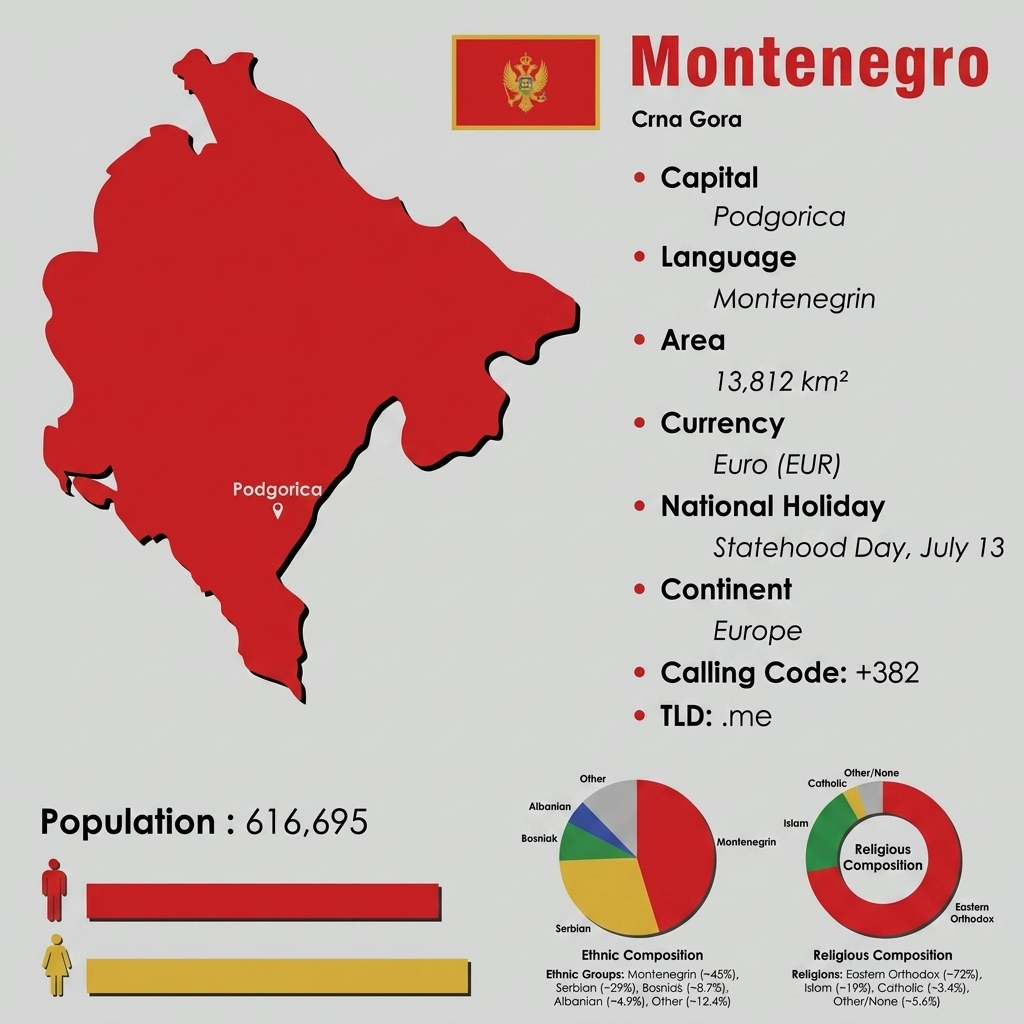
To properly plan your trip, it is essential to have a detailed road map of Montenegro, which are available in advance at specialized bookstores, travel agencies, or directly on site at tourist offices.
Table on the main geographical features of Montenegro
| Feature | Detail |
|---|---|
| Area | 13,812 km² |
| Capital | Podgorica |
| Population | About 616,695 inhabitants |
| Official language | Montenegrin |
| Highest point | Mount Zla Kolata, 2,534 meters |
| Main rivers | Tara, Morača, Lim |
| Geographical region | Southeast Europe, Balkans |
Montenegro is bordered by the following countries:
- Bosnia and Herzegovina to the northwest.
- Serbia to the northeast.
- Kosovo to the east.
- Albania to the southeast.
Additionally, to the west, Montenegro has a coastline along the Adriatic Sea. This coastline provides direct access to the sea, which is an important geographical feature for the country.
What to do in Montenegro: Tourism and must-see attractions ?
Below are some ideas for activities and tourist sites worth visiting during your stay in Montenegro:
- The old town of Kotor: listed as a UNESCO World Heritage site, this fortified medieval town is located in a magnificent bay and offers narrow cobblestone streets lined with historic buildings and charming shops
- Durmitor National Park: offering some of the most spectacular landscapes in the country, this park is ideal for hiking, climbing, or rafting in the wild waters of the Tara River
- Sveti Stefan: A medieval village located on a landscaped islet, Sveti Stefan is also famous for its fine sandy beaches and crystal-clear water.
- Perast: A charming small town located on the Lustica peninsula, where you can take a boat to explore the two nearby islands – Our Lady of the Rock and Saint George
When to go: climate and best seasons to travel
The climate of Montenegro varies considerably depending on the region. The Adriatic coast enjoys a Mediterranean climate with hot, dry summers and mild, wet winters. However, the inland areas, towards the mountains, experience more weather variations and much cooler temperatures.

In general, it is recommended to visit Montenegro between May and September, when temperatures are pleasant and the days are generally sunny. The summer months (July and August) can be very busy on the coast, so consider traveling in June or September to avoid the crowds and make the most of your stay.
Montenegro airports: how to get there and get around
Montenegro has two main international airports located in the cities of Podgorica (Podgorica Airport – TGD) and Tivat (Tivat Airport – TIV). Most international travelers arrive through one of these entry points, with weekly flights from a wide variety of European destinations.
Additionally, some low-cost airlines offer seasonal connections to certain major European capitals.
Once there, bus transportation is a convenient and economical way to get around between the main cities.
Car rentals are also available for those who want greater freedom to explore the country at their own pace. Don’t forget to bring a road map to facilitate your trips!
Budget and money: practical tips
The national currency of Montenegro is the Euro (EUR), even though the country is not part of the Eurozone. ATMs are widely available in major cities and tourist centers, while international cards such as Visa/MasterCard are accepted by several businesses.
Regarding accommodation, there is something for every budget: from friendly hostels to luxurious 5-star lodgings. Book in advance to take advantage of the best hotel deals online.
Also, it is often cheaper to eat in local taverns or cafés than in prestigious restaurants. To save even more, check if your accommodation has a shared kitchen where you can prepare your own meals.

Formalities: documents required to travel to Montenegro
To enter Montenegro, European citizens only need a valid national identity card or a valid passport; non-European nationals should consult their respective embassies to know the precise entry conditions concerning their nationalities.
It is recommended to take out travel insurance before your departure and to keep the contact details of your nearest consulate with you in case you need assistance during your stay in Montenegro.
The flag of Montenegro is rich in symbolism and colors, reflecting the country’s history and culture.
Here is an explanation of its design and colors:
- Design :
- The flag consists of a red base with a golden border.
- In the center, it features the national emblem of Montenegro. This emblem is a golden double-headed eagle. The double-headed eagle is a traditional symbol in the Balkan region, representing duality and sovereignty.
- On the eagle’s chest, there is a shield bearing a passant lion, also in gold, a common heraldic motif in the region.
- Colors :
- Red: The background of the flag is red, a color often associated with bravery, courage, and sacrifice.
- Gold: The golden elements, including the flag’s border, the double-headed eagle, and the lion on the shield, symbolize nobility, honor, and wealth.
- Symbolism :
- The double-headed eagle is a historical symbol that has been used by many dynasties and empires, symbolizing power and the extent of a reign. In the context of Montenegro, it also represents the country’s history and culture.
- The passant lion on the shield is a symbol of courage and strength.
The current flag of Montenegro was adopted on July 13, 2004, following the country’s independence from the state of Serbia and Montenegro. It reflects not only Montenegro’s history and culture but also its contemporary national identity.
FAQ – Montenegro map: Geographic and demographic information
Montenegro is a Balkan country located in southeastern Europe, bordered by the Adriatic Sea. Its territory includes mountains, canyons, lakes, and a coastline renowned for its beautiful natural landscapes.
Montenegro has a population of just over 600,000 people living across a relatively sparsely populated territory. Most of the population lives in urban areas, particularly in Podgorica, Nikšić, and along the Adriatic coast.
The capital of Montenegro is Podgorica, which serves as the country’s main administrative, economic, and cultural center. Montenegrin is the official language, although Serbian, Bosnian, Albanian, and Croatian are also spoken in different parts of the country.
