
The country of Serbia is a must-see for travel and tourism lovers. What to do in this culturally rich European nation? What are the best means of transport to get there, and how to optimize your budget and money during such a stay? Here you will find all the useful information to best prepare your getaway in Serbia.
Countries bordering Serbia
Serbia, located in the Balkans region of Southeast Europe, shares its borders with several countries:
- Hungary to the north.
- Romania to the northeast.
- Bulgaria to the east.
- North Macedonia to the south.
- Albania to the southwest (via Kosovo, which Serbia does not recognize as an independent state).
- Montenegro to the west.
- Bosnia and Herzegovina to the west.
- Croatia to the northwest.
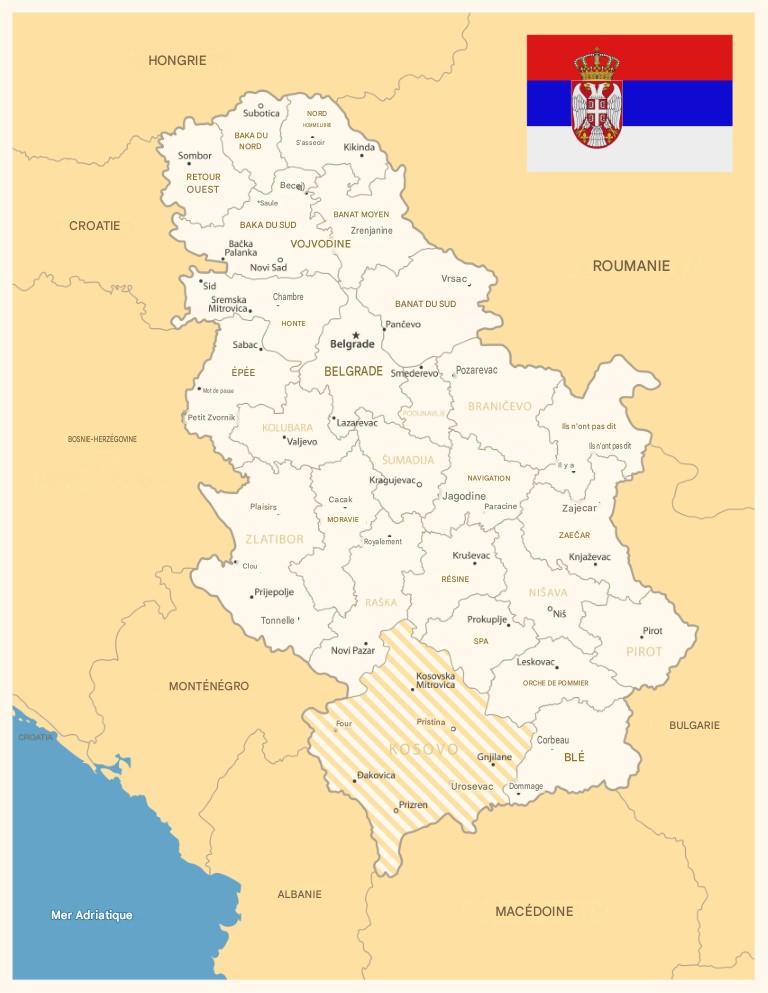
Map of Serbia: General and administrative situation
Located on the European continent, Serbia is part of the Balkans and shares its land borders with several other nations. Serbia is surrounded by Hungary, Romania, Bulgaria, North Macedonia, Croatia, Bosnia and Herzegovina, Kosovo, and Montenegro.

Following the breakup of the former Yugoslavia since 2006, it is an independent and sovereign republic. Composed of autonomous provinces with historical and cultural character, Serbia encompasses several regions with rich and varied traditions.
Budget and money: How to save in Serbia?
Like any vacation destination, it is necessary to manage your budget well during a stay in Serbia in order to fully enjoy the tourist attractions this country offers. Here are some tips to optimize your budget:
- Pay attention to exchange rates between the local currency, the Serbian Dinar (RSD), and your own currency.
- Compare prices between different airlines to find the best fare.
- Opt for affordable accommodations such as youth hostels or local guesthouses.
- Use public transportation when possible rather than renting a car to save on travel expenses.
Tourism: What to do in Serbia?

Serbia has a rich history, resulting in an incredible cultural and natural heritage. Here are some must-see attractions not to be missed:
- Belgrade, the capital of the country, known for its lively nightlife and eclectic architecture;
- Đerdap National Park and its fabulous Danube Gorge;
- The Studenica Monastery, listed as a UNESCO World Heritage Site;
- The charming town of Novi Sad, famous for its EXIT festival;
- The medieval fortifications of Golubac and Smederevo;
- The folk village of Kopaonik. Kopaonik Mountain, ideal for winter sports lovers during the season.
When to travel to Serbia?
Since the Serbian climate is continental, it is advisable to visit Serbia in spring (April to May) or autumn (September to October). The temperature is pleasant and precipitation is moderate. Summer can also be a good time to enjoy festivals and other cultural events throughout the country.
Transportation: airport, road map, and public transport
To reach Serbia from your home country, travelers have several transport options:
- Travel by plane via Nikola Tesla International Airport in Belgrade;
- Travel by car via European roads;
- Travel by train with the many railway lines serving the entire country.
Once there, tourists can easily get around thanks to a developed public transport network – buses, trams, and trolleybuses in particular – as well as taxis available at reasonable prices.
Travel formalities for Serbia

To ensure your stay goes smoothly, certain formalities must be respected to enter and stay in Serbian territory:
- Be in possession of a valid passport and ensure its expiration date does not exceed more than three months after your departure from Serbia.
- Check the visa requirements if necessary depending on your nationality.
Serbia thus proves to be a rich tourist destination, both culturally and naturally. To make the most of this experience, it is important to prepare your trip well and take into account the advice given in this article regarding the road map, transportation, budget and money to spend, as well as the administrative procedures necessary for a successful stay.
Flag of Serbia: Explanation and colors
- Design :
- The Serbian flag is a horizontal tricolor composed of three equal bands.
- The bands are arranged in the following order, from top to bottom: red, blue, and white.
- To the left of the flag is the coat of arms of Serbia, centered in the red band.
- Colors :
- Red : Symbolizes the blood shed for freedom and courage.
- Blue : Represents the sky and justice.
- White : Evokes peace and innocence.
- Coat of arms :
- The coat of arms features a white double-headed eagle on a red background, holding a shield with a pattern of four stylized “C”-shaped fire signals, known as the “Serbian cross”.
- The double-headed eagle is a historical symbol of the Byzantine and Orthodox empires, representing duality and sovereignty.
- The Serbian cross is a traditional symbol of Serbia, with deep historical and cultural significance.
The flag of Serbia thus combines traditional and historical elements to represent the national identity and heritage of the country.
FAQ-Serbia map: Geographical and demographic information
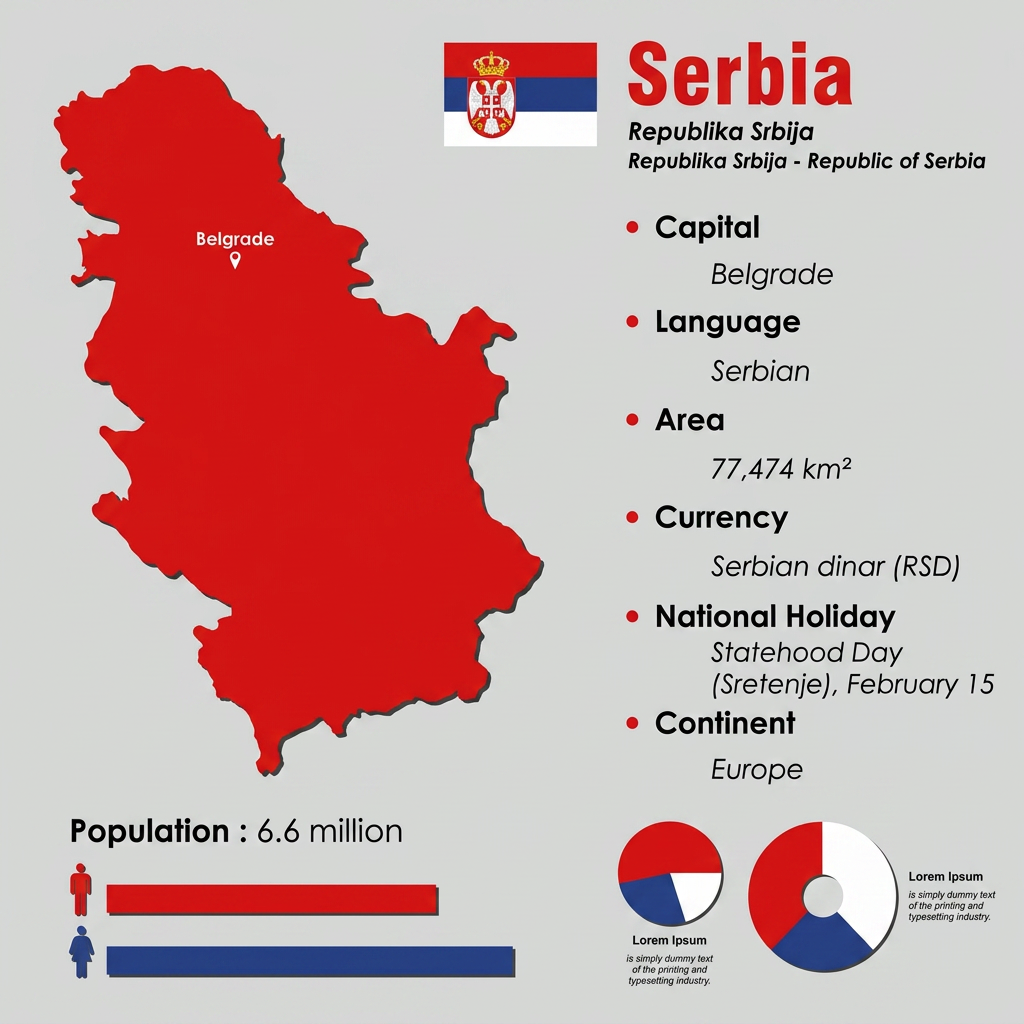
Serbia is located in the Balkans in Southeastern Europe. It is a landlocked country that shares borders with eight neighboring countries.
Belgrade is the capital and largest city of Serbia. The country has a population of approximately 6.6 million people.
A map of Serbia helps locate its major cities, regions, and international borders. It is also useful for planning a trip or gaining a better understanding of the geography of the Balkans.
