
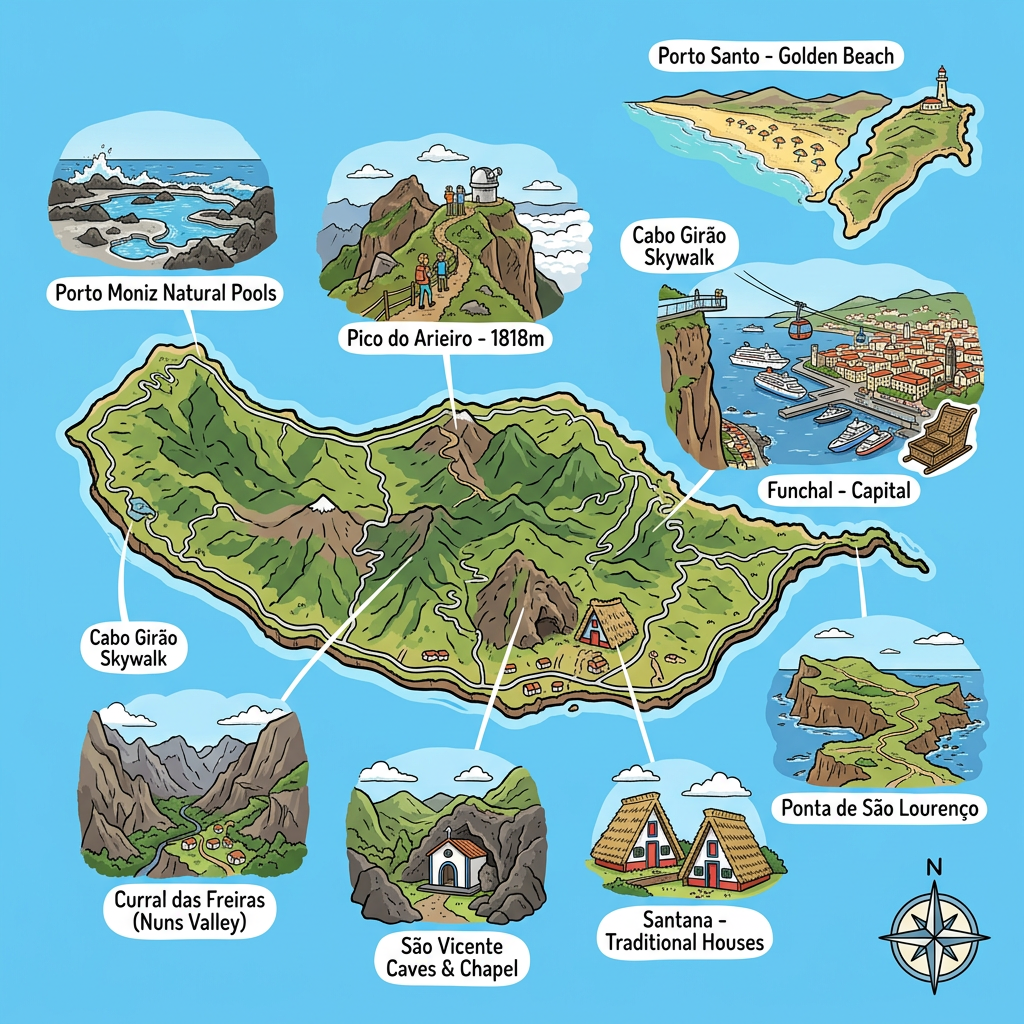
Discovering Madeira is not limited to admiring photos of cliffs and lush gardens. A good map of Madeira reveals the full richness of its landscapes, its perched villages, and the sometimes little-known trails that crisscross this Portuguese island. Using a tourist map becomes the starting point of a tailor-made adventure, where every detour holds its share of discoveries, whether it be famous tourist sites or spots preserved from the passage of travelers.
Archipel portugais au large du Maroc, Madère combine montagnes volcaniques, microclimats et falaises spectaculaires. La carte met en lumière la côte sud abritée autour de Funchal, les crêtes centrales (Pico Ruivo : Pico do Arieiro) et les levadas qui structurent les randonnées.
Geography of Madeira: a unique playground for explorers
The island of Madeira, jewel of the Portuguese archipelago, attracts with its geographical diversity. Located off the coast of Morocco in the Atlantic Ocean, it combines steep volcanic mountains, wooded valleys, and rugged coastline. Its subtropical climate allows for lush vegetation found all around, creating a contrasting landscape between rocky peaks and golden beaches.
On a road map, it quickly becomes apparent that Madeira is not vast but is full of sharp turns, impressive tunnels, and picturesque roads. This mix of mountains and plateaus offers spectacular views, making the use of a map essential to optimize every journey. The maps also facilitate the discovery of lesser-known regions, far from the main tourist routes.
Why use a map of Madeira during a trip?
Having a detailed map does not only provide logistical support: it is above all an opportunity to go off the beaten path. Between the lively towns and the multitude of small villages, navigation sometimes requires a sharp sense of direction. The particular topography greatly influences the duration and nature of journeys, hence the usefulness of regularly consulting a tourist map during travels.

Preparing visits becomes easier with a precise map. Identifying the main points of interest in advance or spotting scenic routes allows for a variety of activities, from hiking to coastal road trips. Paper maps or interactive ones guide without mobile connection, avoiding many surprises in this mountainous and fragmented territory.
What are the main regions and points of interest on the island of Madeira?
Divided into three main parts – north, south, and west – Madeira reveals very different faces depending on the region observed on a map. Each area offers unique atmospheres, varied landscapes, and distinct experiences for visitors eager for original discoveries.
Must-see towns and villages on a map of Madeira
The capital Funchal always holds a prominent place on any tourist map. There you find hotels and accommodations suited to all budgets as well as a wide choice of museums, markets, and renowned gardens. To the west, Câmara de Lobos charms with its typical fishing port atmosphere, while Santana in the north offers its traditional colorful houses that delight photography enthusiasts.

Ponta do Sol, a small sun-drenched town on the south coast, is a popular stop to admire the sea. Heading eastward, you pass Machico and Santa Cruz, two municipalities blending ancient history with convenient beach access. Further into the mountains, Curral das Freiras amazes with its spectacular panorama and romantic isolation, always identifiable on a detailed map.
Major tourist sites visible on a map
Some tourist sites are systematically featured on any Madeira map worthy of the name. The Pico do Arieiro, the island’s second highest peak, attracts hikers and dreamers with its mountain clouds. The Cabo Girão, towering cliffs above the Atlantic, offers a glass platform for the bravest.
Numerical table: Madeira (map reading)
| Cartographic indicator | Precise data | Useful map reading |
|---|---|---|
| Total area | 801 km² | Compact island, quick travel |
| Maximum length (E-W) | 57 km | Full crossing in < 2 h |
| Maximum width (N-S) | 22 km | Very concentrated relief |
| Highest point | Pico Ruivo – 1,862 m | Mountainous central zone |
| Average altitude | ~1,200 m (center) | Steep elevation visible on relief map |
| Total coastline | ≈ 150 km | Few beaches, steep coasts |
| Capital | Funchal | South of the island, economic hub |
| Total population | ≈ 251,000 inhabitants | High density in the south |
| Average density | ≈ 313 inhabitants/km² | Highly localized population |
| Population share south | ≈ 70 % | South = urban areas |
| Population share north | ≈ 30 % | North more rural, greener |
| Road tunnels | > 140 tunnels | Very technical road map |
| Expressways (VR) | ≈ 180 km | High accessibility despite relief |
| Distance Funchal ↔ Porto Moniz | ≈ 49 km | Clear climate change |
| Distance Funchal ↔ Santana | ≈ 42 km | Quick access to typical houses |
| Secondary islands | Porto Santo (43 km²) | Separate island to the east |
| Average annual climate | 19–23 °C | Visible south/north gradient |
| Sunniest area | South / Southwest | Major tourist zones |
| Greenest area | North / Laurisilva | Hiking, levadas |
The forest park of Ribeiro Frio invites you to explore the famous levadas (irrigation channels) scattered throughout the dense vegetation. Heading southwest towards Paul do Mar or Jardim do Mar, the waves attract experienced surfers while the tranquility appeals to those seeking peace.
Strategic reading of the Madeira map
- South: urbanization, sun, infrastructure, tourism
- Center: mountains, technical roads, hiking
- North: humidity, nature, raw landscapes
- East: airport + windy areas
- West: natural pools, cliffs, road trips
This division explains 90% of itinerary and accommodation choices on the island.
Planning your stay: choosing hotels and accommodation according to the map of Madeira
Drawing inspiration from a comprehensive tourist map greatly helps in selecting the ideal accommodation. Hotels can be located in the urban center of Funchal, isolated near cliffs, or nestled in the mountains. The distance between localities remains modest in kilometers, but the road layout often makes distances deceptive. Consulting a map therefore helps minimize travel times according to your activity preferences.
Here are some useful criteria to consider when choosing your lodging based on a Madeira map:
- Proximity to main attractions or hiking trails
- Accessibility of main roads for easy exploration
- Desired atmosphere: peaceful village, seaside resort, or lively center
- View of the sea, mountains, or lush valleys
- Presence of restaurants, shops, and public transport nearby
Maps also help locate rural lodgings that offer an authentic immersion in local culture, outside traditional hotel complexes. Many travelers appreciate the variety of accommodations available, spread across the island in the most charming spots.
To locate the archipelago in the Atlantic and prepare your itineraries, start with where Madeira is located. Then frame the geographical and cultural context with the map of Portugal. If you are comparing Atlantic archipelagos for a combined trip, also see where Tenerife is located to evaluate climates, access, and terrain.
How to effectively use a road map of Madeira?
Faced with Madeira’s winding network, knowing how to read a road map can make the difference between an enjoyable excursion and an endless journey. Some main roads, including the Via Rápida (expressway), allow connecting major hubs fairly quickly. Other routes wind along hillsides, requiring reduced speeds and offering unforgettable scenic stops.

By analyzing the geography of Madeira displayed on a map, it is possible to identify:
- The secondary roads perfect for discovering hidden villages
- Steep sections requiring some driving experience
- The tunnels piercing the mountains to shorten distances
- Strategic stopping points to enjoy natural viewpoints
This information makes each getaway smoother and helps avoid many unintended detours, especially if you want to explore numerous tourist sites during a short stay.
A Madeira map, enriched with practical information and local suggestions, transforms the trip but also inspires confidence in visitors eager to freely explore all the riches of this Portuguese archipelago.
FAQ: Madeira map
A Madeira map detailing ridges, tunnels, and levadas helps choose safe routes between Pico do Arieiro, Pico Ruivo, and the humid northern valleys.
Opt for a Madeira map with altitude profiles and exposures: the south coast is drier, the north more humid, which affects visibility and trail choices.
Yes, a Madeira map showing coastal roads, cable cars, and levada starting points facilitates logistics from Funchal and FNC airport.
A Madeira map highlights Cabo Girão, Paul da Serra, and the central ridges, useful for anticipating travel time and changing weather.
