

If you are planning a trip to Portugal, a detailed map can become your best ally. Whether it’s to stroll through the historic streets of Lisbon or to explore the vast beaches of the Algarve, having a good map will help you maximize your experience. Imagine navigating through the various regions, from Porto in the north to the Madeira archipelago, with ease thanks to the valuable road and tourist information at your disposal.

The key to an unforgettable adventure often lies in the details. Having a Michelin map of Portugal, for example, is like holding a treasure. Thanks to its convenient format, it easily slips into your bag, ready to guide you at every intersection.
Imagine yourself, map in hand, spontaneously deciding to cross the border into Spain or head back toward France, thus enriching your journey with impromptu discoveries. These maps, true passports to adventure, transform every trip into a unique experience, shaped by your curiosity and desire to explore beyond the beaten paths.
Portugal map: some interesting facts
Table on the main geographical features of Portugal
| Feature | Detail |
|---|---|
| Area | 92,090 km² |
| Capital | Lisbon |
| Population | About 10.3 million inhabitants |
| Official language | Portuguese |
| Highest point | Mount Pico, 2,351 meters (located in the Azores) |
| Main rivers | Tagus, Douro, Guadiana |
| Geographical region | Southwest Europe, on the Iberian Peninsula |
Portugal is also called the Portuguese Republic. It is one of the oldest countries in Europe as its borders have been defined since 1139. Its area is 92,391 km² and it is bordered by the Atlantic Ocean and Spain. The country also consists of two archipelagos, “The Azores, the island of Madeira,” off the Atlantic Ocean, which are designated as Autonomous regions.
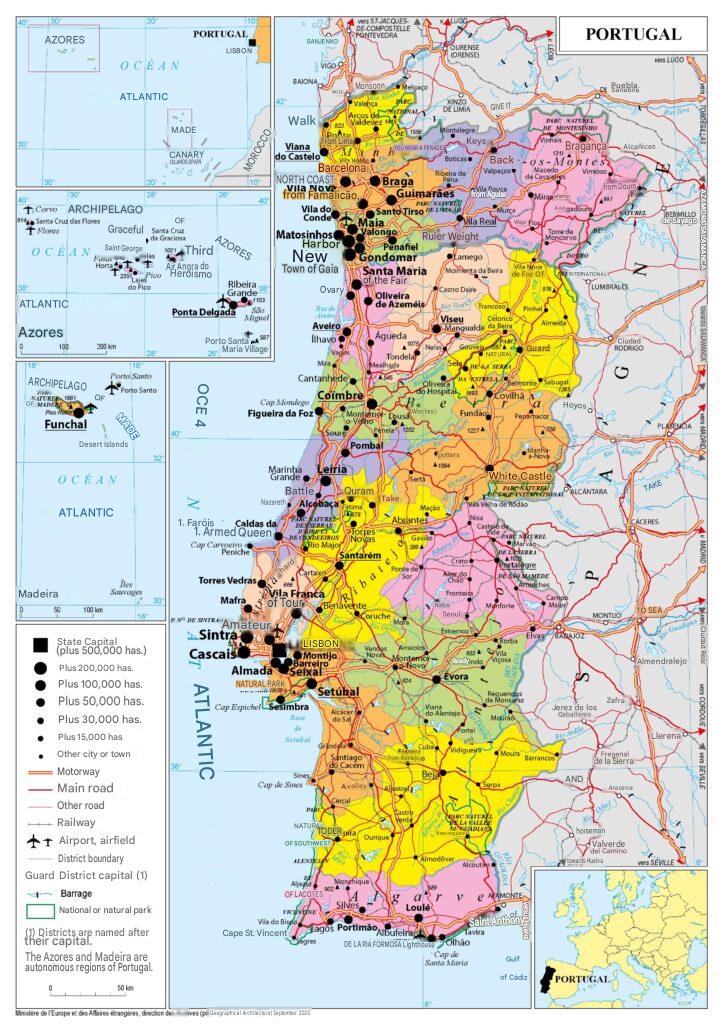
The official language spoken in Portugal is Portuguese. It is also the official language of 9 other countries with 236 million people. The capital of Portugal is Lisbon, which is a special city. It is a city crossed by the Tagus River and located near the sea. Tourists love this destination because it is sunny and ideal for seaside walks.
Regarding religion, Portugal is a country with a Roman Catholic tendency and very strict about family ethics. It is also a country rich in culture, which is the result of ancient civilizations such as Celtic, Lusitanian, Phoenician, Germanic, Visigothic, Jewish, and Moorish.
The most important cities of Portugal
Lisbon
Lisbon is one of the most interesting capitals in the world. It should be your top destination when you think about visiting Portugal. It is a tourist destination renowned for its dynamism and unique history. Tourists can visit the city and enjoy the nightlife and crafts. Lisbon’s destinations include the seaside resort of Cascais, the port of Setubal, or the beaches of Sesimbra. To visit all of this, you will need at least three days to fully enjoy it.
Tavira
It is also a favorite city among tourists and a preferred destination for vacationers. Tavira is located to the east of the Algarve. This city is adorned with beaches located on the coastline of the Parque Natural da Ria Formosa, which is a protected coast.
Evora
It is a magnificent city located in the arid region of Alentejo. Its main attractions are the Roman temple, the Chapel of Bones, and other important monuments. The city experiences intense heat during the summer periods.
Porto
Also known as the second largest city in Portugal, Porto has various interesting sites and activities. The city is appreciated for its popularity but also for its history and the nightlife that takes place there. Vacationers love the Ribeira and Baixa neighborhoods, which are also destinations for boat cruises along the Douro River. Porto is also a destination for wine enthusiasts.
Lagos
It is a city combining traditional and modern culture. It is also called the magnificent resort of the Algarve coast. This is where you find the most beautiful beaches in Portugal with the Ponte Piede rocks where you can rent a boat for exploration. Lagos is a dream destination for tourists who love nightlife and nightclubs.
Understanding Portugal’s maps for effective planning
Maps of Portugal are available in different formats. You can choose between road maps, ideal for car travel, or topographic maps, perfect for those looking to explore the relief and altitudes during hikes. Each type of map adapts to your specific needs, whether you are booking a hotel in the city or planning an excursion in less known areas of the country. For those who like meticulous preparations, it is possible to download maps before departure, thus ensuring constant availability regardless of connectivity.
Discovering the regions of Portugal with precision and detail
Each region of Portugal has its own charm and specificities. A detailed map can reveal hidden gems far from the beaten paths. For example, the North Portugal region, with its deeply rooted traditions and green landscapes, is a must-see for nature and culture lovers. Maps will help you locate less frequented but spectacular sites, such as some little-known museums or national parks. For those crossing the border into Spain, a map detailing both Portugal and Spain can be extremely useful for planning a combined itinerary.
- Travel: Plan your trips efficiently.
- Regions: Understand the specificities of each area.
- Lisbon: Discover the major points of interest.
- Porto: Explore this dynamic and historic city.
- Algarve: Enjoy the best beaches.
- Madeira: Venture into breathtaking hikes.
- Northern Portugal: Immerse yourself in the local culture.
- Spain Portugal: Plan cross-border excursions.
Thus, whether you are a tourist seeking adventure or a professional looking to deepen your geographical knowledge of Portugal, a well-chosen map is an indispensable tool. It not only enriches your travel experience but also ensures that every moment spent in this beautiful country is optimized for enjoyment and discovery.
To locate the country on the Iberian Peninsula, remember that Portugal borders only one neighbor by land: Spain. On the Atlantic side, complete your orientation with the archipelago of Madeira and, for an overall view, consult the map of Europe. If you are preparing an Iberian-Atlantic combination: compare the neighboring islands with where Tenerife is located to assess distances and access.
General administrative organization
Portugal is structured according to the NUTS (Nomenclature of Territorial Units for Statistics) system, with:
- Mainland regions
- Autonomous island regions
- Districts (historical level, still used administratively)
Administrative regions of mainland Portugal (NUTS II)
Mainland Portugal has 5 major regions:
- Norte
- Centro
- Lisboa
- Alentejo
- Algarve
In addition, there are the autonomous regions:
- Azores
- Madeira
Norte region (North)
- Regional capital: Porto
- Type: NUTS II
- Subregions (NUTS III – current version):
The Norte region is subdivided into 8 official subregions:
- Alto Minho
- Cávado
- Ave
- Área Metropolitana do Porto
- Alto Tâmega
- Tâmega e Sousa
- Douro
- Terras de Trás-os-Montes
👉 Former names such as “Minho-Lima,” “Grande Porto,” or “Entre Douro e Vouga” are no longer officially used.
Centro region (Center)
- Regional capital: Coimbra
- Type: NUTS II
- Sub-regions (NUTS III – current version):
The Centro region includes 8 sub-regions:
- Região de Aveiro
- Região de Coimbra
- Região de Leiria
- Viseu Dão Lafões
- Beira Baixa
- Beiras e Serra da Estrela
- Médio Tejo
- Oeste
👉 The former divisions “Pinhal Interior,” “Baixo Mondego,” “Cova da Beira” are no longer in effect.
Districts (historical administrative level)
Districts do not correspond to NUTS regions, but remain used for certain administrative functions.
Districts mainly covering the Centro region:
- Aveiro
- Castelo Branco
- Coimbra
- Guarda
- Leiria
- Viseu
⚠️ Important correction
The following districts do not belong to the Centro region:
- Braga
- Bragança
- Porto
- Viana do Castelo
- Vila Real
👉 They belong to the Norte region.
Districts: distinct administrative level, not equivalent to regions
Mainland Portugal: 5 NUTS II regions
Norte Region: 8 NUTS III sub-regions
Centro Region: 8 NUTS III sub-regions

“Lisboa” Region with Lisbon as the regional capital
Divided into 2 sub-regions
- The Grande Lisboa sub-region
- The Península de Setúbal sub-region
Districts covered: the districts of Lisbon, Leiria, Santarém, and Setúbal.
“Alentejo” Region with Évora as the regional capital, composed of 5 sub-regions
- The Central Alentejo sub-region
- The Coastal Alentejo sub-region
- The Upper Alentejo sub-region
- The Lower Alentejo sub-region
- The Tagus Edge sub-region
Districts covered: the districts of Beja, Évora, and Portalegre; Setúbal and Santarém
“Algarve” region with Faro as the regional capital
- Composed of the Algarve as the only region
District covered: the district of Faro.
2. Island regions
- Autonomous region of the “Azores” with Ponta Delgada as the regional capital. It covers 3 former districts: the districts of Angra do Heroísmo, Horta, and Ponta Delgada.
- Autonomous region of Madeira with Funchal as the regional capital
Postal codes of Portugal
- 23 Azores District
- 02 Aveiro District
- 03 Beja District
- 04 Braga District
- 05 Bragança District
- 06 Castelo Branco District
- 07 Coimbra District
- 08 Évora District
- 09 Faro District
- 11 Guarda District
- 13 Leiria District
- 14 Lisbon District
- 10 Madeira District
- 16 Portalegre District
- 17 Porto District
Borders and neighbors
The only border of Portugal is the one between it and Spain. This boundary is called La Raya or A Raia in Spanish and Portuguese. The border starts at the estuary of the Minho River and ends at that of the Guadiana. The bordering provinces are: Pontevedra, Orense, Zamora, Salamanca, Cáceres, Badajoz, Huelva. The bordering districts are: Viana do Castelo, Braga, Vila Real, Bragança, Guarda, Castelo Branco, Portalegre, Évora, Beja, Faro.
Demographics Portugal
According to United Nations data, the population of Portugal is 10,183,160 inhabitants. The population increased to 10,196,709 in the middle of this year according to UN data. The Portuguese population is estimated at 0.13% of the world’s population. This percentage ranks it 89th compared to other countries in terms of demographic situation. According to recent information, the population density is 288 inhabitants per km2.
Portugal has an area of 35,363 square miles or 91,590 square kilometers with an urban population numbering 6,775,807 inhabitants. The Portuguese population is an aging population with an average age of 46.2 years.
Climate Portugal
Portugal is located in the Southwest of Europe and next to the Atlantic and the Mediterranean. This greatly influences Portugal’s climate, making it moderate, that is, between hot and cold throughout the year. In the North, the average temperature is 15°C and in the South the average temperature is 18°C. High precipitation is also observed in the North and low precipitation in the Southeast.
Overall, Portugal displays a Mediterranean climate more or less variable between regions. Consequently, one will observe hot summers and cool or humid winters. However, there are on average 2500 to 3200 hours of sunshine each summer.
Throughout the country, in winter, snowfall is common in mountainous regions. In the north, winter is harsher, especially at the summit of Portugal. Only the highest temperatures are observed in the center of Portugal, such as in the city of Amareleja. The subtropical climate is characteristic of the Azores and Madeira archipelagos. In these regions, temperatures average 20°C with very little variation.
Financial Situation of Portugal
Portugal has been part of the European Monetary Union since 1998 and adopted the Euro as its official currency in 2002. It then experienced economic growth higher than that of the European Union from 2001 to 2004. Its GDP is 2 to 3 times higher than those of other EU countries.
However, the Portuguese Republic faces a weakened educational system and significant corruption within its government. These issues are obstacles to the country’s productivity and thus to GDP growth. Currently, the country is experiencing difficulties in carrying out its functions, and there is an economic competitiveness deficit of 3% compared to the eurozone GDP.
Here are now the financial statistics of Portugal: GDP of 275 billion dollars, real growth rate of -0.3%, GDP per capita $23,000, external debt 515 billion dollars, inflation rate: 1.4%, public debt 96%
Essential Tools for Navigating Through Portugal
When delving into the cartography of Portugal, it becomes clear that the use of precise maps is indispensable for any traveler or researcher. Whether it is the Michelin maps, known for their accuracy and clarity, or the more modern digital plans, each type of map offers unique advantages.

For those planning a trip to the North region, for example, a detailed map can reveal scenic routes not apparent on more general maps. Similarly, for explorers of vibrant Lisbon or sunny Algarve, understanding urban and interurban connections is essential to optimize travel and discover hidden gems.
On the other hand, for those seeking to venture to less touristy places, such as the autonomous region of Madeira, a map can help decipher the mountainous terrain and areas of high altitude. It is fascinating to see how a simple sheet of paper or a digital display can enrich the experience by providing details about cities, regions, and even border areas with Spain. The map then becomes a silent but powerful guide, turning a simple outing into a memorable adventure.
The Importance of maps in portuguese culture and tourism
The enthusiasm for maps in Portugal goes far beyond practical use; it also touches on cultural aspects. By exploring a map, one discovers not only roads and territories but also the history and culture of a country marked by maritime discoveries. Each city, each village marked on a map has its own story, often linked to centuries of trade and exchange, as is the case for Porto and its famous wine cellars. Maps thus become a gateway to understanding the deep identity of Portugal.

Beyond the historical aspect, maps play a crucial role in tourism. They allow visitors to plan their routes, to choose their destinations according to their interests, whether it be gastronomy, history, or nature.
A good map offers the freedom to explore while reducing the anxiety of getting lost. This is especially true in a country where each region has so much to offer, from the exuberant Madeira carnival to the peaceful beaches of the Algarve.
Navigating Lisbon: between history and modernity
Lisbon, the capital of Portugal, is a charming labyrinth of old neighborhoods and new avenues. Using a detailed map to navigate this city can help fully appreciate its unique blend of history and modernity. From trams straight out of postcards to modern museums like the MAAT, a good map ensures you miss nothing.
Discovering porto and Its wine secrets
Porto, famous for its wine and riverside architecture, offers a rewarding experience when explored with a reliable map. The details on the maps allow you to follow the footsteps of old wine merchants and discover wine cellars not mentioned in the usual tourist guides.
Summary: Optimize your portuguese experience with maps
While there are a thousand ways to discover Portugal, the smart use of a map remains a proven method to enrich your trip. Whether you head to the high mountains of Madeira or wind through the narrow alleys of Lisbon, a well-designed map is your best ally.
It does not just guide you; it invites you to understand and immerse yourself in the cultural and historical richness of Portugal. So, why not take a map today and start charting your own route through this fascinating country? The journey promises to be as rewarding as it is diverse.
FAQ: Everything You Need to Know About the Map of Portugal
On a map of Portugal, you will find symbols indicating main roads, historical sites, beautiful beaches, and much more. Take the time to familiarize yourself with these symbols to better understand the landscape before you.
By carefully examining a detailed map of Portugal, you might uncover unsuspected treasures such as picturesque villages, breathtaking panoramas, and small authentic restaurants. Let yourself be guided by the magic of cartography to experience unforgettable adventures!
