

The kingdom of Sweden is a constitutional monarchy located in the northern part of Europe. Its area is 173,860 square miles, equivalent to 450,295 square kilometers. Based on this area, Sweden ranks 5th compared to other European countries. Among the countries of the European Union, Sweden ranks 3rd in terms of area.
Sweden’s current population is estimated at 10.6 million inhabitants, giving it a population density of approximately 26 inhabitants per square kilometer. The country’s capital is Stockholm, which is also its largest city. Sweden’s telephone country code is +46 (or 0046).
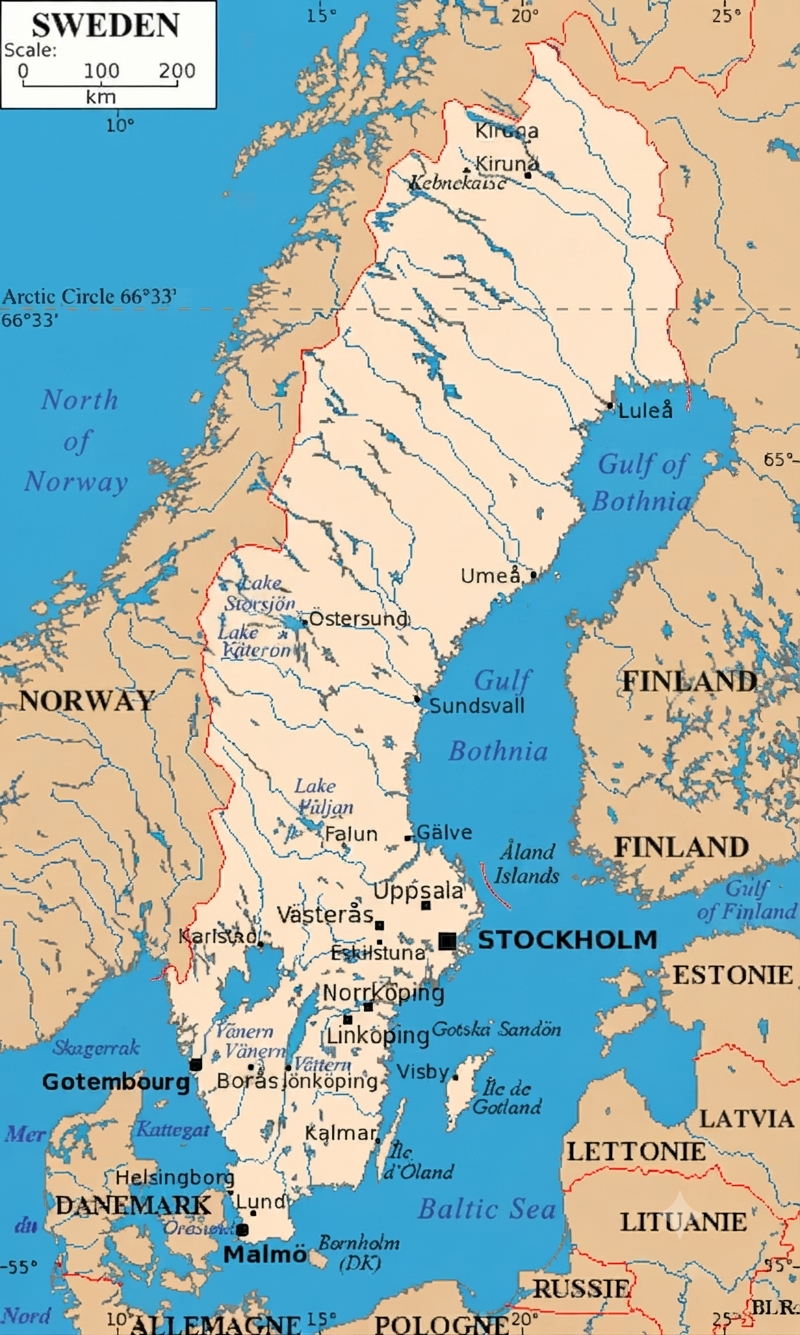
Which countries border Sweden?
The neighboring countries of Sweden are Norway and Finland, with respectively 1,619 km to the West and 586 km to the East. The Swedish maritime border is shared with Denmark via the Øresund Strait.
Table of the main geographical characteristics of Sweden
| Characteristic | Detail |
|---|---|
| Area | 450,295 km² |
| Capital | Stockholm |
| Population | About 10.6 million inhabitants |
| Official language | Swedish |
| Highest point | Kebnekaise, 2,097 meters |
| Main rivers | Göta älv, Dalälven, Klarälven |
| Geographical region | Northern Europe, Scandinavian Peninsula |
Population of Sweden
According to the latest United Nations estimates, Sweden’s population is approximately 10,760,000 inhabitants. This represents around 0.13% of the world’s total population, placing the country 91st among the world’s most populous nations. With a land area of 447,425 km², Sweden has a population density of approximately 24 inhabitants per km². Around 88% of Swedes live in urban areas, and the median age of the population is approximately 41.5 years.
What are the colors of the country?
The flag of Sweden consists of two colors: yellow (or gold) and blue. The gold color is arranged in the shape of a cross on the flag, which signifies generosity. Conversely, the blue color represents righteousness, sincerity, and determination.

What are the best cities to visit in Sweden ?
Main tourist attractions and places of interest
- Stockholm: The capital, known for its archipelago, the old town of Gamla Stan, and the Vasa Museum.
- Gothenburg: The second largest city, famous for its port, the Liseberg amusement park, and its museums.
- Abisko National Park: Located in Lapland, a prime spot for observing the northern lights.
- Gotland Islands: A popular destination for its beaches, medieval villages, and rich historical heritage.
- Malmö: A cosmopolitan city connected to Copenhagen by the Øresund Bridge, with modern attractions like the Turning Torso.
- Kiruna: The northernmost city in Sweden, famous for its iron mine and the renowned ice hotel of Jukkasjärvi.
- Lake Vänern: The largest lake in Sweden, offering fishing, boating opportunities, and picturesque landscapes.
Stockholm
The capital of Sweden is spread over more than 14 islets. Its nickname is actually “Venice of the North.” This magnificent city is a true blend of modern and classical architecture. You will also see several palaces and ancient cathedrals while strolling through the city’s cobblestone streets.
The view in the city is absolutely stunning; you can visit cafes, restaurants, or trendy bars to have a good time. There are even nightclubs and restaurants offering the country’s specialties.
Gothenburg
It is a wonderful place to live; Gothenburg is a port city with a coastline lined with white sands and crisscrossed by canals dating back to the 17th century. You will also see beautiful ships, a commercial port, and magnificent museums.
The city of Gothenburg is very lively as festivals and various events often take place there. It is also a very trendy student city with bars, cafes, and luxury shops. Swedish cuisine is very present in the wonderful restaurants of Gothenburg.
Malmö
It is the third largest city in Sweden by area and also a metropolitan city as more than 150 nationalities gather there. It is a beautiful city very close to Germany and facing the Baltic Sea. You will also find oriental markets and cuisines to taste unique flavors of the country.
It is also a cultural city because many old architectures are present there. The city has a very charming old castle and is a seaside city ideal for lovers of beach walks.
Helsingborg
It is the Swedish city closest to Denmark. This city has many fortresses built on heights overlooking the coastline. The waterfront of Helsingborg is lined with charming cafes and restaurants that you can visit to relax.
Many tourists prefer Helsingborg because it is a cultural place where art theaters or various cultural events frequently take place. If you walk through the city’s cobblestone streets, you may come across turreted buildings overlooking Helsingborg.
Karlskrona
It is a former military base; you will still see several naval architectures representing the old naval base. The buildings that still remain date from the 17th and 18th centuries, and many of these buildings are still used by the military.
You will also see old churches and many unique restaurants serving unique dishes. Moreover, it is a port city where you can enjoy swimming around the archipelago.
Lund
It is one of the oldest cities in the country, with many old alleys running through the town. You can take them to reach the forests bordering the city as well as the ancient architectures.
The city of Lund is also a university town, moreover the oldest in the country. While walking around, you will meet plenty of young students and find a very lively nightlife.
Where are the cities located on the Sweden map?

Stockholm
The capital is located in the eastern section of the country, at the estuary of Lake Mälar which flows into the Baltic Sea. Geographic coordinates: 59° 19′ 46″ north, 18° 04′ 07″ east
Göteborg
On the Sweden map, the city of Göteborg is located in the southwestern section of the country, in the western part facing the tip of Denmark. Geographic coordinates: 57° 42′ 00″ north, 11° 56′ 00″ east.
Malmö
On the Sweden map, the city of Malmö is situated in the southernmost part of the country. The city is also located on the coast of the Öresund canal which connects Sweden to Denmark.
Helsingborg
On the Sweden map, Helsingborg is located on the coast of the Öresund canal at its narrowest part. Geographic coordinates: 56° 03′ 00″ north, 12° 43′ 00″ east.
Karlskrona
The city of Karlskrona is located in the southern section of the country, inside the Blekinge archipelago. Geographic coordinates: 56° 11′ 00″ north, 15° 39′ 00″ east
Lund
On the Sweden map, the city of Lund is located in the extreme south. It is separated from the Öresund canal by only 10 km. Geographic coordinates: 55° 42′ north, 13° 12′ east.
Sweden climate map
The Swedish climate is influenced by the large land area, therefore, there are many variations. We observe the subpolar climate (Lapland, Alps) as well as the Baltic continental climate of the central southern region. And finally, there is the cold temperate oceanic climate of the southern coast.
Compared to other Scandinavian countries, Sweden has a fairly cold winter and a very sunny summer. This climate is strongly influenced by westerly winds.
Precipitation: It rarely rains in Sweden although generally, the annual rainfall does not exceed 500 millimeters. The coasts, however, show rainfall that can reach 1500mm annually due to the North Atlantic currents.
The winter period in the country is quite different across all regions. But in general, temperatures hover around 0°C. In the capital and other central cities, there is heavy snowfall but in coastal regions, even lower temperature peaks are observed, down to -20°C. This is the result of the influence of cold winds from Russia.
Summer is warm but not too much because some parts of Sweden show constant cold. The central-southern regions, for example, have daytime temperatures ranging between 18 and 21°C and nighttime temperatures around 10°C. However, the city center experiences temperature peaks during very hot periods around 30 to 32°C.
Stockholm:
The capital has an average rainfall of around 530 mm per year, which turns into snowfall during the winter periods. Sunshine in winter is quite low, about 6 hours, and in summer the duration of sunshine triples. However, the temperature in spring does not exceed 17°C, but there can be sudden rises in summer up to 32°C.
Economic map of Sweden

Sweden is a developed country and its inhabitants have a high standard of living, reflected by a high GDP per capita. Trade with neighboring countries is possible thanks to very developed road infrastructures and communication networks. The workforce in the country is quite expensive but clearly skilled.
The main activities are wood, steelmaking, and the automotive and aeronautical industries. The majority of the salaried active population is affiliated. All these indicators make Sweden one of the world’s economic powers, ranked 22nd. The country’s official currency is the Swedish krona. Here are some economic indicators:
- Gross domestic product at nominal parity: US$638
- GDP at purchasing power parity (PPP): US$741 billion
- Annual GDP growth rate:1.0 %
- Human Development Index: 0.952
- Employees: about 5.2 million inhabitants.
- Unemployment rate: 8.4 %
- Public revenues: approximately US$154 billion
Administrative subdivisions and demo-linguistic data
Administrative subdivisions
The Swedish territory is administratively divided into 3 regions which are:
- Götaland (South)
- Svealand (Center)
- Norrland (North)
These regions are then subdivided into 22 counties or län:
- Blekinge
- Dalarna
- Gävleborg
- Gotland
- Halland
- Jämtland
- Jönköping
- Kalmar
- Kronoberg
- Norrbotten
- Örebro
- Östergötland
- Scania
- Södermanland
- Stockholm
- Uppsala
- Värmland
- Västerbotten
- Västernorrland
- Västmanland
- Västra Götaland
After the counties, there are municipalities, which number 290.
Demo-linguistic data
The Swedish language is subdivided into 6 dialects according to the regions:
- Southern Swedish
- Eastern Swedish
- Götalandic
- Gotlandic
- Svealandic
- Norrlandic
These dialects are respectively spoken in the northern region, the Stockholm region, the island of Gotland, the central region, the southern region, and the eastern region.
FAQ-Sweden map: Geographic and demographic information
Sweden is a Northern European country located on the Scandinavian Peninsula. It shares land borders with Norway and Finland and is bordered by the Baltic Sea and the Gulf of Bothnia.
Stockholm is the capital and largest city of Sweden. The country has a population of approximately 10.6 million people.
A map of Sweden helps locate its major cities, regions, and numerous lakes and islands. It is also useful for planning a trip or gaining a better understanding of the geography of Scandinavia.
