📋 To remember: Personally, I consider structuring the list of countries by continent to be the clearest method to understand the geographical and demographic diversity of our planet. Each continental group has its own territorial and geopolitical specificities. Knowing these distributions greatly facilitates the overall memorization of the world’s states.
195 countries can be classified in this list of countries of the world by continent, provided that the 193 UN member states and the two observer states are considered, and each country is assigned to only one continent. Here are the countries of Africa, North and South America, Asia, Europe, and Oceania, while Antarctica is treated separately.

I designed a detailed cartographic directory classifying all nations by major region on February 18th, intended for a geography student audience. This experience allowed me to observe that the distribution of African and Asian countries generates the greatest number of comparative searches.
The classification below follows a unique geographical choice: America is divided into two groups, Central America and the Caribbean are attached to North America, and Russia is placed in Europe to avoid double counting. The numbers change when a list adds territories, Kosovo, Taiwan, or associated states.
| 📌 | Definition: 193 UN members and 2 observer states |
|---|---|
| 🌍 | Total retained: 195 countries classified once only |
| 🌍 | Africa: 54 countries |
| 🌎 | America: 23 countries in the north and 12 in the south |
| 🌏 | Asia: 48 countries depending on the chosen attachment |
| 🇪🇺 | Europe: 44 countries, Russia included in this perimeter |
| 🏝️ | Oceania: 14 countries; Antarctica: none |
Africa: the 54 countries classified by major regions
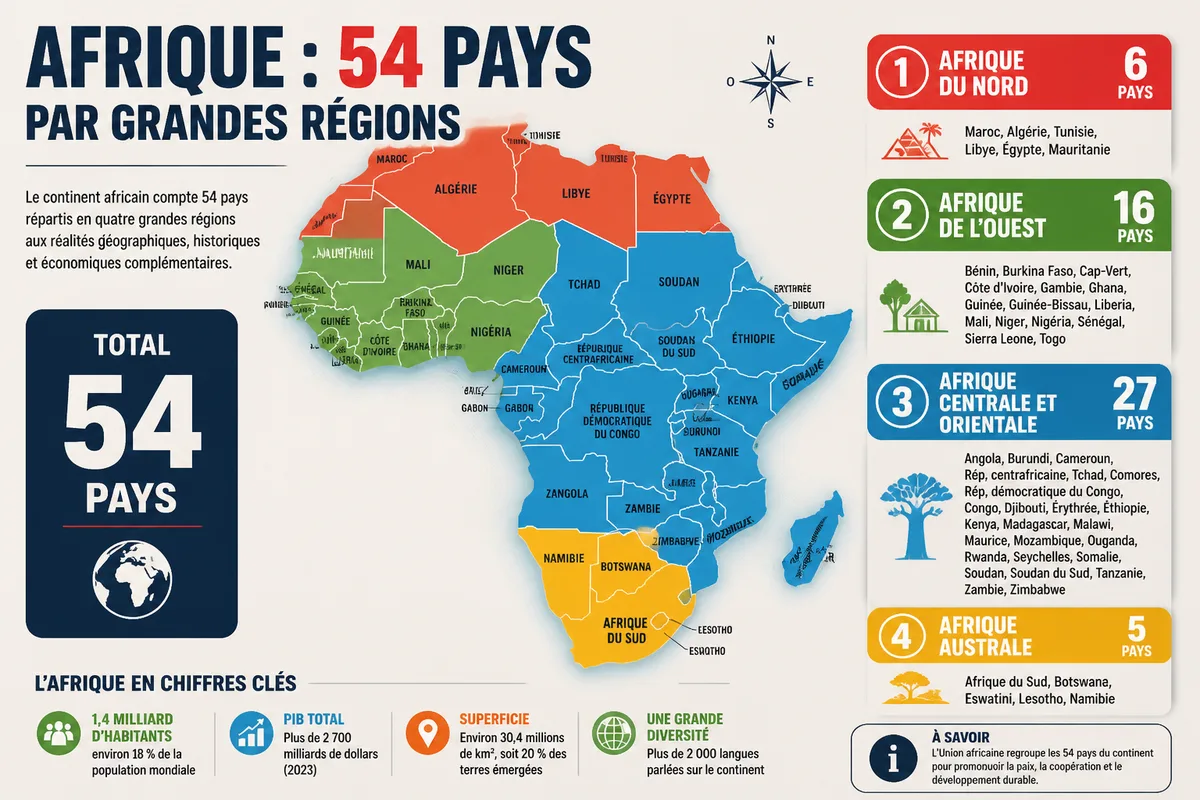
Africa has 54 countries in this classification. The list follows alphabetical order within major geographical regions, excluding Western Sahara as a separate sovereign state, and dependent territories.


For further insight, I recommend this cartographic exploration which complements this topic well. The wall world map also offers useful leads. You can also consult the ideal period in Asia, discover the countries to visit there, or read our article on map design.
North Africa and West Africa
North Africa: Algeria, Egypt, Libya, Morocco, Sudan, and Tunisia. West Africa: Benin, Burkina Faso, Cape Verde, Ivory Coast, Gambia, Ghana, Guinea, Guinea-Bissau, Liberia, Mali, Mauritania, Niger, Nigeria, Senegal, Sierra Leone, and Togo.
This geographic distribution facilitates consultation without changing the total number of states. Mauritania, for example, is often described as Sahelian or North-West African; it is counted only once. Cape Verde belongs to Africa despite its island nature.
- North Africa: 6 countries.
- West Africa: 16 countries.
- Total for this section: 22 countries.
Central and Eastern Africa
Central Africa includes Angola, Cameroon, the Central African Republic, Congo, Gabon, Equatorial Guinea, the Democratic Republic of the Congo, Sao Tomé and Príncipe, and Chad. Eastern Africa includes Burundi, Comoros, Djibouti, Eritrea, Ethiopia, Kenya, Madagascar, Malawi, Mauritius, Mozambique, Uganda, Rwanda, Seychelles, Somalia, South Sudan, Tanzania, Zambia, and Zimbabwe.
The names “Congo” and “Democratic Republic of the Congo” refer to two different states. This clarification avoids a common mistake in alphabetical lists, especially when capitals are not displayed.
Southern Africa
The conventional model of the five continents represented by the Olympic rings groups Africa, America, Asia, Europe, and Oceania, thus encompassing all the inhabited lands of the planet.
Southern Africa includes South Africa, Botswana, Eswatini, Lesotho, and Namibia. Together with the 22 countries of North and West Africa, and the 27 countries of Central and Eastern Africa, this organization totals the 54 countries considered.
Western Sahara is a territory with a disputed status and is not added to the 54 sovereign states on this list. Therefore, it is necessary to distinguish a political map, which may display this territory, from a count of countries.
North America, Central America and the Caribbean: 23 countries
In this list, North America includes Canada, the United States, and Mexico, to which are added the seven countries of Central America and the thirteen sovereign states of the Caribbean. The total retained is therefore 23 countries, excluding dependent territories.

⚠️ Classic pitfall: Forgetting to classify transcontinental states such as Turkey or Russia in the correct regional categories according to the geographical conventions adopted.
North America and Central America
The three countries of North America are Canada, the United States, and Mexico. Central America includes Belize, Costa Rica, Guatemala, Honduras, Nicaragua, Panama, and El Salvador.
The term “America” can therefore refer to a group of 35 countries when it includes the North, Central, Caribbean, and South regions, while this page separates the two subcontinents to make the search clearer.
Caribbean
The Caribbean here includes Antigua and Barbuda, the Bahamas, Barbados, Cuba, Dominica, Grenada, Haiti, Jamaica, the Dominican Republic, Saint Kitts and Nevis, Saint Lucia, Saint Vincent and the Grenadines, and Trinidad and Tobago.
Puerto Rico, Guadeloupe, Martinique, Aruba, and Curaçao are not added to this total: they are territories or entities attached to another state, with distinct statuses. A tourist map and a list of sovereign states therefore do not answer the same question.
South America: the 12 countries
South America includes 12 sovereign countries within the chosen perimeter. They are presented in alphabetical order, without including French Guiana as an independent country, since it is a French territory.

Alphabetical list of South American countries
Argentina, Bolivia, Brazil, Chile, Colombia, Ecuador, Guyana, Paraguay, Peru, Suriname, Uruguay, and Venezuela.
The border between Central America and South America is conventional, but it does not pose any difficulty for the twelve states on this list. French Guiana appears on the region’s maps; its territorial status explains its absence from the country count.
Asia: 48 countries according to a unique geographical attachment
Asia includes 48 countries in this ranking, with a choice of attachment that places Russia in Europe and keeps in Asia the other states located around the Caucasus or the Eastern Mediterranean. This convention is necessary to avoid counting transcontinental countries twice.

Central and Eastern Asia
Central Asia includes Kazakhstan, Kyrgyzstan, Uzbekistan, Tajikistan, and Turkmenistan. Eastern Asia includes China, North Korea, South Korea, Japan, and Mongolia.
Russia is intentionally classified in Europe in this version, even though a large part of its territory is in Asia. Here, the classification criterion is used to obtain a table without duplicates.
South and Southeast Asia
South Asia includes Afghanistan, Bangladesh, Bhutan, India, the Maldives, Nepal, Pakistan, and Sri Lanka. Southeast Asia includes Brunei, Cambodia, Indonesia, Laos, Malaysia, Myanmar, the Philippines, Singapore, Thailand, Timor-Leste, and Vietnam.
These two subregions present very different geographical realities, from archipelagos to large continental masses. Their alphabetical classification remains more useful than an organization by area or population to quickly find a country.
💡 Practical tip: Study countries continent by continent by associating each state with its capital to sustainably consolidate your geographical knowledge.
Western Asia and special cases
Western Asia includes Saudi Arabia, Armenia, Azerbaijan, Bahrain, Cyprus, the United Arab Emirates, Georgia, Iraq, Iran, Israel, Jordan, Kuwait, Lebanon, Oman, Palestine, Qatar, Syria, Turkey, and Yemen.
This list includes the State of Palestine as a UN observer state. Taiwan is not added to the total of 195 countries retained here, as its political status and international recognition do not correspond to the chosen institutional scope.

Europe: the 44 countries in the ranking
Europe has 44 countries in this distribution, including Russia. The Caucasus states, Turkey, and Cyprus are placed in Asia to maintain a single attachment rule, while Kosovo remains outside the total of 195 states due to its incomplete international recognition.

Woodbridge, William C.
Pelton, C.
Story & Atwood.
Case, Tiffany & Co.
Atwood, J.M.
Williams, W. / Wikimedia Commons

Northern and Western Europe
Northern Europe includes Denmark, Estonia, Finland, Ireland, Iceland, Latvia, Lithuania, Norway, the United Kingdom, and Sweden. Western Europe includes Germany, Austria, Belgium, France, Liechtenstein, Luxembourg, Monaco, the Netherlands, and Switzerland.
The ranking of European countries does not correspond to that of the European Union. The European Union has 27 member states, while geographical Europe also includes the United Kingdom, Norway, Switzerland, the Balkans, and several microstates.
Eastern and Southern Europe
Eastern Europe includes Belarus, Bulgaria, Hungary, Moldova, Poland, the Czech Republic, Romania, Slovakia, and Ukraine. Southern Europe includes Albania, Andorra, Bosnia and Herzegovina, Croatia, Spain, Greece, Italy, Malta, Monaco? No: Monaco is already classified in the West. The correct list therefore includes Montenegro, North Macedonia, Portugal, San Marino, Serbia, Slovenia, and the Vatican.
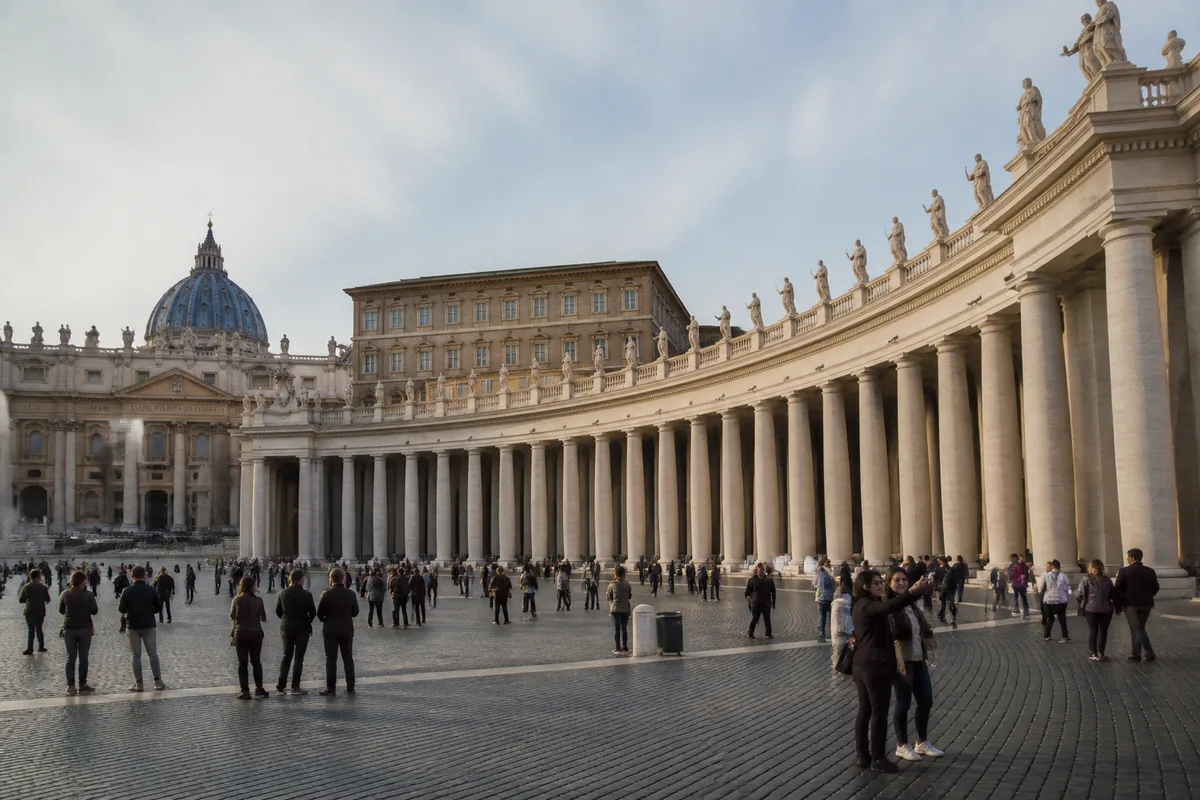
The Holy See is the sovereign entity represented at the UN, while “Vatican” is the commonly used name for the territory of Vatican City. In a list intended for the general public, the two names should be brought together.
✅ Strengths
Clear and structured organization by major groups
Synthetic view of the global distribution of populations
Geographical landmarks facilitating learning
🔻 Limitations
Continental borders sometimes arbitrary or disputed
Complex classification for countries spanning two continents
Constant evolution of territorial names
Oceania: the 14 island and continental countries
Oceania includes 14 sovereign countries in this list. They are distributed among Australasia, Melanesia, Micronesia, and Polynesia, excluding dependent territories and associated states which do not have the same status.
Australasia and Melanesia
Australasia includes Australia and New Zealand. Melanesia comprises Fiji, Papua New Guinea, the Solomon Islands, and Vanuatu.
Micronesia and Polynesia
Micronesia includes the Federated States of Micronesia, Kiribati, the Marshall Islands, Nauru, and Palau. Polynesia includes Samoa, Tonga, and Tuvalu.
New Caledonia, French Polynesia, Guam, and American Samoa are not counted as sovereign countries in this table. Lists that mention 16 countries sometimes include associated entities or apply a different political scope.
Antarctica: no sovereign countries
Antarctica has no sovereign countries. Scientific bases, claimed zones, and permanent stations do not create independent states, even though several countries maintain a presence or territorial claim.
A map of Antarctica may thus show named sectors, while a list of countries by continent shows a total of zero for this continent.
Why does the number of countries vary according to lists?
Lists show different totals because they do not always count the same entities. The scope may include UN members, observer states, states with limited recognition, dependent territories, or associated states.
Explorateur interactif des continents
Sélectionnez un continent pour afficher ses caractéristiques
Choisissez un continent :
Sélection active :

The short answer fits in one sentence.
The total first depends on the definition adopted for “country”.
UN Members and Observers
The United Nations has 193 member states. Two states hold permanent observer status: the Holy See and the State of Palestine. The total of 195 used here adds these two categories together, without claiming to resolve cases of limited recognition. To explore the difference between observer states and other statuses, see our dedicated explanation.
To verify this scope, consult the list of countries in the world, then compare it to the official list of UN member states. This verification is more robust than an isolated number placed in a page title.
Transcontinental States and Territories
Russia, Turkey, Kazakhstan, Egypt, and several Caucasus countries can be assigned to multiple geographic areas. Here, each country appears only once: Russia is in Europe, Turkey and the Caucasus states are in Asia, and Egypt is in Africa.
The chosen classification thus resolves a presentation difficulty. If your school textbook or statistical organization applies a different convention, its total may differ without the list automatically being incorrect.
Official Names and Common Names
Popular lists use short names: Afghanistan, South Africa, or Albania. Official forms can be longer, such as Islamic Republic of Afghanistan, Republic of South Africa, and Republic of Albania.
The list of countries from the CITES application of the ministry responsible for sustainable development provides a useful institutional check: it notably associates an ISO code, a country name, a status, and a CITES entry into force date. France appears under the code FR, while Afghanistan and South Africa are listed respectively under AF and ZA.
Summary of Countries by Continent
| Rank | Continent or Group | Number Counted | Main Convention |
|---|---|---|---|
| 1 | Africa | 54 | Sovereign states, Western Sahara excluded from total |
| 2 | North, Central America and Caribbean | 23 | Central America and Caribbean included |
| 3 | South America | 12 | Dependent territories excluded |
| 4 | Asia | 48 | Russia classified in Europe |
| 5 | Europe | 44 | Russia included, Kosovo excluded |
| 6 | Oceania | 14 | Sovereign states only |
| 7 | Antarctica | 0 | No sovereign state |
A reliable list starts with its scope, not its number.
FAQ on the List of Countries in the World by Continent
Which African countries are landlocked?
Africa has 16 countries without direct access to the sea: Botswana, Burkina Faso, Burundi, Eswatini, Ethiopia, Lesotho, Malawi, Mali, Niger, Uganda, Central African Republic, Rwanda, South Sudan, Chad, Zambia, and Zimbabwe. This list includes states that have no coastline.
Which Asian countries have no access to the sea?
The landlocked Asian countries are Afghanistan, Armenia, Azerbaijan, Bhutan, Kazakhstan, Kyrgyzstan, Laos, Mongolia, Nepal, Uzbekistan, Tajikistan, and Turkmenistan. Azerbaijan, Kazakhstan, and Turkmenistan border the Caspian Sea, but it is not directly connected to the world ocean.
Which European states use the euro without belonging to the European Union?
Andorra, Monaco, San Marino, and the Vatican officially use the euro thanks to monetary agreements with the European Union. Montenegro and Kosovo also use it de facto, without having a monetary agreement with the European Union.
Useful sources to consult
To verify names, statuses, and classification boundaries, first consult the official list of UN member states, the UN pages dedicated to observer states, and the M49 geographical classification. The “List of countries” page of the CITES application also provides ISO codes, statuses, and CITES entry into force dates.
This page was structured in 2026. The figures are valid for the scope defined here; they should be reviewed if an authority changes a status or if your source includes territories. For school use, especially check the convention chosen for Russia, the Caucasus, Kosovo, and overseas territories.
If you need to compare several lists, choose the one that clearly states its criteria, separates territories from sovereign states, and avoids counting a transcontinental country twice.