
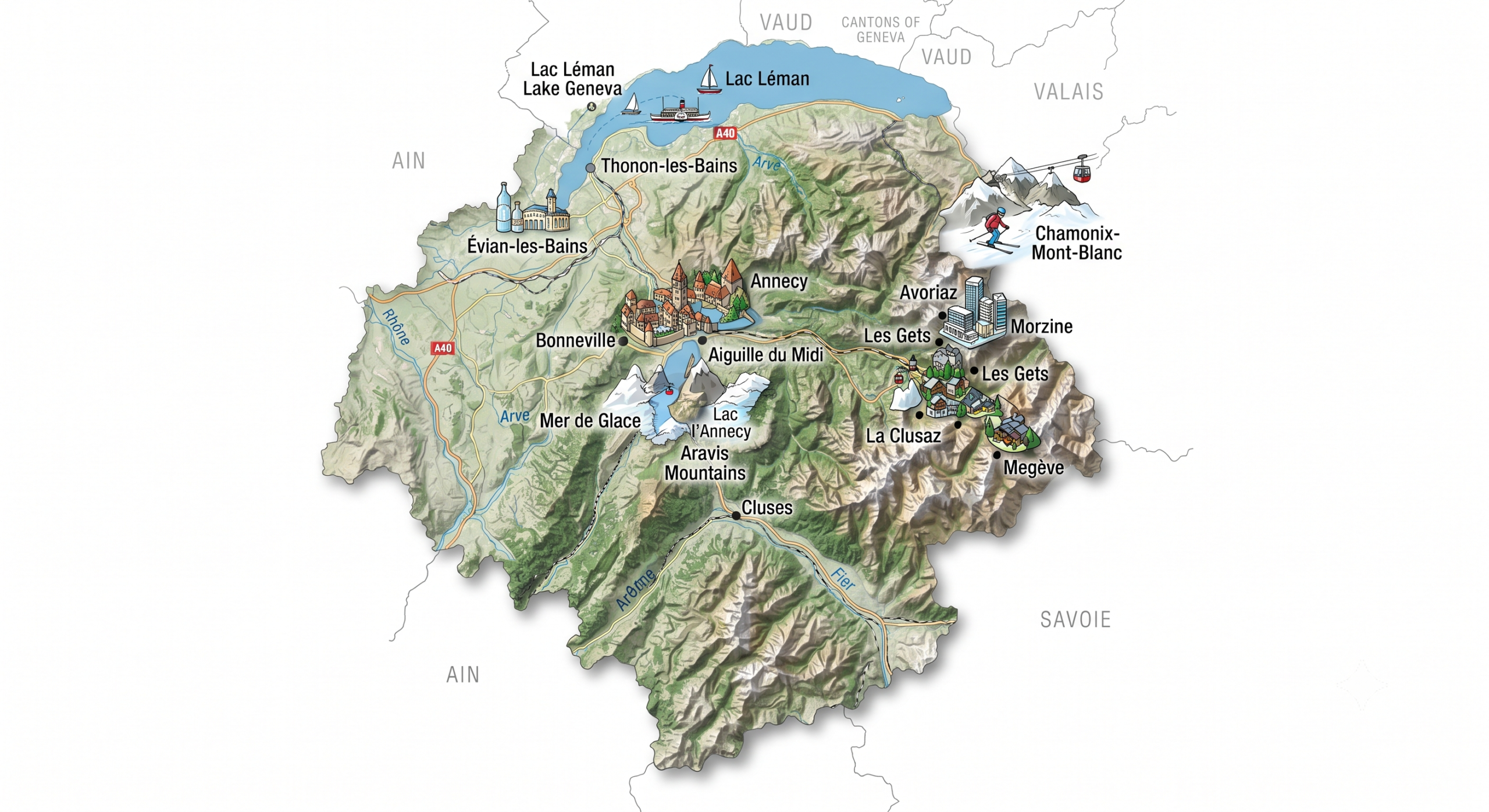
What you need to know about the Haute-Savoie department ?
We present to you a department that holds a central place in the eastern area of the country. It is indeed department 74, Haute-Savoie, and the region to which it belongs is the Auvergne-Rhône-Alpes commune.
The largest division and city, which is also the capital of Haute-Savoie, is called Annecy, but its sub-regions are called Thonon-les-Bains, Saint-Julien-en-Genève, and Bonneville.
Moreover, regarding demographics, Haute-Savoie has 860,976 inhabitants spread over an area of 4,388 square kilometers, with a population density of 196 inhabitants per square kilometer.
Administratively, the 74 is divided into 4 districts, 6 management districts, 17 states, 21 cooperatives, and 279 communities.

Which departments border the Haute-Savoie branch?
As we mentioned earlier, the constituency to which division 74 belongs is the Auvergne-Rhône-Alpes commune. Thus, the contiguous branches of the Haute-Savoie department are: the branch of Ain, the branch of Savoie.
In any case, the Haute-Savoie department also has a border line with Switzerland through the cantons of Geneva, the canton of Vaud, and the canton of Valais. Likewise, the border with Switzerland is definitively marked by the division of Lake Geneva.
What is the climate like in the Haute-Savoie department?
The environment of the Haute-Savoie department is mainly characterized by its continental or, more precisely, sub-continental nature. Furthermore, the reason for this parameter is that the geology of the division is mountainous. This is described by a winter that is both cold and freezing. Additionally, throughout the middle of the year, there are many storms and incessant showers.
Moreover, there are low seasons that generally occur between April and October. During this period, department 74 is dry and there is also a chance of heavy rain; it is also the rainiest department in the country.
Furthermore, the impact of the sea is undeniably felt because after crossing the Rhône valley, disruptive influences begin after its contact with the Alps. Therefore, there will be 1,000 to 1,500 mm of precipitation each year. This will mainly occur in the Annecy basin, which closes the circle at 2,000 mm, notably in the western massifs of the Aravis-Faucigny-Chablais massifs.
This will also happen on Mont Blanc with 1,260 mm of rainfall each year. In other words, the levels are governed by a microclimate characterized by much lower temperatures that become more significant as one approaches the Italian line.
So, in case you are told that there are tilting and inclination impacts that can cause temperature increases, the warm amplitudes would also be marked. Thus, when going to the shores of Lake Geneva, the weather conditions prove to be calmer.
Thus, in the capital of the department, more precisely in Annecy, temperature contrasts or variations of 1°C are observed during the January period and 20°C during the long July period. This could mainly be used to establish plants.
What are the main cities of the Haute-Savoie department?
Here are the most populated cities of the Haute-Savoie department, that is to say, these urban areas of the departments are those with the highest population densities
- Annecy
- Thonon-les-Bains
- Annemasse
- Annecy-le-Vieux
- Seynod
- Cluses
- Cran-Gevrier
- Sallanches
- Rumilly
- Bonneville

What are the main municipalities of the Haute-Savoie department?
As for this ranking of municipalities in the Haute-Savoie part of the department, we grouped them according to area in km2:
- Sixt-Fer-à-Cheval
- Samoëns
- Sallanches
- Saint-Gervais-les-Bains
- Le Grand-Bornand
- Chamonix-Mont-Blanc
- Passy
- Saint-Gervais-les-Bains
- Fillière
- Abondance
To make this list, we tried to consider the occupant density per km2 of each municipality in Haute-Savoie:
- Annecy
- Thonon-les-Bains
- Sallanches
- Bonneville
- Passy
- Annemasse
- Cluses
- Rumilly
- Gaillard
- La Roche-sur-Foron
FAQ – Haute-Savoie map
A map of Haute-Savoie displays the main municipalities, roads, lakes, and the department’s administrative boundaries. It also helps users better understand the geography of this Alpine department in the Auvergne-Rhône-Alpes region.
The prefecture and main city of Haute-Savoie is Annecy, renowned for its lake, historic old town, and exceptional natural surroundings. The city is also a major tourist and economic hub within the department.
A map of Haute-Savoie is useful for planning a trip, locating a municipality, or discovering the department’s mountain resorts and natural attractions. It also makes traveling easier and provides a comprehensive overview of the area.
