
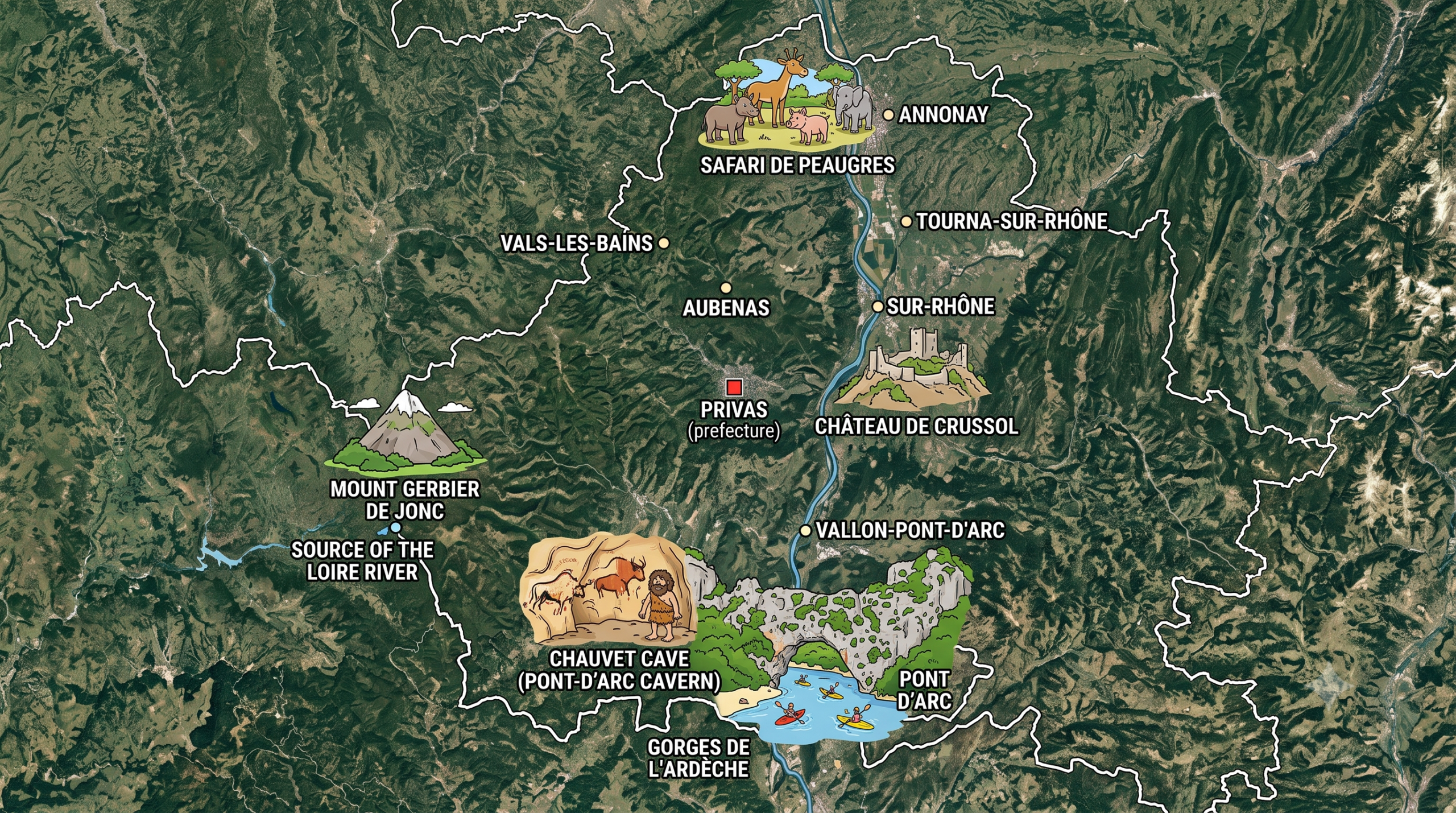
What you need to know about Ardèche ?
Here is the seventh department of France in alphabetical order, named Ardèche, which is divided into 335 municipalities, 17 cantons and 3 districts. The Ardèche department is one of the French administrative divisions shown on the map of France and is now part of the Auvergne-Rhône-Alpes region. Its population is around 334,000 inhabitants spread over an area of 5,529 km², representing an average density of 60.4 inhabitants per km².
Referring to the immigration rate, that of Ardèche is much lower compared to neighboring departments. However, most of its immigrants are native to the country and mainly gather in tourist sites. For the latter, the following are noted: Le Bourg-Saint-Andéol and Le Pouzin.
Historically, this department was created in 1790, following the adoption of the principles of the French Revolution and the establishment of the new administrative divisions. The inhabitants of Ardèche, particularly the Protestant communities that had long been affected by religious conflicts, gradually gained full recognition of their civil rights. At the beginning of the 19th century, the department had around 290,000 inhabitants, including nearly 34,000 Protestants belonging to a still significant religious community in the area.
We can therefore also affirm that Ardèche is one of the oldest French departments and, moreover, it was one of the 83 pioneers born following the revolution of 1790.

What are the neighboring departments of Ardèche?
Formerly named Vivarais, Ardèche was an old province before becoming a department. Moreover, it is integrated into the Auvergne-Rhône-Alpes region and its neighbors are:
- Drôme
- Vaucluse
- Gard
- Lozère
- Haute-Loire
- Isère
- Loire
Geographically, the territory of Ardèche is very contrasting due to its varying altitude: 40 m altitude for the lowest point, that is near the Rhône spillway, in the southern part.

What is the climate like in Ardèche?
Located in the southern part of the Hexagon, its climate is terrestrial with fluctuations caused by the Mediterranean Sea. Although there is a lot of sunshine here and mild winters, there will be a strong temperature fluctuation due to the influence of the mistral wind.
This wind could lower the temperature down to 8° during the month of January, which is also the coldest month. Conversely, during the summer months, temperatures hover around 29 °C especially in July, which is the hottest month. In short, the Ardèche climate is characterized as Oceanic type.
What are the cities of Ardèche?
Indeed, when based on demography, that is the number of inhabitants per km2, we were able to list these few cities:
- Annonay,
- Aubenas,
- Guilherand-Granges,
- Tournon-sur-Rhône,
- Privas,
- Le Teil,
- Bourg-Saint-Andéol,
- Saint-Péray,
- La Voulte-sur-Rhône,
- Viviers,
- Vals-les-Bains,
- Le Cheylard,
- Villeneuve-de-Berg,
- Les Vans,
- Le Pouzin,
- Davézieux,
- Roiffieux,
- Cruas.
What are the 10 largest municipalities in Ardèche ?
In terms of area, the 10 largest municipalities in Ardèche are:
- Saint-Remèze
- Saint-Étienne-de-Lugdarès
- Saint-Agrève
- Sablières
- Mazan-l’Abbaye
- Lagorce
- Gras
- Désaignes
- Cros-de-Géorand
- Bourg-Saint-Andéol
In terms of population density per km2, the 10 most important municipalities in Ardèche are:
- Annonay
- Aubenas
- Guilherand-Granges
- Tournon-sur-Rhône
- Privas
- Le Teil
- Saint-Péray
- Bourg-Saint-Andéol
- La Voulte-sur-Rhône
- Viviers
FAQ-Map of Ardèche
Ardèche is a department located in the Auvergne-Rhône-Alpes region, in southeastern France. It is famous for its natural landscapes, impressive gorges, mountains, and charming villages.
The prefecture of Ardèche is Privas, a town located in the heart of the department. It is the main administrative center and provides easy access to the territory’s natural and cultural attractions.
A map of Ardèche helps locate the main towns, rivers, landscapes, and must-see tourist sites. It is useful for planning a trip, organizing hiking routes, or discovering the different landscapes of the region.
