
What you need to know about the Doubs department ?
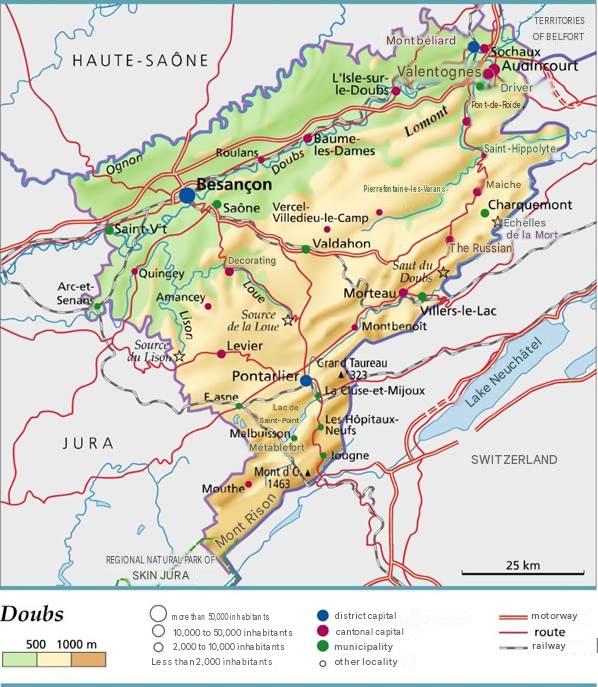
The Bourgogne-Franche-Comté region includes several French departments, and department 25 is one of them. It is the Doubs department, which takes its name from a river of the same name. Its capital and prefecture is called Besançon, but it also has sub-prefectures named Pontarlier and Montbéliard.

The surface area of the Doubs territory currently stands at 5,232 km² and its inhabitants total 553,062. This results in a density of 106 inhabitants per km², making the Doubs department the 50th most populous in France. This department is divided into 3 arrondissements, 19 cantons, and 571 communes.
Which departments border the Doubs department?
Since Doubs is a department in the Bourgogne-Franche-Comté region, it also borders other French departments, namely: the Jura department, the Territoire de Belfort department, the Haute-Saône department, the Jura department, and Neuchâtel.
What is the climate like in the Doubs department?
Doubs is remarkably warm in summer, which is pleasant, but winters are snowy and very harsh. However, cloudy skies are often observed throughout the entire year. Throughout the year, temperature fluctuations range from 12 to 15 °C, but do not go beyond that. Consequently, the warmest months in the Doubs department are July and August.
First, it should be noted that the summer periods last about 3 months, that is, from early June to early September. Temperatures hover around 18 °C during this period and the maximum temperature can even reach 22 °C.
The cold season, on the other hand, can last about 4 months and occurs between late November and early March. During this period, temperatures can drop to 7 °C at minimum, with this temperature drop observed in January.
Regarding humidity, the lowest humidities are about 0.04 inches during periods when precipitation is lowest. But the wet periods in Doubs are very variable throughout the year. Wet periods last about 8 months annually, starting from late April until early December, during which there is a 37% probability of precipitation. However, May is the rainiest month of the year. During this month, there are about 12.9 days of precipitation with 0.04 mm of precipitation per day.
On the other hand, during rainy periods, there are times when there is only rain or only snow, but sometimes both occur. The rainiest months are May and June, during which it rains about 13 days.
What are the best cities in the Doubs department?
To make this ranking, we based it on the most visited cities in the Doubs department:
- Besançon
- Pontarlier
- Montbéliard
- Morteau
- Baume-les-Dames
- Ornans
- Doubs
- Valdahon
- Audincourt
- Valentigney

What are the largest communes in the Doubs department?
For this ranking, we based it on the area of the Doubs departments, so here are the largest communes:
- Besançon
- Chapelle-des-Bois
- Levier
- Ornans
- Vercel-Villedieu-le-Camp
- Pontarlier
- Mouthe
- Frasne
- Villers-le-Lac
- Éternoz
For this ranking, we categorized the municipalities by population density per km2, so here are the most populated municipalities of Doubs.
- Besançon
- Pontarlier
- Valentigney
- Bethoncourt
- Baume-les-Dames
- Montbéliard
- Audincourt
- Morteau
- Seloncourt
- Grand-Charmont
FAQ: Doubs map
The citadel of Besançon offers an impressive panoramic view over the city. The Saut du Doubs is a spectacular natural wonder to discover.
Summer is perfect for hiking in the Jura Mountains. Winter attracts ski enthusiasts thanks to its numerous snowy resorts.
A car is recommended for exploring the hilly landscapes and remote sites. The rail network efficiently connects the main towns of the department.
