
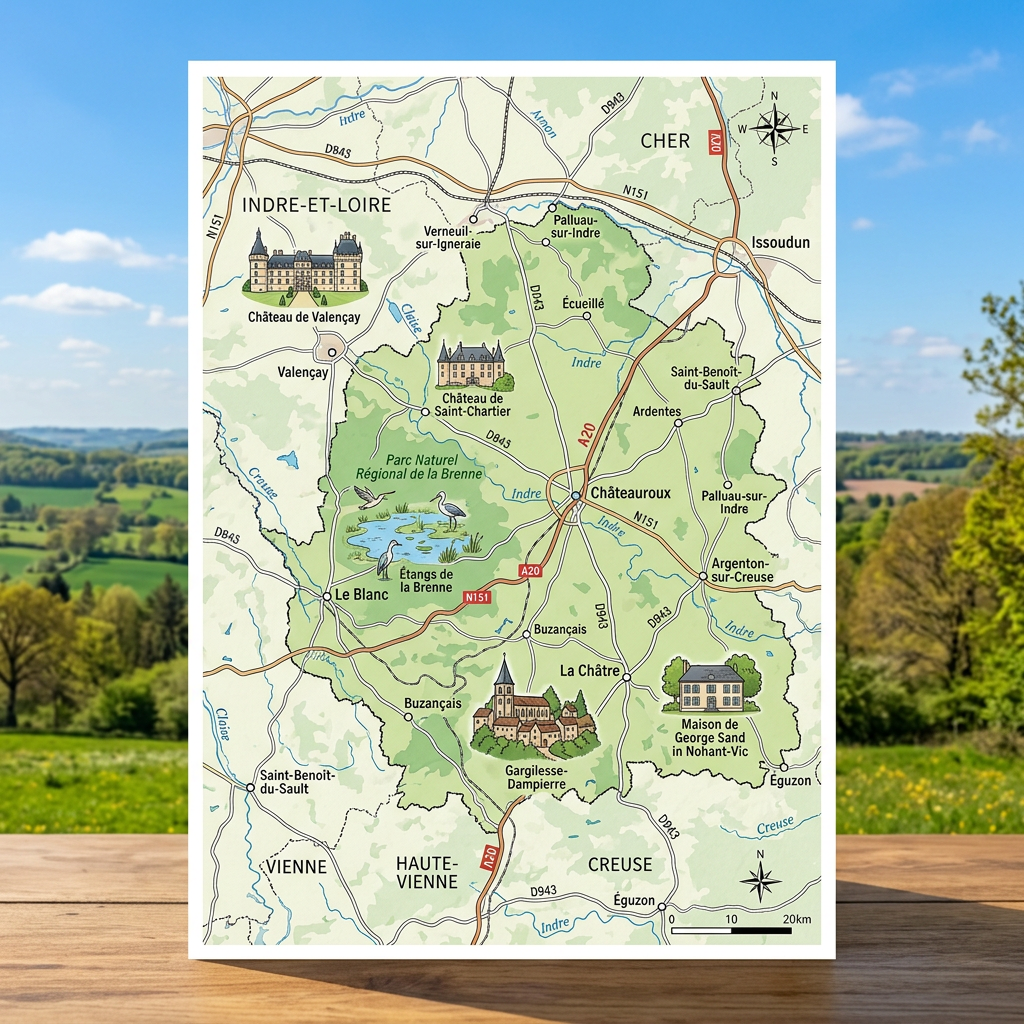
In the heart of the Berry region, the Indre department offers a mix of tranquil rivers, the ponds of La Brenne, and villages full of character. The map of the Indre helps link Châteauroux, Issoudun, Le Blanc, and La Châtre, while also serving as a base for exploring La Brenne and the valleys of the Creuse and Anglin rivers.
What you need to know about the Indre department ?
The department 36, called Indre, takes its name from the Indre river that runs through the center of France. An entirely landlocked territory, it has no access to the sea. The inhabitants of Indre are called Indriens and the department is part of the Centre-Val de Loire region.
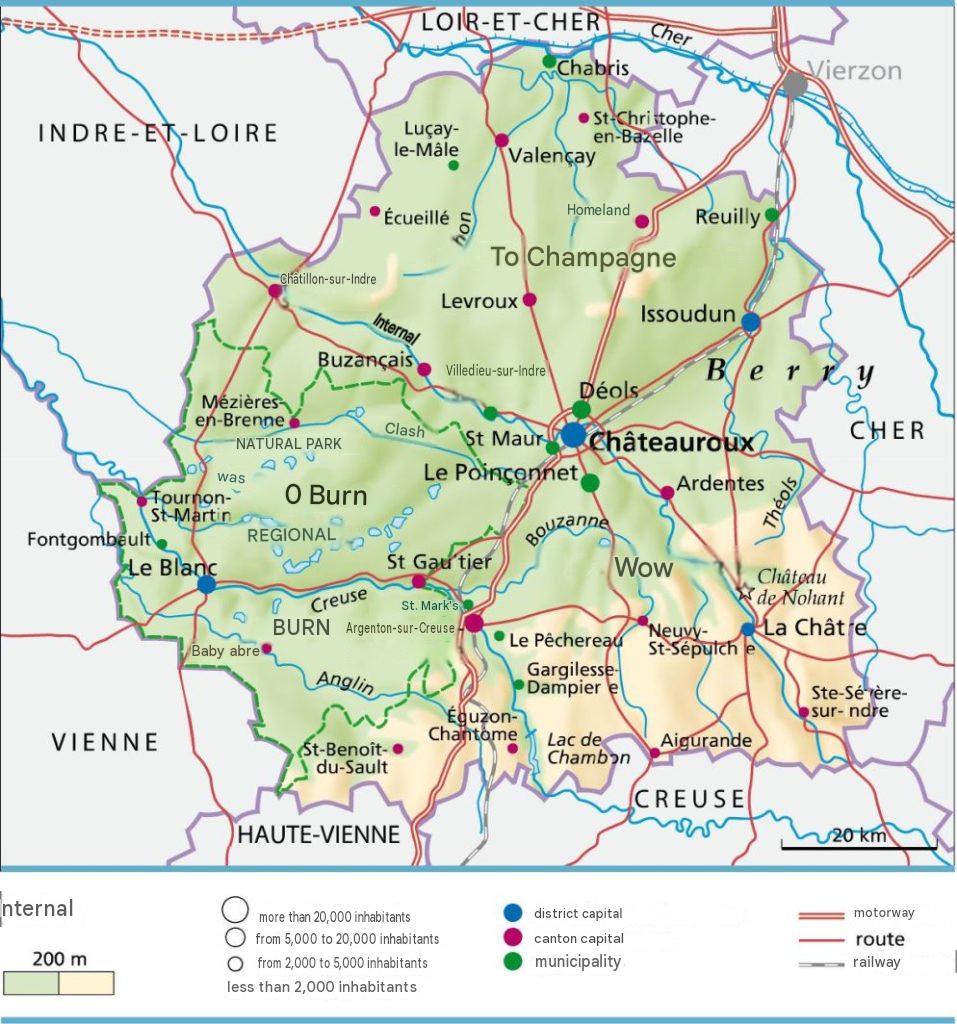
The prefecture and most populous city of the territory is Châteauroux. The department has three other sub-prefectures: Le Blanc, La Châtre, and Issoudun.
Indre covers 6,791 km² and is home to approximately 219,316 inhabitants, with an average density of 32 inhabitants per km². It is organized into 4 arrondissements, 13 cantons, and 241 communes.
Created in 1790 among the 83 departments established during the French Revolution, the territory of Indre largely corresponds to the former province of Berry.
Which departments border the Indre department?

| Element | Details |
|---|---|
| Region | Centre-Val de Loire |
| Prefecture | Châteauroux |
| Sub-prefectures | Issoudun, Le Blanc, La Châtre |
| Population | ~225,000 inhabitants |
| Area | ~6,800 km² |
| Relief: hydrography | Berry plains and plateaus, valleys of the Indre, Creuse and Anglin rivers, bocage and ponds of Brenne |
| Climate | Degraded oceanic with continental tendency: cool winters, mild summers |
| Economy | Agri-food, tertiary sector in Châteauroux, light industry, nature and heritage tourism |
| Key sites | Brenne Regional Natural Park, Azay-le-Ferron castle, Gargilesse-Dampierre, Saint-Benoît-du-Sault, Valencay (nearby) |
| Access | A20 Paris-Toulouse, N151, TER to Orléans-Tours, Châteauroux-Centre airport for freight and occasional flights |
The neighboring departments of department 26 are the Indre-et-Loire department bordering it on its western section, the Loir-et-Cher department bordering it on the northern and eastern sections, the Haute-Vienne and Creuse departments bordering it in the southern part, and the Vienne department bordering it in the southern section.
What is the climate like in the Indre department?
Based on the Köppen climate classification system, department 36, that is the Indre department, has an oceanic climate. This type of climate is also called a West Coast marine climate.
Overall, precipitation in the Indre department reaches 736 mm annually, with May being the wettest month. During this period, monthly precipitation reaches 73.7 mm. Conversely, the driest month is February, during which the average precipitation is 48.3 mm.
In Indre, the average annual temperature is 11.8 °C, but during warm periods, especially in July, the temperature can reach 20.2 °C. And during the coldest month, that is in January, the temperature can average 4.2 °C.
The best cities in the Indre department
Here are the cities in the Indre department with the highest tourist attendance:
- Châteauroux
- Buzançais
- Issodun
- Châtillon-sur-Indre
- Le Blanc
- Saint-Maur
- Maillet
- Le Poinçonnet
- Argenton-sur-Creuse
- Arthon
What are the largest communes in the Indre department?
Here are the largest communes by area in the Indre department:
- Vendœuvres
- Luçay-le-Mâle
- Velles
- Ardentes
- Chaillac
- Saint-Maur
- Lignac
- Prissac
- Azay-le-Ferron
- Rosnay

Here are the communes with the highest population density per km2, that is, the most populated communes in Indre:
- Châteauroux
- Déols
- Le Poinçonnet
- Buzançais
- Ardentes
- Issoudun
- Le Blanc
- Argenton-sur-Creuse
- La Châtre
- Saint-Maur
For your reference, start with the map of Indre and then broaden your preparation with the map of Loir-et-Cher and the map of Indre-et-Loire to connect Berry and the Loire Valley. To the southeast, compare the landscape continuities with the map of Creuse to anticipate relief and travel time.
FAQ: Map of Indre
Yes, the Indre Map highlights the Brenne, the valleys of the Creuse and Indre rivers, as well as remarkable villages to plan coherent stages.
An Indre Map with simplified relief and greenways allows you to create loops around ponds, hedgerows, and river valleys.
The Indre Map positions the A20, national roads, and TER stations towards Orléans and Tours to coordinate routes and connections.
