
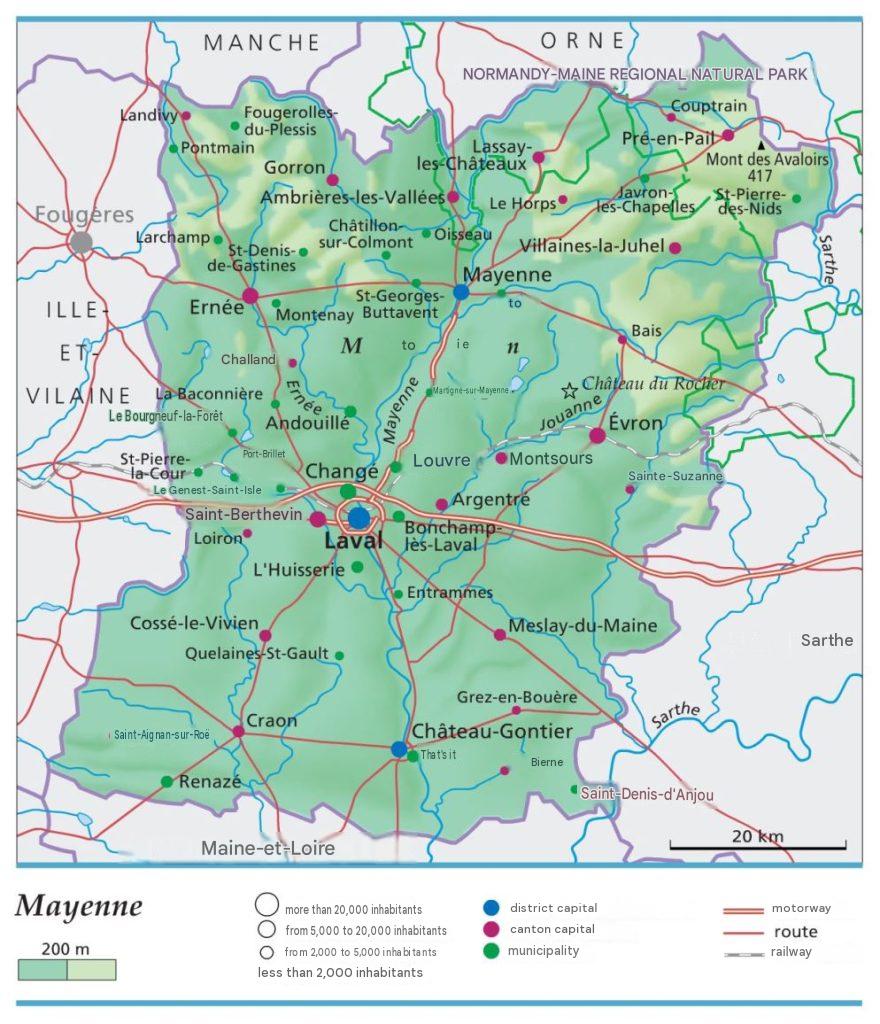
Here we present to you department 53, which is the department of Mayenne. Indeed, the region to which this department belongs is the Pays-de-la-Loire region. Department 53 is actually one of the 83 oldest departments in the Pays-de-la-Loire region and in France, established in 1790.
The prefecture, administrative center, and at the same time the largest city of the department is called Laval. Additionally, there are other sub-prefectures called Château-Gontier-sur-Mayenne and Mayenne. Led by a president of the departmental council, the territory of the Mayenne department is divided into Arrondissements, Legislative constituencies, Cantons, intercommunalities, and communes numbering respectively 3, 3, 17, 9, and 240.
Demographically, the territory of Mayenne, which covers an area of 5,175.2 km², is populated by 307,084 inhabitants. This means that the population density in Mayenne is approximately 59 inhabitants per km².

What are the neighboring departments of the Mayenne department?
Geographically, the territory of Mayenne is an inland territory of France, located in the northwestern section. It is also close to the Bay of Mont-Saint-Michel towards the northwest. Simply put, the department is rectangular in shape with a north-south axis. That is to say, it is crossed by the Mayenne river in its center.
To the west, its neighbor is the Brittany region with the department of Ille-et-Vilaine. To the north, it is the Normandy region with the departments of Orne and Manche. To the east, Mayenne’s neighbor is the department of Sarthe, and finally to the south, there is the department of Maine-et-Loire, which are also departments of the Pays-de-la-Loire region. In short, department 53 is a truly central department located halfway between Paris, Brittany, Caen, Angers, and Nantes.
What is the climate like in the Mayenne department?
Indeed, the Mayenne department is located in the Sequanian area. This means that its climate is somewhat similar to the climate of the Seine. This implies a healthy climate due to the fact that its territory is dominated by numerous hills, forests, ponds, and rivers. This means there is a lot of humidity in the air, so temperatures in this department are lower compared to neighboring departments.
Moreover, since the Mayenne department is located in northern France, summer in Mayenne is generally warm and occurs between June and September. Additionally, in terms of humidity, the rainiest month is December and the driest month is July.
In short, it is described as a temperate climate because Mayenne benefits from high rainfall. This means that even during the month with the least humidity, there is rain. The average annual temperature hovers around 11.3°C and precipitation is around 815 mm per year.

What are the most important cities in the Mayenne department?
We have ranked these cities based on the number of tourists they receive. So, here are the top 10 cities you should visit in the Mayenne department:
- Mayenne
- Laval
- Changé
- Saint-Berthevin
- Château-Gontier-sur-Mayenne
- Louverné
- Craon
- l’Huisserie
- Ernée
- Cossé-le-Vivien
What are the largest municipalities in the Mayenne department?
To make this ranking, we referred to the area of each municipality in the Mayenne department:
- Juvigné
- Torcé-Viviers-en-Charnie
- Pré-en-Pail-Saint-Samson
- Bouère
- Saint-Denis-d’Anjou
- Lassay-les-Châteaux
- Saint-Denis-de-Gastines
- Cossé-le-Vivien
- Quelaines-Saint-Gault
- Saint-Pierre-des-Landes
In the current second ranking of the municipalities of Mayenne, we grouped them according to the population density per km2:
- Laval
- Château-Gontier-sur-Mayenne
- Saint-Berthevin
- Bonchamp-lès-Laval
- Craon
- Mayenne
- Évron
- Ernée
- Changé
- Louverné

FAQ – Mayenne map
A Mayenne map helps locate the department’s main cities, roads, and administrative boundaries. It also provides an overview of rivers, natural areas, and neighboring municipalities.
A map is useful for planning a trip, organizing a route, or locating a place of interest. It also helps users better understand the department’s geography and territorial organization.
A detailed Mayenne map is available in printed form from certain organizations or in digital format on various specialized platforms. It may include municipalities, road networks, landforms, and the department’s main points of interest.
