
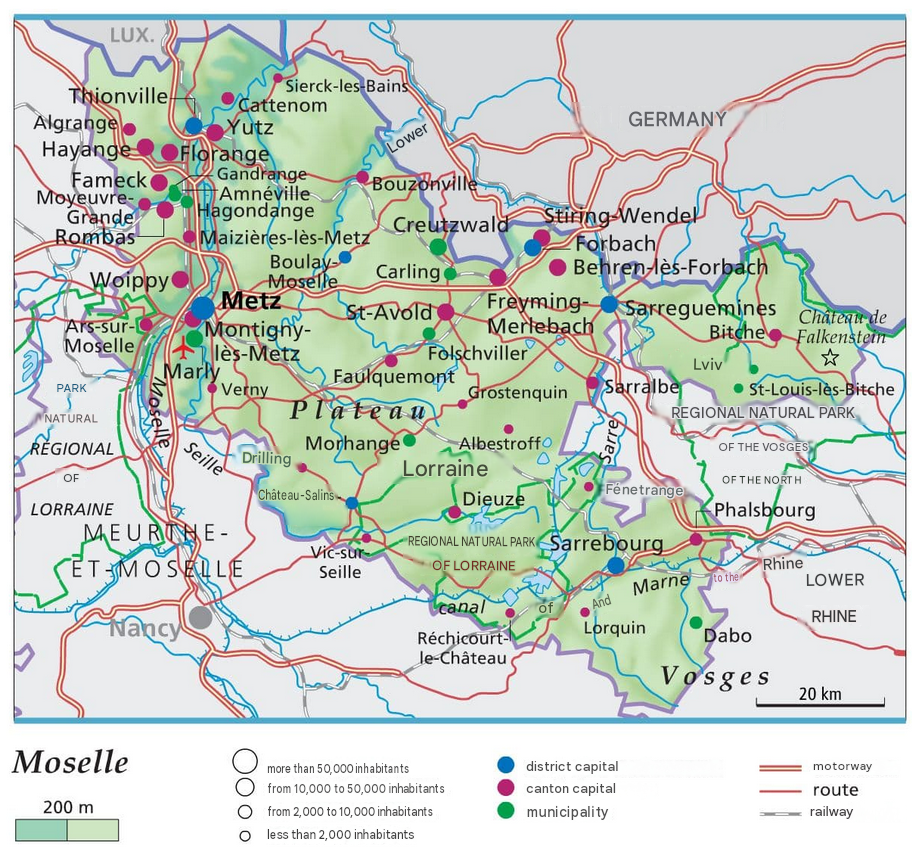
What you need to know about the Moselle department ?
Here we present to you the Moselle department, which, like the Morbihan department, is part of the Grand Est region. Furthermore, the fact that the name of the said department 57 comes from the river of the same name that runs through it, a river that is a tributary of the Rhine. This river also passes through Metz in a westward direction.
The department is currently one of several French departments that are very old, dating back to 1790. The prefecture of the department and its largest city is called Metz. In addition, its sub-prefectures are called Thionville, Sarreguemines, Sarrebourg, and Forbach. Department 57 is also governed by a departmental council led by its president Patrik Weiten.
In demographic terms, the Moselle department currently has 1,052,636 inhabitants, and the area of department 57 is 6,216 km², resulting in a population density of approximately 169 inhabitants per km². In addition, administratively, department 57 is divided into 5 arrondissements, 9 legislative constituencies, 27 cantons, 22 intermunicipal authorities, and 725 municipalities.

What are the neighboring departments of the Moselle department?
Indeed, the Moselle department is a department that has a western border with the Meurthe-et-Moselle department. To the east, department 57 is bordered by the Bas-Rhin department. And finally, to the north, department 57 shares a border with Luxembourg and Germany.
What is the climate like in the Moselle department?
The climate type of the Moselle area is degraded maritime or weakened with a semi-continental influence. The seasons are differentiated and perfectly distinct, but depending on the general gyres, periods of precipitation (maritime impact) or intense heat (continental impact) can occur in the short term.
Metz
The climate of Metz is of the altered maritime type with a truly controlled continental subtlety. Unlike those in western France, the temperature differences between winter and summer are generally more marked. Winters are moderately cold, summers generally stifling, and precipitation is fairly evenly distributed over time. However, the city’s location in the lower part of the valley relaxes the contrasting atmosphere with the surrounding levels, which is observable on winter nights.
Sarreguemines
The city of Sarreguemines has a warm and mild climate type. Sarreguemines is a city with challenging rainfall. In fact, even during the driest month, there are many showers. The Köppen-Geiger environmental guide classifies the environment as type Cfb. Sarreguemines has an average annual temperature of 9.5 °C. The annual rainfall is 722 mm.
What are the most important cities in the Moselle department?
We have ranked these communes according to the number of tourists who visit them, that is, here are the best tourist cities in Moselle:
- Metz
- Thionville
- Yutz
- Saint-Avold
- Forbach
- Hayange
- Sarreguemines
- Montigny-lès-Metz
- Vic-sur-Seille
- Baerenthal

What are the most important communes in the Moselle department?
To make this ranking, we referred to the area of each of the municipalities in the Moselle department.
- Saint-Quirin
- Dabo
- Metz
- Bitche
- Walscheid
- Thionville
- Mouterhouse
- Abreschviller
- Baerenthal
- Saint-Avold
Regarding this second ranking of the municipalities of Moselle, we grouped them based on the density of inhabitants per km2.
- Metz
- Montigny-lès-Metz
- Forbach
- Yutz
- Creutzwald
- Thionville
- Sarreguemines
- Saint-Avold
- Hayange
- Freyming-Merlebach
FAQ – Moselle map
A Moselle map helps locate the department’s main cities, roads, and administrative boundaries. It also provides an overview of valleys, rivers, natural areas, and neighboring municipalities.
A map is useful for planning a trip, organizing a route, or locating a place of interest. It also helps users better understand the department’s geography and territorial organization.
A detailed Moselle map is available in printed form from certain organizations or in digital format on various specialized platforms. It may include municipalities, road networks, landforms, and the department’s main points of interest.
