
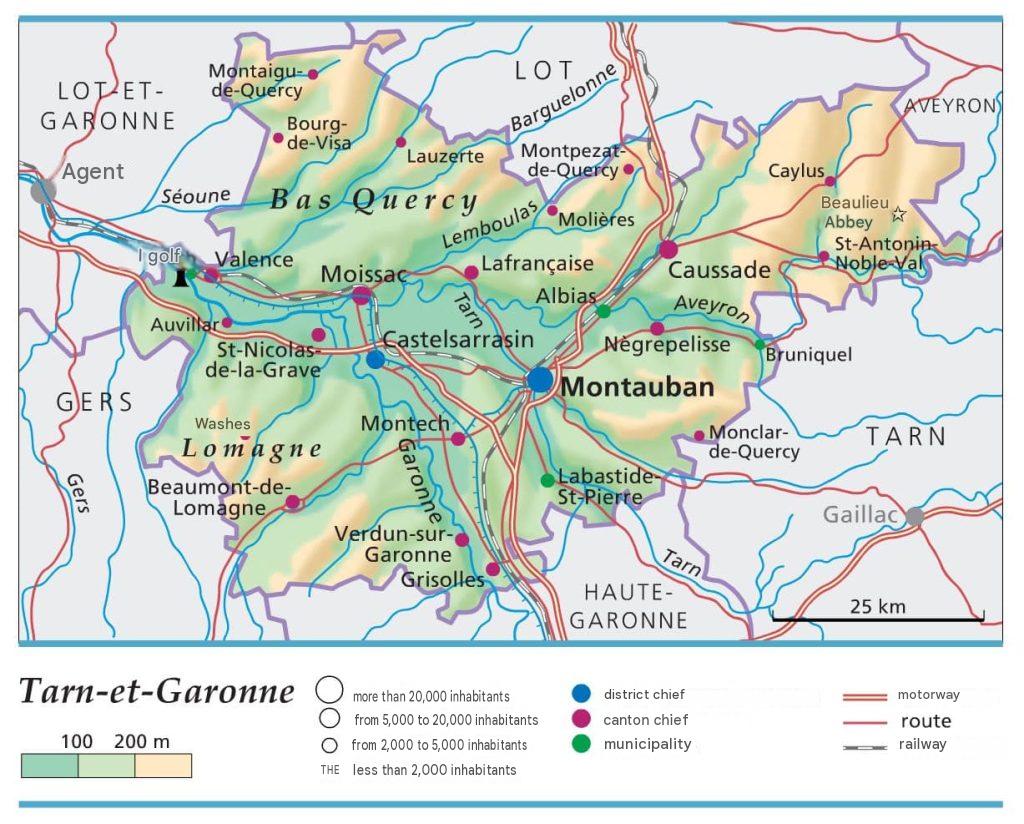
What you need to know about the Tarn-et-Garonne department ?
Let’s talk about a French department that is part of the Occitanie region; it is actually the 82nd French department called the Tarn-et-Garonne department. The name of the department obviously comes from a river of the same name and the Tarn, its tributary. This department 82 has a prefecture, which is also its administrative center, named Montauban, however, it has only one sub-prefecture called Castelsarrasin.
Demographically, the Tarn-et-Garonne department has a population of 267,803 inhabitants who are also called Tarn-et-Garonnais. Their density is 72 inhabitants per km² due to the fact that the surface area of the 82 is 3,717 km². Administratively, the Tarn-et-Garonne department is divided into 2 arrondissements, 2 legislative constituencies, 15 cantons, 10 intercommunal entities, and 195 communes.

Which departments border the Tarn-et-Garonne department?
As we know, department 82 is an integral part of the Occitanie region; its neighboring departments are the Lot department, the Aveyron department, the Haute-Garonne department, the Gers department, and the Lot-et-Garonne department.
What is the climate like in Tarn-et-Garonne?
It is important to first understand that the Tarn-et-Garonne department is located halfway between the Massif Central (which generates mountainous influences) and Gascony, which generates a mild climate. This allows the territory to benefit from the wildness and harshness of the Causse as well as the richness of the Garonne plains.
Thus, the fact that the department is halfway between the Atlantic Ocean and the Mediterranean Sea means that the Pyrenees and the Massif Central strongly influence the climate of Tarn-et-Garonne, making it oceanic and degraded.
This type of climate mainly produces a mild and humid winter, also interspersed with slightly cool periods, meaning there are 37 days of frost throughout the entire territory of department 82, specifically in Montauban. It could even reach -5°C. The winter period is consistently cold, causing winters to reach temperatures as low as -10°C. There is also a rarity of snowfall and rainfall is scarce.
When we talk about the summer period, on the other hand, we see many high temperatures and also a dry period. Sometimes, during this season, temperatures reach 30°C in the shade for 20 days or more per year. Regarding precipitation, rains are mainly generated by winds coming from the western part of the Tarn-et-Garonne department. Moreover, this amount of rain never exceeds 646 mm, specifically in the town of Monbéqui, which is also the least rainy part of the department.
But when we talk about other regions, on the other hand, it rains much more, about 836 mm in the commune of Montaigu-de-Quercy. Furthermore, in the western part of the department, more precisely in the northwest, there are 941 mm of precipitation.
Rains mainly occur during the winter and spring periods. There are also thunderstorms and sometimes a lot of hail in spring and autumn. During these periods, in Montauban, there are 425 mm of precipitation, but sometimes these rains reach up to 1000 mm. Regarding winds, they are numerous and mainly come from the west; in Montauban, winds can reach 119 km/h.
What are the most important cities in the Tarn-et-Garonne department?
Indeed, we have made this list of the 10 most visited cities by tourists in the 82 department.
- Montauban
- Bressols
- Moissac
- Caussade
- Labastide-Saint-Pierre
- Corbarieu
- Verdun-sur-Garonne
- Montech
- Goas
- Valence-d’Agen
- Glatens
What are the largest communes in the Tarn-et-Garonne department?
To establish this ranking, we referred to the area of the communes in the Tarn-et-Garonne department, so here are the 10 largest communes of the 82.
- Montauban
- Saint-Antonin-Noble-Val
- Caylus
- Moissac
- Castelsarrasin
- Montaigu-de-Quercy
- Cazes-Mondenard
- Lafrançaise
- Montech
- Nègrepelisse

FAQ: Tarn-et-Garonne map
The cloister of the Moissac Abbey is a masterpiece of Romanesque art. The village of Bruniquel offers an exceptional historical setting on the cliffs.
Summer allows you to fully enjoy water activities on the rivers. Spring is ideal for hiking among the orchards.
The car is the easiest way to access rural sites. The road network allows you to quickly connect Montauban to other towns.
