
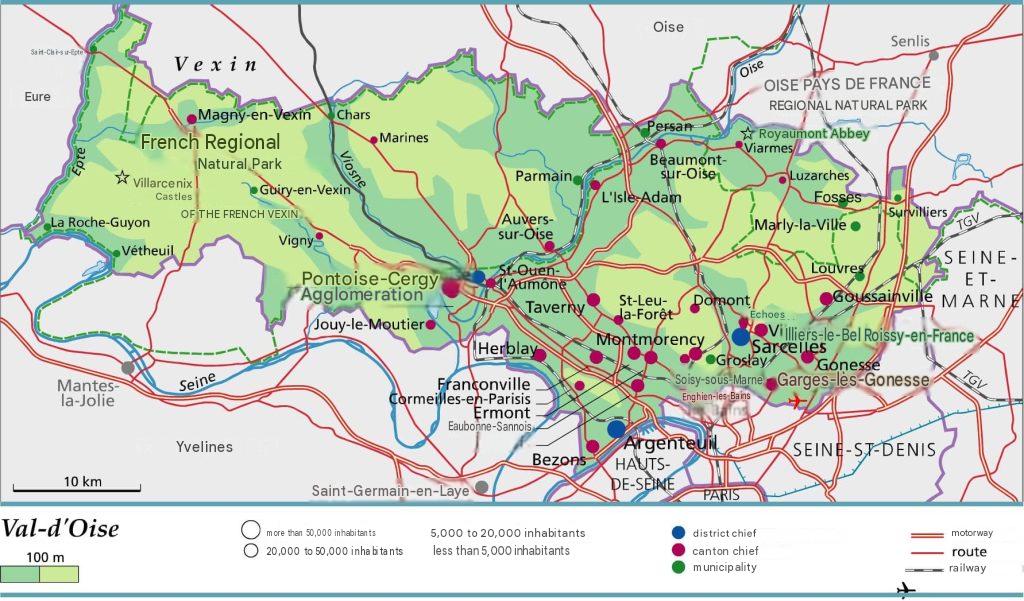
What should be known about the Val-d’Oise department?
We present to you here a French department that is an integral part of the Île-de-France region. It is an old department that was created from territories previously occupied by the Seine-et-Oise department. The Val-d’Oise department is also called department 95; it is a department that is part of the northern section of the Paris metropolitan area.
The fact is that the name of the department comes from the fact that it is crossed by a tributary of the Seine called the Oise. Department 95 has as its largest city and at the same time its prefecture, the city called Pontoise; its sub-prefectures are rather called Argenteuil and Sarcelles.
When discussing the demographics of the department, the Valoisiens total 1,304,986 inhabitants, and their density is approximately 1,047 inhabitants per km². This is due to the fact that the department covers an area of 1,246 km². Administratively, the department of Val-d’Oise is divided into 3 arrondissements, 10 electoral constituencies, 21 cantons, 10 inter-municipal cooperation structures, and finally 184 communes.

Which departments border the Val-d’Oise department?
The territory of the Val-d’Oise department being in the Île-de-France section of the country, its neighboring departments are: the Oise department bordering it to the north, the Seine-et-Marne department, which borders it to the east, the Seine-Saint-Denis department, which borders it to the east. Then there is the Hauts-de-Seine department which also borders it to the east, the Yvelines department which borders it to the south, the Yvelines department which borders it to the south, and finally, the Eure department which borders it to the south and southwest.
What is the climate like in the Val-d’Oise department?
Given that geographically, department 95 is an integral part of the Île-de-France region, its climate is then of a somewhat degraded oceanic type. The fact is that this climate is occasionally influenced by the continent with some moderation.
There is also the fact that the department is located in the southern part of the Paris metropolitan area department, which causes the temperature to rise a bit, around 1 or 2°C depending on climatic conditions compared to other areas. This type of difference is what one quickly notices when approaching dawn when the weather is calm and with an anticyclone, and it should also be added that this situation can be strongly accentuated as the year progresses.
On average, the temperature in the department’s territory is 12°C throughout the year with the coldest month being January. Also, during this month, the average temperature fluctuates around 4°C. In contrast, during the hottest months, July and August, the average temperature oscillates around 19°C.
There are 40 days in the year with average temperatures of 25°C and 8 days are very hot with average temperatures around 30°C. When talking about precipitation, there are about 115 rainy days throughout the department, these rains have approximately 625 to 718 mm of average precipitation per year. Finally, when talking about sunshine duration, it is 1,719 hours per year.
What are the most important cities in the Val-d’Oise department?
We have compiled for you the 10 best cities in the Val-d’Oise department; these are the 10 most visited tourist cities in department 95
- Herblay-sur-Seine
- Cergy
- Eaubonne
- Franconville
- Cormeilles-en-Parisis
- Saint-Leu-la-Forêt
- Enghien-les-Bains
- L’Isle-Adam
- Taverny
- Eragny
What are the largest municipalities in the Val-d’Oise department?
To establish this ranking, we referred to the area of the municipalities in the Val-d’Oise department. Here are the 10 largest municipalities in the 95:
- Luzarches
- Gonesse
- Argenteuil
- Chars
- Arronville
- L’Isle-Adam
- Chaussy
- Roissy-en-France
- Asnières-sur-Oise
- Magny-en-Vexin

FAQ: Val-d’Oise map
The departmental website or local tourist offices provide detailed cycling maps. These resources highlight greenways and safe routes for your rides.
Yes, departmental tourist maps showcase the castles, museums, and notable sites to visit. You will also find practical information there to organize your cultural trips.
The Vexin Français Regional Natural Park offers specialized maps to discover its hiking trails. These documents are available at park visitor centers or on their website.
