
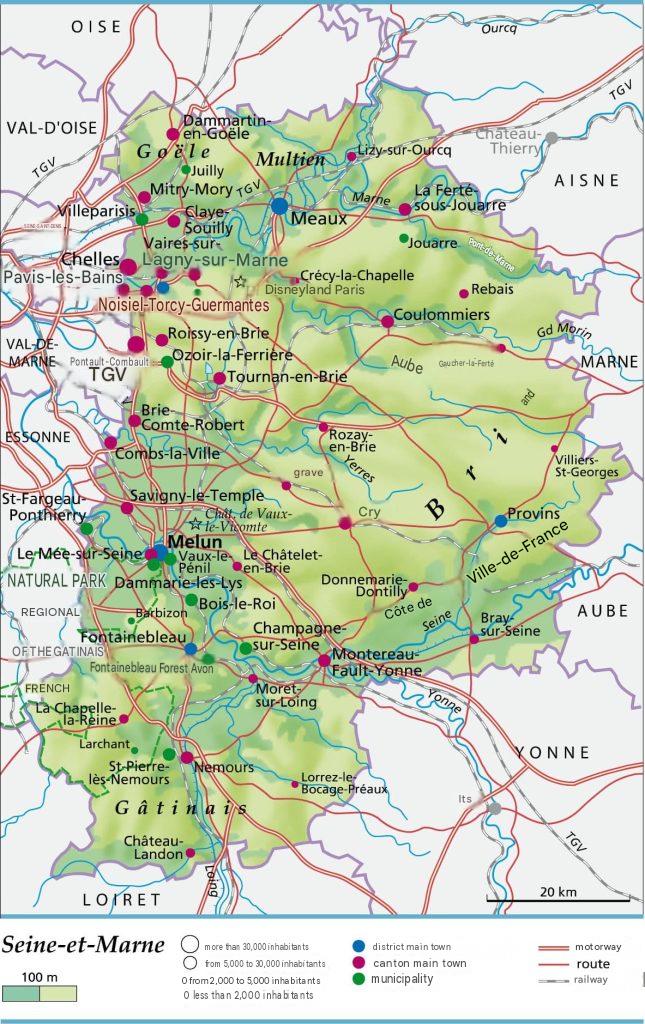
What you need to know about the Seine-et-Marne department ?
We now present to you a landlocked French department, meaning it has no access to the sea and is an integral part of the Ile-de-France region. Moreover, its name is indeed derived from the two rivers that cross it, namely: the Marne, which is a river, and the Seine, which is a major river. The Seine-et-Marne department is also called department 77.
It is actually one of the oldest departments, dating back to the French Revolution of 1790. The territory it currently occupies was formerly part of the old provinces of Orléans (in part), Champagne, and the province of Ile de France.
The administrative center and prefecture of the Seine-et-Marne department is Melun. The department has four sub-prefectures: Torcy, Provins, Meaux, and Fontainebleau. Regarding demographics, the department covers an area of 5,915 km² and has a population of 1,502,094 inhabitants (2026 INSEE estimate). This results in a population density of approximately 254 inhabitants per km². Administratively, the department is divided into 5 arrondissements, 11 legislative constituencies, 23 cantons, 23 intercommunal structures (EPCI), and 507 municipalities.
Furthermore, administratively, department 77 is subdivided into several territories, namely 5 Arrondissements, 11 administrative districts, 23 cantons, 21 intercommunalities, and 507 communes.

Which departments border the Seine-et-Marne department?
Indeed, since Seine-et-Marne is a landlocked department, its neighbors belong to several regions including:
- The Hauts-de-France region: there is the neighboring department of Oise which borders it to the northwest, the Oise department which borders it to the north, and Aisne which borders it to the northeast and north.
- Next, there is the Centre-Val-de-Loire region: to the west, there is the Val-de-Marne and Essonne departments (which also incidentally border it in the southwest) and finally, the Loiret department to the south.
- As for the Bourgogne-Franche-Comté region, there is the Yonne department which borders it to the south and southeast. Finally, for the Grand-Est region, there is the Marne department and the Aube department.
What is the climate like in the Seine-et-Marne department?
Indeed, it is a temperate climate type strongly influenced by the Atlantic. This type of climate is characterized by somewhat high rainfall, especially near the area occupied by Fontainebleau, but this is also felt approaching the Brie-Française from the east. This is why this rainfall zone is called: Humid Brie, defined by 700 mm of annual rainfall compared to the average of department 77 which is 650 mm.
This is slightly more than the rest of the Île-de-France region, which only receives 600 mm of rain. However, in terms of temperature, winter is a bit colder in this department 77 area. That is to say, at the beginning of the year (January), the temperature averages 3.2 °C with 18.6 °C during the warm period, i.e., in July.
There are also times of somewhat stronger thunderstorms. Sometimes there is also a heatwave inside the Seine-et-Marne department because temperatures can even reach 39.5°C during the summer, which is one of the highest in the Île-de-France region.
There are even sometimes many storms that can raise the level of the riverbed and cause them to overflow. This is the cause of some floods because sometimes it has even been measured that there were 2 to 3 meters of water level rising during rainy periods.
What are the most important cities in the Seine-et-Marne department?
To make this ranking of the most important cities in department 77, namely Seine-et-Marne, we referred to their surface area.
- Chelles,
- Meaux,
- Melun,
- Pontault-Combault,
- Savigny-le-Temple,
- Champs-sur-Marne,
- Villeparisis,
- Torcy,
- Roissy-en-Brie,
- Combs-la-Ville,
What are the largest communes in the Seine-et-Marne department?
To establish this ranking, we referred to the surface area of the communes in the Seine-et-Marne department, so here are the 10 largest communes of 77
- Fontainebleau
- Jouarre
- Louan-
- Villegruis-Fontaine
- Jouy-le-Châtel
- Lumigny-Nesles-Ormeaux
- Chenoise-Cucharmoy
- Villiers-Saint-Georges
- Égreville
- Mitry-Mory

FAQ: Seine-et-Marne map
The department’s official website offers a comprehensive interactive map. It allows for precise viewing of roads and municipalities.
Yes, it lists monuments and protected natural areas. These places are quickly identifiable thanks to icons.
The site allows you to export the selected area in PDF format. You can then print this document to make your navigation easier.
