
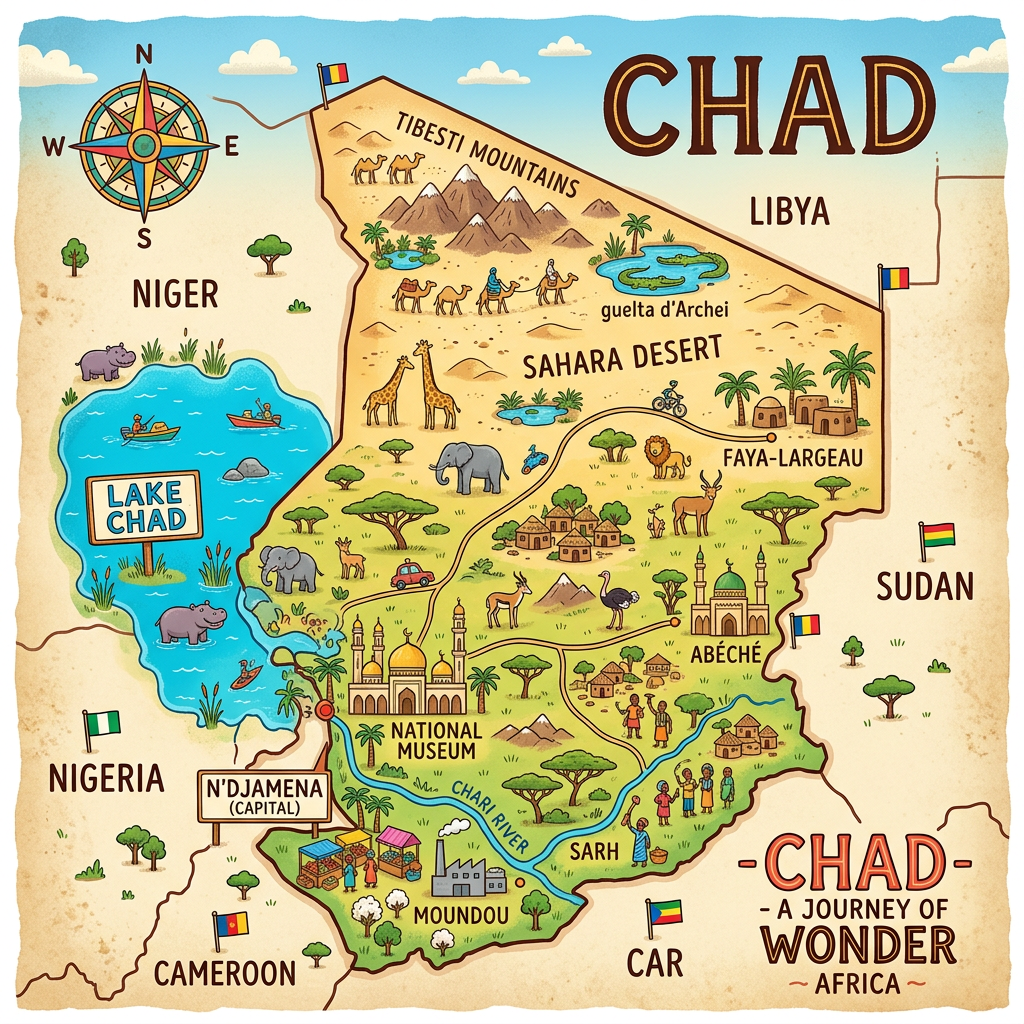
What You Need to Know About Chad
The Chadian state is an African state, it has the status of a unitary presidential constitutional republic. Its metropolis and largest urban area is N’Djamena, and the official languages spoken in the country are French and Arabic.
Furthermore, the total area of the Chadian territory is 1,284,000 km2 and the total population of the country is 16,877,357 inhabitants. Chad is part of several international organizations including the UN, the AU, the ECCAS, the CEMAC, and OHADA, and the country’s telephone code is 235.

Colors of Chad
The flag of Chad is a rectangular flag composed of 3 vertical stripes blue, yellow, and red from left to right. The blue color represents the blue of the sky and the sea. The yellow symbolizes the sun and the beach, and the red color symbolizes the blood shed during the struggle for independence.

Best places to visit in Chad
N’Djamena: As the capital and largest city in the country, it blends modern districts with traditional architecture, showcasing the dynamism of a nation in full development. It is a vibrant cultural hub where you can explore the National Museum, rich in Chadian history, before enjoying its lively bars and nightlife.
Sarh: Once a key outpost of the French colonial administration, this southern city is now a major economic hub, renowned for its cotton plantations and textile industries. It also features an international airport to facilitate regional travel.
Faya-Largeau: Located in the heart of the Sahara, in the northern part of the country, this large oasis is marked by a particularly hot and arid desert climate. It serves as the perfect starting point for guided expeditions to discover the spectacular landscapes of the Chadian desert.
Moundou: The second most populous city in Chad, located in the south, it is considered the true economic capital of the country. Traveled by the Logone River, it is particularly famous for its industrial production, notably its historic brewery (producing Gala beer, famous throughout the region) and cotton processing.
Abéché: The fourth-largest city and a historic crossroads of eastern Chad, it is the ancient capital of the powerful Ouaddai Sultanate. It is a city with a unique Sahelian charm, well-known for its bustling livestock markets, leather craftsmanship, and colonial and royal ruins.
Where is Chad located
On the world map, the Chadian state is located in Africa, more precisely, it is situated in the center of the continent and is landlocked between Libya, Cameroon, Nigeria, Niger, the Central African Republic, and Sudan.

Climate in Chad
The Chadian territory is subject to a hot continental climate. This translates into varying rainfall from 100mm to 1,200mm. Saharan zone: this part of the territory experiences less frequent rainfalls, between 50 and 200 mm per year.
The central zone or Sahelian belt experiences higher rainfall ranging between 400 and 800mm. Finally, there is the Sudanian zone which is the rainiest part of the Chadian territory, with rainfall between 800 and 1200 mm per year.
Administrative division of Chad

The territory of Chad is divided into 23 provinces, which are further subdivided into 107 departments. Here are the 23 provinces of the country:
- Barh el Gazel
- Batha
- Borkou
- Chari-Baguirmi
- Ennedi East
- Ennedi West
- Guéra
- Hadjer-Lamis
- Kanem
- Lac
- Logone Occidental
- Logone Oriental
- Mandoul
- Mayo-Kebbi East
- Mayo-Kebbi West
- Moyen-Chari
- Ouaddaï
- Salamat
- Sila
- Tandjilé
- Tibesti
- Wadi Fira
- Region of N’Djamena
Economy of Chad
About one-third of the country’s active population is rural, their main activity being livestock farming and subsistence agriculture. The country’s industrial sector has recently developed as oil fields have been put into production. Now oil represents 80% of the country’s trade. Here is some economic information:

- Currency: Central African CFA franc (XAF)
- Nominal GDP: $19.1 billion USD
- GDP in Purchasing Power Parity (PPP): ~$67.4 billion USD
- Annual GDP Growth Rate: +5.6%
- Nominal GDP per Capita: ~$1,035 USD
- GDP per Capita in PPP: ~$3,460 USD
- Population Below the Poverty Line: 42.3% (National poverty line) / Over 62% (According to World Bank international vulnerability criteria)
- Inflation Rate: -2.6% to -2.8% (Temporary deflation driven by lower food prices)
Population and linguistic data of Chad
According to the most recent demographic data, the population of Chad has now reached approximately 19.2 million inhabitants. The country displays an exceptional demographic momentum with an annual growth rate of 3.1%. The fertility rate remains among the highest in the world, with an average of 5.6 children per woman. Meanwhile, birth and mortality rates stand at 41.8‰ and 9.4‰ respectively.

At birth, the average life expectancy for a Chadian is 53.5 years – specifically 51.6 years for men and 55.4 years for women. The median age of the population is 15.7 years, confirming that Chad has one of the youngest populations in the world. The overall sex ratio is perfectly balanced at approximately 100 men per 100 women.
French and Chadian Arabic are the two official languages of the country, with Sara being the most widely spoken local language in the south. The population is characterized by a rich ethnic diversity, led by the Sara (30.5%), followed by the Arabs (12.3%), the peoples of Mayo-Kebbi (11.5%), the Kanem-Bornou (9%), the Ouaddai and Zaghawa (8.7%), the Hadjarai (6.7%), the Tandjilé (6.5%), and the Gorane (6.3%).
On the spiritual front, the dominant religions are Islam (52.1%) and Christianity (44.1%) – the latter being divided between Catholicism (20%) and Protestantism (24.1%). Traditional beliefs, such as Animism, along with other faiths, represent about 3.8% of the population.
FAQ: Chad Map: Geographic and Demographic Information
Chad covers approximately 1,284,000 km², making it one of the largest countries in Africa. It stretches from the Sahara Desert in the north to the savannas in the south.
The capital of Chad is N’Djamena, located in the southwestern part of the country. It serves as the nation’s main political, economic, and administrative center.
According to recent estimates, Chad has a population of more than 18 million inhabitants. Its population is young and made up of a wide diversity of ethnic and linguistic groups.
