
There are countries where the train is used for transportation, and a country where it is the destination itself. In Switzerland, some lines were laid not to save time, but to cross landscapes that the road does not reach.
Two trains alone carry this reputation, and a good part of the journey takes place on tracks listed as a World Heritage site. Here is what you need to know before booking.
The Glacier Express, eight hours between Zermatt and Saint-Moritz
Nicknamed the slowest express in the world, the Glacier Express connects the foot of the Matterhorn to the Engadine in a full day, about eight hours of travel for 291 bridges and 91 tunnels.
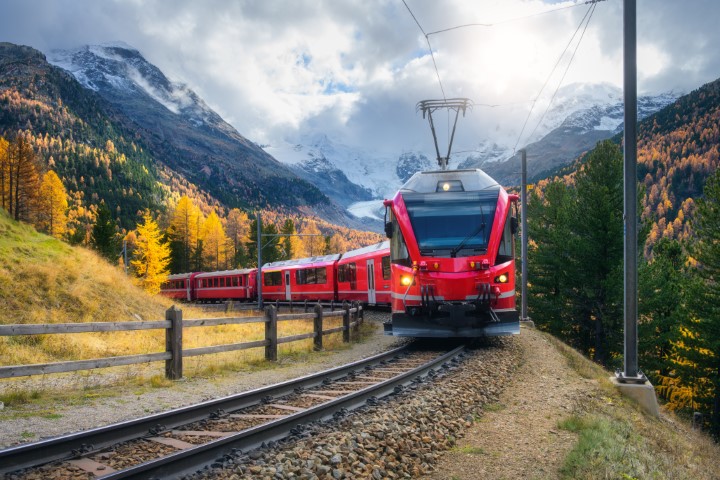
The route peaks at the Oberalp Pass, at 2,033 meters. It mainly crosses the Rhine Gorge, this white limestone canyon that the Swiss call their Grand Canyon, where the river winds for about fifteen kilometers between cliffs several hundred meters high.
The panoramic cars with windows extending onto the roof completely change the experience: you look upwards, towards the peaks, and no longer just horizontally.
Eight hours sitting seems long on paper. On site, no one looks at their watch.
The Bernina Express, from glaciers to palm trees
The other great classic connects Chur, the oldest city in Switzerland, to Tirano in Italy. The nickname sums up the journey: you start from the snow and arrive among the palm trees of Valtellina, in about four hours.
The train crosses the Bernina Pass at 2,253 meters, at the Ospizio Bernina station, the highest point of the Rhaetian Railway network. Then it descends to about 430 meters altitude at Tirano, with slopes reaching 70 per thousand.
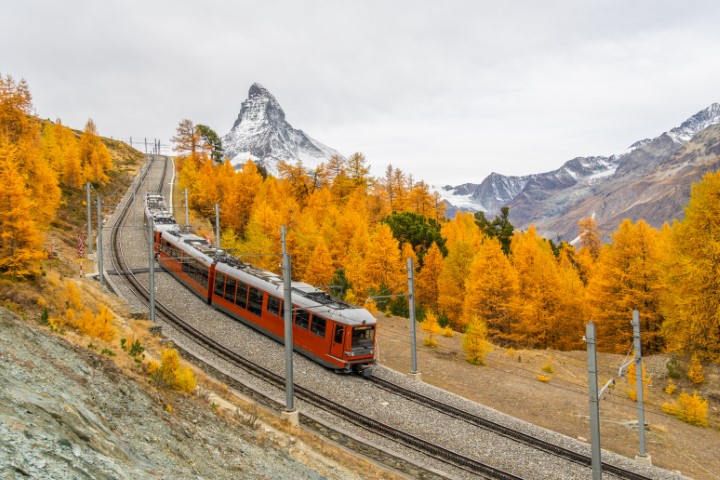
A technical feat deserves to be noted, and it escapes most travelers: this line climbs and descends entirely by adhesion, without a rack, on a meter-gauge track. The 55 tunnels and 196 bridges on the route serve precisely to spread out the slope to make this feat possible.
Since 2008, the Albula and Bernina lines have been listed as UNESCO World Heritage sites for the exceptional integration of a railway into a mountain landscape.
The three structures that justify the ticket alone
The Landwasser viaduct first. 142 meters long and 65 meters high, it draws a curve over the void before plunging directly into the rock face, without transition. It is one of the most photographed railway structures on the planet.
The Brusio spiral viaduct next, a complete 360-degree loop in the open air, designed to lose altitude without excessively lengthening the route. From the last cars, you can see its own locomotive completing the spiral.
The Morteratsch glacier finally, visible from the train, marked with indicators showing the successive positions of the glacier front since the 1880s. The geography lesson is silent and perfectly clear.
Organizing your trip without unpleasant surprises
Some practical guidelines avoid common mistakes.
- Seat reservation is mandatory on these panoramic trains, in addition to the travel ticket. It must be made in advance, especially during the high season.
- The direction of travel matters. Find out which side offers the best views depending on the direction taken; the gap between the two windows is real.
- The season changes everything. Winter offers the most spectacular snowy landscapes, summer the long days and clear glaciers.
- Splitting the journey remains possible. Getting off at Saint-Moritz, Filisur, or Poschiavo allows you to break up a long trip and explore the villages, provided you take a reserved train again.
For those who have several days, the Swiss network allows chaining these lines with other panoramic routes, from Lake Geneva to the Bernese Oberland and then towards Ticino.
The souvenir that rail travelers bring back
The shops in Swiss train stations sell a lot of chocolate, and one more unexpected thing: miniature trains. This is not a commercial coincidence.
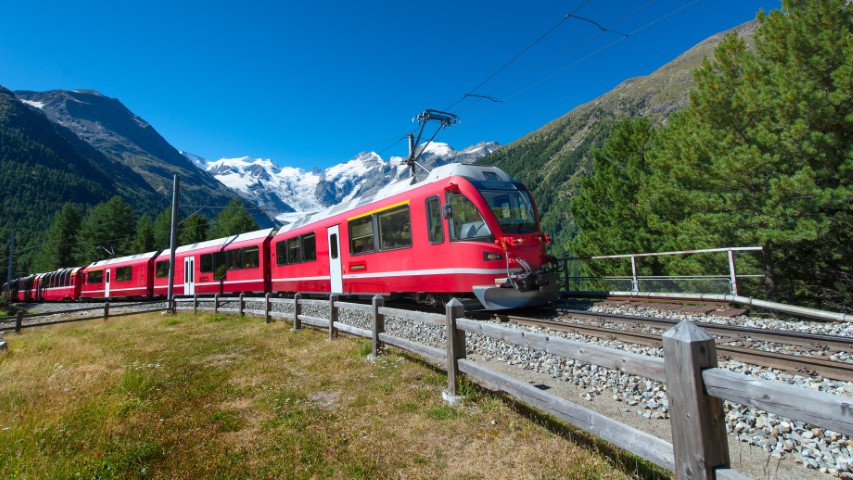
The red trains of the Rhaetian Railway are among the most reproduced models in the world by model manufacturers, and their meter-gauge track even gave rise to a specific variation, the HOm, designed to represent these mountain lines alongside classic trains.
Bringing back the miniature of the train just taken is therefore a more coherent souvenir than it seems. Many travelers start this way, with a single locomotive placed on a shelf, before adding a viaduct, then an alpine scenery.
At specialized retailers, you can find everything needed to gradually compose a HO scale train network, the most widespread scale, which allows you to recreate at home a fragment of the line actually traveled.
A fridge magnet rarely tells a story of a trip. A miniature viaduct does.
To locate the Grisons and prepare your itinerary, find the region on our map of Europe.
FAQ: the panoramic train in Switzerland
The Glacier Express connects Zermatt to Saint Moritz in about eight hours, crossing the Oberalp Pass and the Rhine Gorge. The Bernina Express goes from Chur to Tirano, Italy, in about four hours, via the Bernina Pass at 2,253 meters. The latter uses UNESCO-listed lines and is better suited for family trips.
Yes, seat reservation is mandatory on both the Glacier Express and the Bernina Express, in addition to the ticket or transport pass. It is especially required in summer and during winter holidays, as these trains often sell out.
The Albula and Bernina lines were inscribed on the UNESCO World Heritage list in 2008 for the exceptional quality of their integration into the Alpine landscape. Their viaducts, helical tunnels, and looped routes allow crossing more than 2,200 meters in altitude without a rack railway.
Winter offers snowy landscapes and a special light on the mountain passes, summer longer days, clear glaciers, and the possibility to hike at the stops. Spring and autumn have the advantage of less crowding and often more affordable prices.
Sources
For further reading: Rhaetian Railway in the landscapes of the Albula and Bernina (Switzerland Tourism) and Bernina Express (Switzerland Tourism).


