
What you need to know about Niger ?
The state of Niger is an African semi-presidential republic. It is a member country of ECOWAS as well as the Organization of Islamic Cooperation. Its largest city and metropolis is called Niamey. The total area of Nigerien territory is 1,267,000 km2, making it the 23rd largest in the world.
Niger has an estimated population of around 29.5 million inhabitants in 2026, making it one of the most populous countries in West Africa. The country’s international calling code is +227.
Colors of Niger
The Nigerien flag is a rectangular flag with three horizontal color bands. From top to bottom: orange, white, and green. In the center of the white band, there is an orange disc. The bands are all the same size and here are their meanings:
- The orange color represents the arid northern sections of the country (those bordering the Sahara)
- The white color represents innocence, altruism, and purity
- The green color represents the natural sections of the country (fertile soils and forests)
- The orange disc represents the sun.

Best places to visit in Niger?
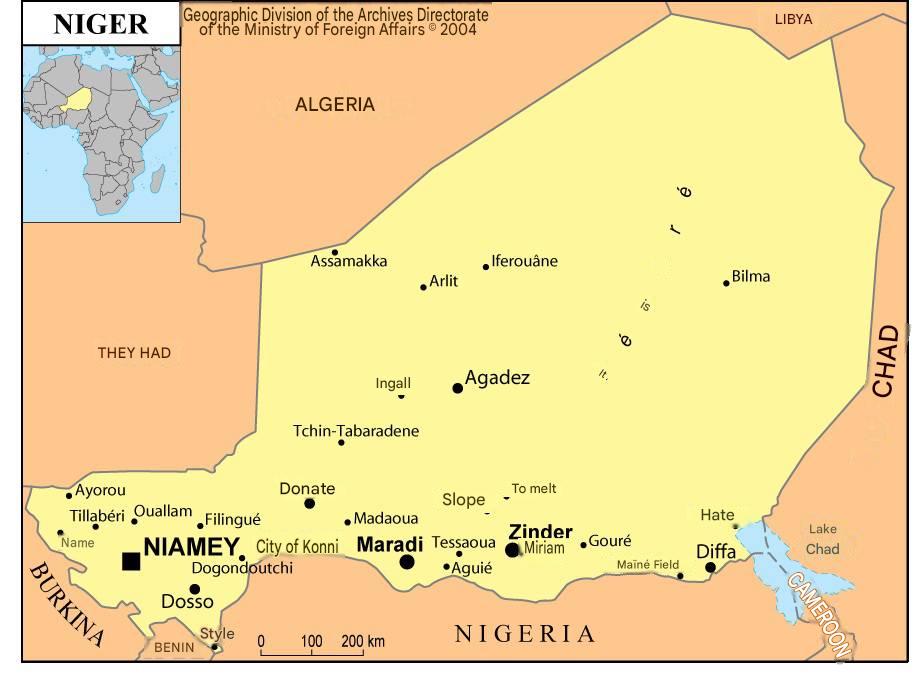
Niamey: The capital of Niger is an agricultural, industrial, and artisanal area of the country. There is a national museum as well as an international airport. However, the modern aspects of the city are contrasted by slums due to a lack of adequate social services.
Zinder: This city is an important trans-Saharan commercial center but also the birthplace of peanut production and processing. Zinder has an international airport as well as road infrastructure for the transportation of goods.
Maradi: It is a city full of administrative buildings as well as oil refining factories and leather manufacturing plants.
Where is Niger located on the world map?
On the world map, Niger is located on the African continent. More precisely, the Nigerien territory is situated halfway between Sub-Saharan Africa and North Africa. It is therefore a landlocked country bordered by Mali, Burkina Faso, Benin, Nigeria, Chad, Libya, and Algeria.
These countries border it respectively to the west, southwest, south-southwest, south, southeast, northeast, and north.

Climate of Niger
The Nigerien climate is generally hot, but the territory can be divided into 3 climatic sections: the northern Sahara desert, the Sahel south of the desert, and the Sudan region in the southwest corner.
The Saharan zone is quite hot and sometimes, precipitation evaporates before reaching the territory due to the heat.
The annual rainfall in this part of the territory is only 20mm per year or in some parts 250mm.
North of the Sahel, the annual rainfall is 165mm but this can vary randomly. To the south, in the Sudanese zone, the annual rainfall is 870 mm.
Temperatures in the northern Sahara range between 31 to 41°C and in the other zones temperatures range between 20 and 32°C.
Administrative division Niger

The Nigerien territory is divided into 7 administrative regions. These regions are then divided into 36 departments which in turn are composed of 265 communes.
Here are the regions of Niger:
- Agadez Region
- Diffa Region
- Dosso Region
- Maradi Region
- Tahoua Region
- Tillabéri Region
- Zinder Region
Economy Niger
The Nigerien economy is essentially agricultural. This primary sector represents about 50% of the country’s GDP. However, the industrial sector is less developed, mainly based on the extraction and processing of uranium mineral, which is one of the main sources of income for the country. Here are some economic data:
- Nominal GDP: approximately USD 21.2 billion in 2026
- GDP at Purchasing Power Parity (PPP): approximately USD 69.8 billion in 2026
- Annual GDP growth rate: 3.6% in 2026
- GDP per capita at Purchasing Power Parity (PPP): approximately USD 2,080
- Inflation rate: approximately 7.8%
- Population living below the poverty line: approximately 75% of the population
Population and linguistic data Niger

The Nigerien population is currently 23,310,715 inhabitants with an annual demographic growth rate of 3.8%. The urban population in the country is 16.5% and the density per km2 is 18 inhabitants.
The median age of the Nigerien population is 16.0 years, which indicates a very young population. However, the life expectancy of a Nigerien man and woman at birth are respectively 60.9 years and 63.2 years. The literacy rate in the country is 28.7%.
The labor force participation rate in the country is 64.7%. Here are the ethnic origins of the population: Hausa (56%), Djerma Songhai (21%), Tuareg (9%), Peuhl or Fulani (8.5%), Kanouri Manga (4%). The religions of the country are: Islam (80%) and the rest (Christians and traditionalists) (20%).
FAQ – Niger map: Geographic and demographic information
Niger is a landlocked country located in West Africa. It shares borders with seven countries, including Algeria, Nigeria, Mali, and Chad.
Niger has a population of more than 28 million people in 2025. It has one of the youngest populations in the world, with strong demographic growth.
Niger covers an area of approximately 1,267,000 km², making it one of the largest countries in West Africa. A large part of its territory is occupied by the Sahara Desert.
