
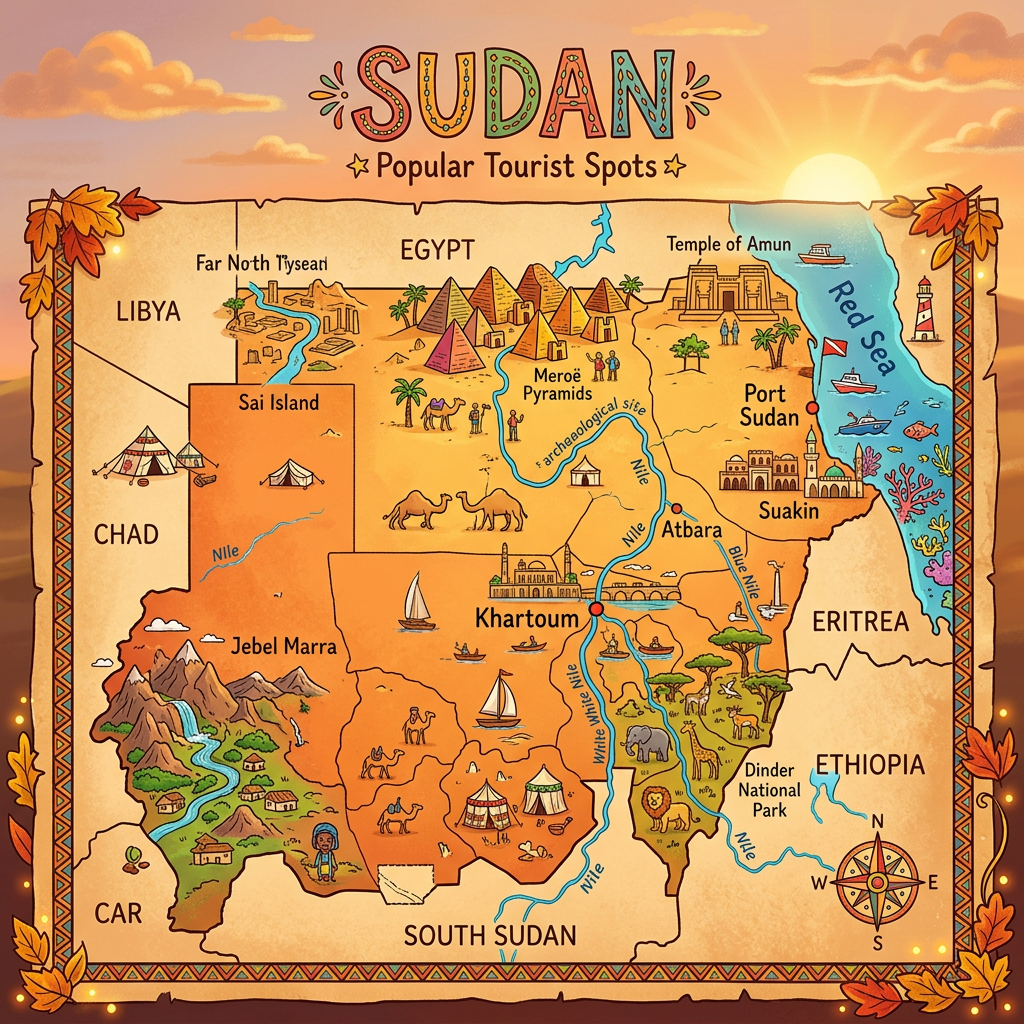
What you need to know about Sudan ?
Sudan is a country located in Northeast Africa. Its territory covers 1,886,068 km², making it the third-largest country in Africa (after Algeria and the Democratic Republic of the Congo) and one of the largest countries in the world. Its population is estimated at around 52 million inhabitants in 2026, placing it among the most populous countries on the African continent.
The metropolis of Sudan is Khartoum and its largest urban area covers 1,886,086 km2. Sudan is part of the Arab League, the United Nations, the African Union, and COMESA. The country’s telephone code is 249.
Colors of Sudan
The Sudanese flag is a rectangular flag with a 1:2 ratio, composed of 3 horizontal bands of equal thickness. From top to bottom: red, white, and black, and towards the hoist, there is a green isosceles triangle. These are Pan-Arab colors: red symbolizes socialism and the struggle for the nation’s freedom, white symbolizes selflessness and brightness. Black symbolizes the country inhabited by black people. Green represents the agricultural nation and religion.

Best places to visit in Sudan?
Khartoum
It is both an administrative, economic, and commercial capital. This city will allow you to find a city reflecting Arab culture in Africa with paved alleys and many trees. The urban atmosphere of the city is what makes it magnificent.
Omdurman
It is a large city in the country but also an important commercial center. You will also see market areas as well as a camel showcase outside the city. It is also an industrial zone.
Nyala
The capital of South Darfur is a true cradle of industries such as textile manufacturing and agro-food industries. It is also an international commercial city with road infrastructure and an international airport.
Where is Sudan located on the world map?
On the world map, the country is located on the African continent, more precisely in the Northeast section. Sudan’s neighbors are Libya, Egypt, Chad, Ethiopia, and Eritrea.

Climate of Sudan
Sudan has a dry or arid-desert climate. It has three climatic zones: the north (arid desert) and the south (tropical savanna climate), and the extreme southwest (humid tropical climate).
Between January and March, the climate is hotter and dry with no precipitation; from July, humidity begins to increase. In August and September, rainfall gradually increases as you move north.
Temperatures throughout the territory range from 41°C to 48°C with cooler temperatures at night. However, the southern areas have temperatures ranging between 6 and 15°C in winter and reach 34°C in summer.
Administrative division of Sudan
The Sudanese territory is divided into 6 political regions. These are further divided into 18 Wilayat, equivalent to federated states:
Here are the 6 political regions of Sudan:
- North Sudan
- Darfur
- Eastern Front
- South Sudan
- Abyei
- Nuba Mountains and Blue Nile
Here are the Wilayat of Sudan
- Al-Jazirah
- Al Qadarif
- Central Darfur
- North Darfur
- South Darfur
- West Darfur
- East Darfur
- Kassala
- Khartoum
- North Kordofan
- South Kordofan
- West Kordofan
- Red Sea
- Nile
- White Nile
- Blue Nile
- North
- Sennar

Economy of Sudan
Sudan is a weakly industrialized country with 90% of its GDP provided by oil exploitation. There is also agriculture, which is a dominant sector in the Sudanese economy. The main products are: cotton, sesame, peanuts, gum arabic. Here are the economic data of the country:
- Current currency: Sudanese pound
- Nominal GDP: approximately USD 30 billion
- GDP at Purchasing Power Parity (PPP): approximately USD 170 billion
- Annual GDP growth rate: approximately -13% (sharp contraction due to the conflict)
- GDP per capita (PPP): approximately USD 3,200
- Inflation rate: approximately 170%
- Population living below the poverty line: more than 65% (estimated)
- Unemployment rate: approximately 32% (estimated)
Population and linguistic data of Sudan
Currently, the Sudanese population numbers 43,120,843 inhabitants, with a demographic growth rate of 2.93% per year. The birth rate is 34.2 ‰ and the death rate is 6.7 ‰.
On the other hand, the life expectancy of a Sudanese at birth is 65.8 years and the median age is 17.9 years. Here are the languages used in the country: Arabic and English as official languages, then Nubian and Fur. The ethnic groups are: Arabs at 70%, the Furs, the Bejas, the Nubas, the Fallata.
FAQ – Sudan Map: Geographic and demographic information
Sudan is located in northeastern Africa, between the Sahara Desert and the Sahel region. It shares borders with several countries, including Egypt, Chad, Libya, Ethiopia, and South Sudan.
The capital of Sudan is Khartoum. The city lies at the confluence of the Blue Nile and the White Nile and serves as the country’s main administrative center.
Sudan has a population of around 51 million people. Its population is made up of many ethnic groups and is mainly concentrated along the Nile Valley and in the country’s major cities.
