
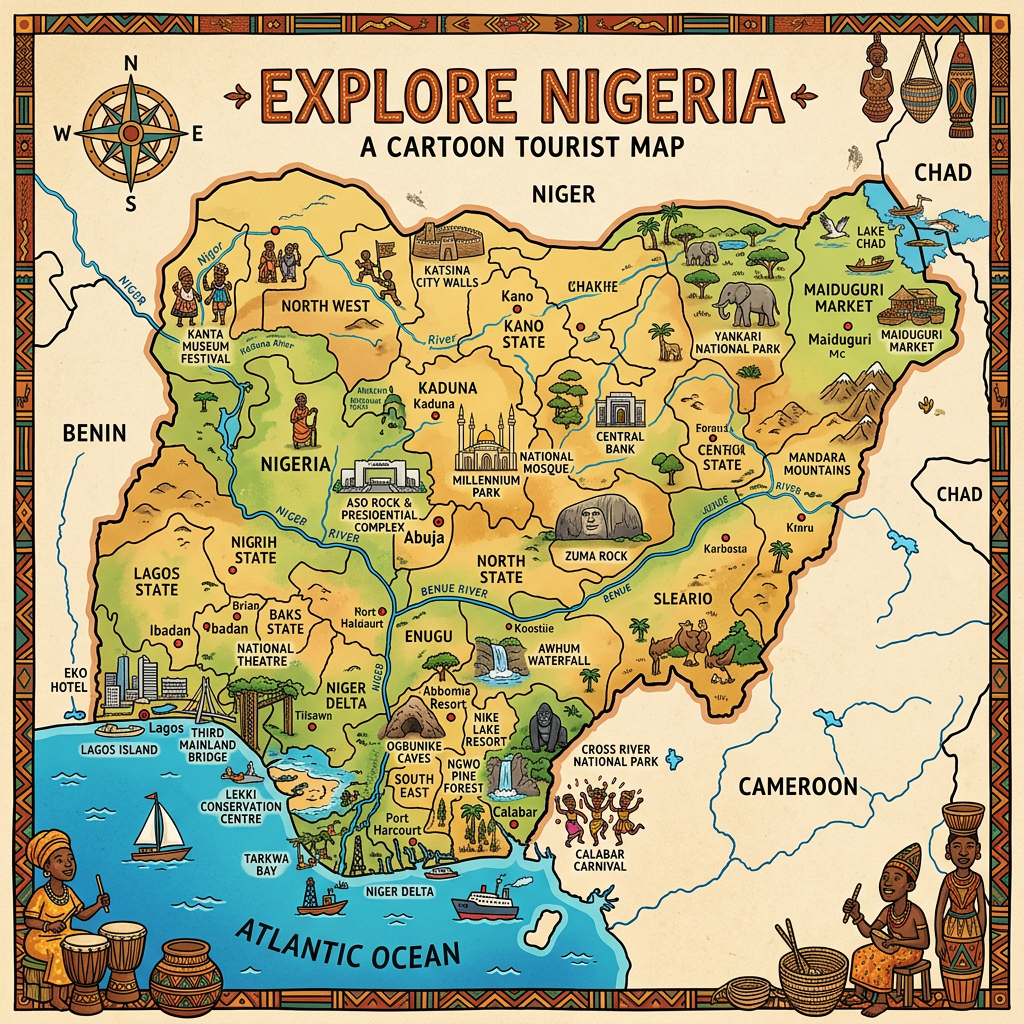
What you need to know about Nigeria ?
Nigeria is a federal republic located in West Africa. Its territory covers an area of 923,768 km², and its population is estimated at approximately 239 million inhabitants in 2026, making it the most populous country in Africa and the 6th most populous country in the world. It is also one of the largest countries on the continent in terms of land area.
The official language used in the country is English and its capital is Abuja. However, its largest city is Lagos. The international organizations of which the country is a member are ECOWAS and the OIC. The inhabitants of the country are called Nigerians and the country’s telephone code is 234.
Colors of Nigeria
The flag of Nigeria is a rectangular flag composed of 3 vertical stripes with a white stripe in the middle and two green stripes on the outside. The stripes are of equal thickness. The green color represents nature (forests and vegetation cover), the white color represents peace and unity.

Best places to visit in Nigeria?
Lagos
This city is popular among visitors who come for vacations or business. In this city, you can stay in hotels but also enjoy the nightlife which offers various entertainments. It is one of the major metropolitan African cities and one of the most developed in Africa. The city has everything: restaurants, bars, beaches, and charming neighborhoods.
Abuja
The federal capital of the country is a surprising city and one of the most beautiful cities in the country. There are several international-class restaurants, various clubs, as well as shopping centers that allow visitors to enjoy the modernity of this African city.
Calabar
Also called the city of Canaan, it is a city with a diverse climate but also a famous tourist attraction. Here, you will see the Tinapa resort, the international museum, various musical festivities as well as diverse restaurants, of course with indigenous menus and world specialties.
Where is Nigeria located on the world map?
On the world map, Nigeria is an African country located on the continent more precisely in the Western part, that is in the Gulf of Guinea. The country is bordered by Cameroon, Chad, Benin and Niger. These countries border it to the East and Southeast, Northeast, North and West.

Climate of Nigeria
The Nigerian climate is tropical, thus marked by a variation of rainy and dry seasons depending on the location within the territory. Throughout the year, the overall climate is hot and humid but in the south it is hot and dry with a dry and humid climate in the northern section.
Precipitation is higher in the South and towards the north, it tends to gradually decrease. Rainfall in the south can reach 3,000 mm annually and in the North it drops to 500 mm annually.
In the north, there is more temperature variation with oscillations between 20 and 35°C and towards the south, temperature variations are smaller, notably between 20 and 22°C. The north is consequently a bit warmer than the rest of the country and the minimum temperatures are lower however.
Between the months of April and May, maximum temperatures will reach over 40°C. The north is also subject to humidity as it is influenced by the warm and dry trade wind called the Harmattan, which blows for three months.
Nigeria administrative division

The Nigerian territory is divided into 36 states plus a region with special status which is the capital. These states are then divided into 774 local government areas.
Here are the 37 administrative states of Nigeria:
- Abia (Umuahia)
- Akwa Ibom (Uyo)
- Anambra (Awka)
- Bauchi (Bauchi)
- Bayelsa (Yenagoa)
- Benue (Makurdi)
- Borno (Maiduguri)
- Cross River (Calabar)
- Delta (Asaba)
- Ebonyi
- Edo
- Ekiti
- Enugu
- Gombe
- Imo
- Jigawa
- Kaduna
- Kano
- Katsina
- Kebbi
- Kogi
- Kwara
- Lagos
- Nassarawa
- Niger
- Ogun
- Ondo
- Osun
- Oyo
- Plateau
- Rivers (Port Harcourt)
- Sokoto
- Taraba
- Yobe
- Zamfara
Nigeria Economy


The Nigerian economy is characterized as an emerging exchange economy but also based on a middle-income revenue. The dominant sectors are mainly manufacturing, finance, the service sector, as well as communications.
Compared to all countries in the world, the Nigerian economy is the 27th most performing in the world if we refer to nominal GDP. However, if we refer to GDP in PPP, the country ranks 24th. On the other hand, it is the most performing economy in Africa.
It thus holds the status of a new emerging economy on the African continent thanks to its production of the majority of goods and services. Here are some economic data of Nigeria:
- Official currency: Nigerian Naira
- Nominal GDP: approximately USD 390 billion
- GDP at Purchasing Power Parity (PPP): approximately USD 1.7 trillion
- Annual GDP growth rate: approximately 3.4%
- Nominal GDP per capita: approximately USD 1,700
- GDP per capita (PPP): approximately USD 7,400
- Inflation rate: approximately 23%
- Population living below the poverty line: approximately 38–40%
- Unemployment rate: approximately 5% according to the revised methodology of the National Bureau of Statistics
- Gross external debt: approximately USD 45 billion
- Public debt: approximately 52% of GDP
- Foreign exchange reserves: approximately USD 40 billion
Population and linguistic data Nigeria
As we stated earlier, the Nigerian territory is the most populous in continental Africa and the 7th in the world. This population currently numbers 219,463,862 inhabitants with an annual demographic growth rate of 2.54%.
The fertility rate in the country is 4.85 children per woman and the birth and death rates are respectively 3.52% and 0.96%, and the infant mortality rate is 6.33%.
The life expectancy of a Nigerian at birth is 59.3 years, with 57.5 years for women and 61.1 years for men. The median age in the country is 18.3 years, indicating an overall extremely young population. The sex ratio of the total population is 102 men to 100 women, and the migration rate is -0.2%.
The main languages used in the country are English as the official language, Hausa, Yoruba, Igbo, and Fulani. The ethnic groups composing the Nigerian population are: Hausas and Fulanis (29%), Yorubas (21%), Igbos (18%), Ijaws (10%), Kanuri (4%), Ibibios (3.5%), Tiv (2.5%). Finally, the dominant religions in the country are Islam at 39% and others at 1.9%.
FAQ – Nigeria Map: geographic and demographic information
Nigeria is located in West Africa along the Gulf of Guinea. It shares borders with Niger, Chad, Cameroon, and Benin.
Nigeria has a population of more than 240 million people in 2025. It is the most populous country in Africa and one of the most populous countries in the world.
Nigeria covers an area of approximately 923,768 km². Its territory consists of coastal plains, savannas, plateaus, and major river valleys.
