
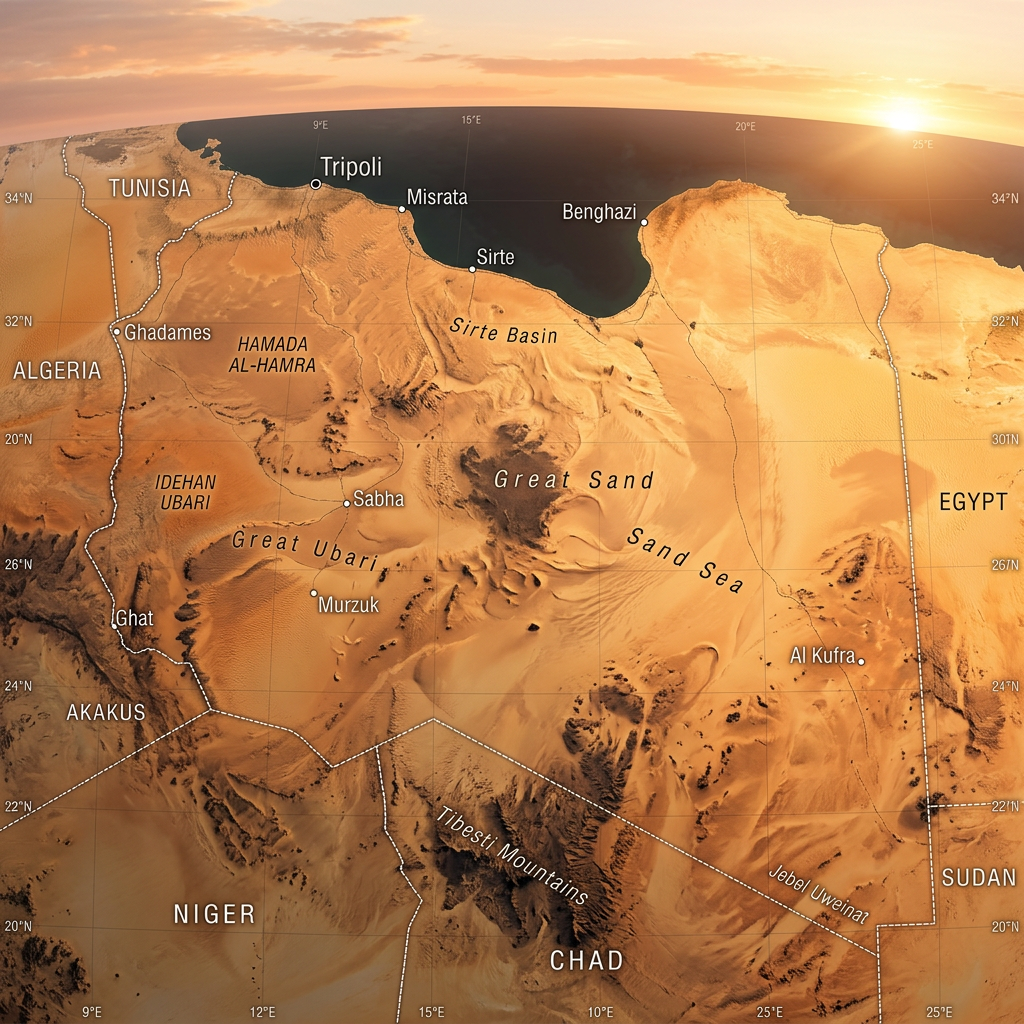
What you need to know about Libya ?
Libya is a North African state, belonging to the Maghreb region. It is currently a parliamentary republic in transition, marked by political instability since 2011, but endowed with strong economic and energy potential.
The country covers an area of 1,759,540 km², making it the fourth largest country in Africa.
Its population is estimated at around 6.9 million inhabitants (2024), which corresponds to a very low density of about 4 inhabitants per km², a direct consequence of the vast desert territory.
The capital, Tripoli, is also the largest city in the country and its main political, economic, and cultural center.
Other major urban areas such as Benghazi and Misrata play an essential role in the country’s economic and industrial life.
The official languages are Arabic and Tamazight (Berber), while English is increasingly used in business and higher education.
The international telephone code for Libya is +218 (or 00218).
| Element | Details |
|---|---|
| Official Name | State of Libya |
| Capital | Tripoli |
| Population | ~7 million inhabitants, concentrated along the Mediterranean coast |
| Area | ~1,760,000 km² (large Saharan desert in the south) |
| Relief & Hydrography | Coastal plateau, plains of Tripolitania and Cyrenaica, Sahara desert, isolated massifs (Akakus) |
| Climate | Mediterranean on the coast (hot summers, mild winters), Saharan arid inland |
| Major Cities | Tripoli, Benghazi, Misrata, Sabha |
| Language | Arabic (main), limited use of English/French outside tourism/business |
| Currency | Libyan Dinar (LYD) |
| Economy | Hydrocarbons (oil/gas), port activities, oasis agriculture |
| Points of Interest | Ancient sites (Leptis Magna, Sabratha), Mediterranean coastline, Saharan landscapes (Acacus) |
| Access | Primarily by air and regional border posts; internal travel varies depending on local conditions |
| Advice | Prepare for heat/UV, desert distances, water/fuel; check local conditions and formalities before any travel |
Colors of Libya

The Libyan flag is a 1:2 format flag composed of 3 colors arranged in horizontal stripes from top to bottom: red, black, green. The black middle stripe is twice the thickness of the other two. In the center of the black stripe is a white crescent moon and star.
These are Pan-Arab colors with green representing nature, red the swords, and black the battles. The star and crescent moon represent Islam.
Best places to visit in Libya

Tripoli
Tripoli, the capital of Libya, is a city rich in history, shaped by many civilizations: Roman, Vandal, Byzantine, Arab, Spanish, Ottoman, and Italian. This diversity is reflected in its architecture and exceptional heritage.
Among the main sites to discover: the medina and its traditional souks, the Red Castle (Assaraya al-Hamra), the Darghut Mosque, the Martyrs’ Square, the Karamanli House, as well as the Janzur Museum, tracing the history of the capital.
Today, Tripoli blends modernity and ancient heritage, offering a unique glimpse into Libyan culture.
Benghazi
As the second largest city in the country, Benghazi is an important Mediterranean port and a symbol of the Libyan renaissance after years of conflict.
Once under Roman, Ottoman, and Italian rule, the city retains traces of these eras through its monuments and ancient ruins.
Visitors can discover the Ottoman palace, the Benghazi Cathedral, the Greek and Roman ruins, as well as the Berenice Cinema, a relic of the Italian colonial era.
Today, Benghazi is a cultural and university center undergoing revival.
Misrata
Located on the northwest coast of the country, Misrata was a major commercial center as early as the 7th century, and a strategic base during Ottoman and Italian rule.
A dynamic port city, it hosts numerous industries, a modern port, and an international airport that make it a pillar of the Libyan economy.
Misrata is also distinguished by its central market, its historic mosques, and its peaceful beaches bordered by the Mediterranean.
Ghadamès
Nicknamed the “pearl of the desert”, Ghadamès is an oasis located at the gates of the Sahara, on the Tunisian border.
Listed as a UNESCO World Heritage site, it is famous for its ancient fortified town, built from mudbrick and designed to withstand the extreme desert heat.
Visitors can admire the covered alleys, the traditional houses decorated with geometric patterns, and the date palm, a vital resource of the region.
It is one of the most authentic and photogenic places in all of Libya.
Leptis Magna
About 130 km east of Tripoli, Leptis Magna is one of the best-preserved Roman archaeological sites in the world.
Founded by the Phoenicians, then enhanced under Emperor Septimius Severus, a native of the city, it offers an exceptional panorama of Rome’s grandeur in Africa.
One can discover temples, baths, an amphitheater, a monumental triumphal arch, and an ancient port still visible today.
The site is listed as a UNESCO World Heritage site and is a must-visit for lovers of ancient history.
Where is Libya located on the world map?
Libya is an African country located in North Africa, among the Maghreb countries. The country is bordered by Tunisia, Algeria, Niger, Chad, Sudan, and Egypt. These countries neighbor it to the northwest, west, southwest, south, southeast, and east. The country faces the Mediterranean Sea to the north.

Climate of Libya
Libya has a warm Mediterranean climate near the sea with a slight arid or desert arid variation towards the interior lands. The coasts have annual precipitation between 200 and 350 mm.
In the Gulf of Sirte areas, precipitation is lower, between 100 and 200 mm. Summer across almost the entire territory is quite dry with temperatures ranging from 20 to 37°C on the coasts, between 35 and 37°C in the north-central region, and finally between 40 and 41°C towards the south.
Spring and autumn are influenced by a warm, dry southern wind called Ghibli, which brings dust and unpredictable temperature increases. The capital has the wettest climate in the country with 330 mm of annual rainfall. Temperatures range between 18 and 33°C.
Administrative division of Libya

Libya is divided into 22 governorates called Shabiyat:
- Al Boutnan
- Derna
- Al Djabal al Akhdar
- Al Marj
- Benghazi
- Al Wahat
- Al Koufrah
- Sirte
- Misratah
- Al Mourqoub
- Tripoli
- Al Djfara
- Az Zaouiyah
- An Nouqat al Khams
- Al Djabal al Gharbi
- Nalut
- Al Djoufrah
- Wadi ach Chatii
- Sebha
- Wadi al Hayaat
- Ghat
- Mourzouq
Economy of Libya

The Libyan economy relies almost exclusively on the oil sector, which accounts for nearly 85% of exports and more than 60% of the national GDP. The country holds the largest oil reserves in Africa and is among the main exporters on the continent.
However, this dependence on oil makes the economy vulnerable to global price fluctuations and political instabilities that regularly disrupt production.
The non-oil sector (agriculture, construction, services) remains limited, although efforts toward economic diversification have begun.
Key economic data (2024-2025 estimates)
- Official currency: Libyan Dinar (LYD)
- Nominal GDP: approximately USD 48 billion
- GDP at Purchasing Power Parity (PPP): approximately USD 123 billion
- Annual GDP growth: approximately 17.3%
- GDP per capita (PPP): approximately USD 17,760
- Inflation rate: approximately 2%
- Population below the poverty line: recent national data not available
- Unemployment rate: approximately 18.7%
- Main resources: crude oil, natural gas, refined petroleum products, petrochemicals
- Main trading partners: Italy, China, Spain, Germany, Turkey, and France
Despite strong energy potential and significant reserves, Libya faces structural challenges: weak institutions, political fragmentation, and degraded infrastructure.
A sustainable political stabilization could, however, revive foreign investments and make Libya a major economic player in the Maghreb and the Mediterranean.
Population and linguistic data

The Libyan population is estimated at around 6.8 million inhabitants (2024), with an annual population growth rate of 1.45%.
The birth rate is 17.2 ‰, compared to a death rate of 3.7 ‰.
The life expectancy at birth reaches 76.9 years, and the median age is 29.4 years, reflecting a young and urban population.
The sex ratio is slightly in favor of men (107 men per 100 women).
Languages
The official languages are Arabic and Tamazight (Berber).
English and Italian are also understood and used in commerce and education, especially in major cities like Tripoli or Benghazi.
Ethnic groups and religions
The Libyan population is mainly composed of:
- Arabs and Berbers: 97%
- Other minorities (Tuaregs, Toubou, sub-Saharan migrants, etc.): 3%
The dominant religion is Sunni Islam, practiced by about 97% of the population.
Other faiths (Christian, Coptic, or animist) represent about 3%, mainly among expatriates and foreign workers.
FAQ: Libya map
Choose a Libya map that clearly distinguishes the Mediterranean coast from the Saharan areas and indicates cities, roads, and strategic water points.
Yes, a well-structured Libya map highlights these three major historical regions and their connecting routes.
Favor a Libya map detailing Leptis Magna, Sabratha, and road access from Tripoli and Benghazi.
Yes, an offline/GPX Libya map is essential in the Sahara, where network coverage and signage are limited.
A regional Libya map showing Egypt, Tunisia, Algeria, Niger, and Chad facilitates understanding of trans-Saharan and coastal routes.
