
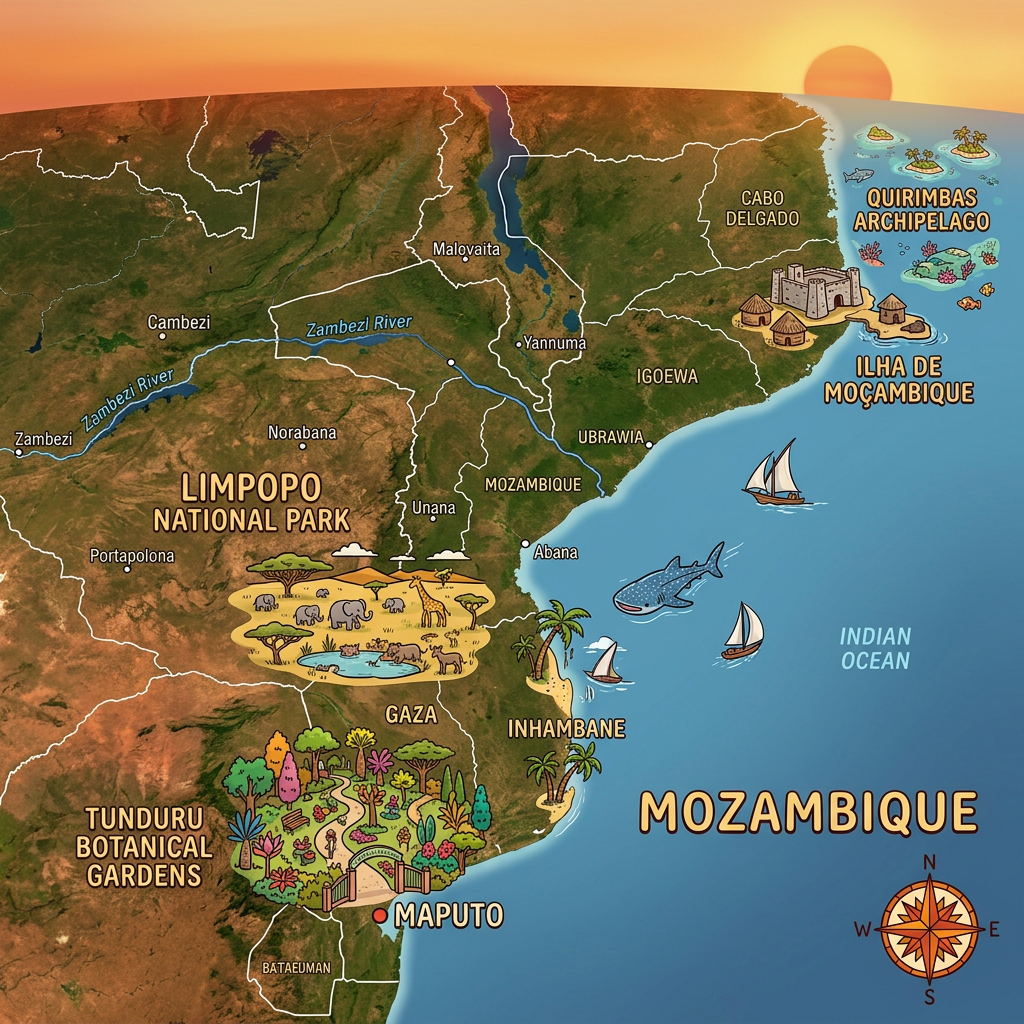
What you need to know about Mozambique ?
Mozambique is an African state also called the Republic of Mozambique due to its status as a presidential republic under a dominant party regime.
Mozambique has an area of 801,590 km² and an estimated population of 36.6 million inhabitants in 2026, making it the 44th most populous country in the world and one of the largest countries in Southern Africa. Its capital and largest city is Maputo, and the country’s official language is Portuguese.
Mozambique is part of SADC, AfDB, CPLP, INBAR, CIR, G33. The telephone code for Mozambique is 258.
Colors of Mozambique
The Mozambican flag is a rectangular flag composed of 3 horizontal color bands. From top to bottom, we have: green, black, and yellow. The bands are separated by two white stripes.
On the hoist side is a red isosceles triangle with the country’s coat of arms featuring a yellow five-pointed star, a bayonet, an AK-47, and a book. The green color symbolizes nature and agriculture, the black color represents Black Africa, and the yellow color represents the country’s mineral wealth.

Where is Mozambique located on the world map?
On the world map, Mozambique is located on the African continent. It is situated in the eastern coastal section of the continent. Its neighbors are Eswatini, Zimbabwe, Zambia, Malawi, Tanzania. Madagascar is separated from Mozambique by the Mozambique Channel.

Population of Mozambique
Mozambique currently has a population of approximately 36.6 million inhabitants. Its annual population growth rate is estimated at 2.9%, one of the highest in Southern Africa.
Mozambique’s fertility rate is approximately 4.4 children per woman. The birth and death rates are about 35‰ and 8‰, respectively.
Life expectancy at birth is approximately 62 years, while the median age of the population is around 17.8 years, reflecting a very young population. The male-to-female ratio is relatively balanced, with approximately 95 men for every 100 women.
What are the best cities to visit in Mozambique?
Maputo: this capital is a city that encompasses all of its colonial past. Previously, it was the colonial capital of the country. Here, you will see several buildings with colonial style such as: the train station, the Casa do Ferro (copied from the Eiffel Tower), the wide boulevards lined with palm trees. So you have an African city with a European image. Also enjoy the magnificent restaurants and exciting bazaars.
Pemba: it is a coastal port city of the country with a Portuguese-style waterfront. It is also rich in colonial architecture and industrial zones.
You will enjoy beautiful white sandy beaches that adorn the city’s shores with palm trees swaying in the wind. There is also Pemba Bay, which is a favorite spot for scuba divers. You can also visit the fishing villages on Ibo Island or see the Quirimbas National Park.
Climate map of Mozambique
The Mozambican climate is heavily dependent on its geographical position within the southern section of the globe. It is a typical tropical climate. It therefore features a dry period occurring between April and October, interrupted by a short rainy season in July.
During this period, temperatures fluctuate around 16 to 20°C. There is also a rainy season that starts in November and ends in March.
During this period, temperatures range between 25 and 31°C with slight temperature increases moving northward. The northern section receives about 870 mm of precipitation annually, while the central section receives between 1400 and 1600 mm of precipitation per year.
Mozambique Economic Data
Despite its notable economic growth since the end of the civil war in 1977, Mozambique’s economy remains one of the least performing in the world.
The IMF and the World Bank thus classify the country among the poorest in the world. This economy is mainly agricultural with a primary sector dominating 21% of the Gross Domestic Product.
This agriculture also represents 80% of exported products. Here are some economic data concerning Mozambique:
- Currency: New Metical
- Nominal GDP: approximately USD 24.8 billion
- GDP at Purchasing Power Parity (PPP): approximately USD 55.5 billion
- Annual GDP growth rate: approximately 5.0%
- GDP per capita (PPP): approximately USD 1,500
- Inflation rate: approximately 4.5%
- Population living below the poverty line: approximately 62%
- Human Development Index (HDI): 0.461
- Unemployment rate: approximately 3.7% (according to the official definition)
- Labour force: approximately 15 million people
- Imports: 578 million USD
- Exports: 193 million USD
- Public debt: approximately 97% of GDP
- Government revenue: approximately USD 5.5 billion
Administrative and Demolinguistic Data

Administrative subdivisions
The Mozambican territory is divided into 10 administrative provinces plus the capital city which has the status of a province. In turn, the provinces are divided into districts (129) and then into administrative posts (405).
Here are the 10 provinces and the autonomous city:
- Zambezia
- Tete
- Sofala
- Niassa
- Nampula
- Maputo (Autonomous city)
- Maputo
- Manica
- Inhambane
- Gaza
- Cabo Delgado
Demolinguistic data
Here are the ethnic groups composing the Mozambican population:
- Makua
- Lomwe
- Others
- Tsonga
- Sena
Apart from the official language which is Portuguese, the ethnic groups in Mozambique speak several dialects including:
- Echuwabo (5.8%)
- Elomwe (8.8%)
- Sena of Mozambique (6.8%)
- Xichangana (11.3%)
- Emakhuwa (26.1%)
- Others (33.6%)
The religions in Mozambique are
Roman Catholic (28.4%), Protestant (27.7%), Muslim (17.9%), Others (7.2%), No religion (18.7%)
FAQ – Mozambique Map: Geographic and demographic information
Mozambique is located on the southeastern coast of Africa along the Indian Ocean. It shares borders with six countries, including Tanzania, Malawi, and South Africa.
Mozambique has a population of more than 34 million people in 2025. The population is predominantly young and is mainly concentrated in coastal and urban areas.
Mozambique covers an area of approximately 801,590 km², making it one of the largest countries in Southern Africa. Its territory includes vast coastal plains, plateaus, and several major rivers.
