
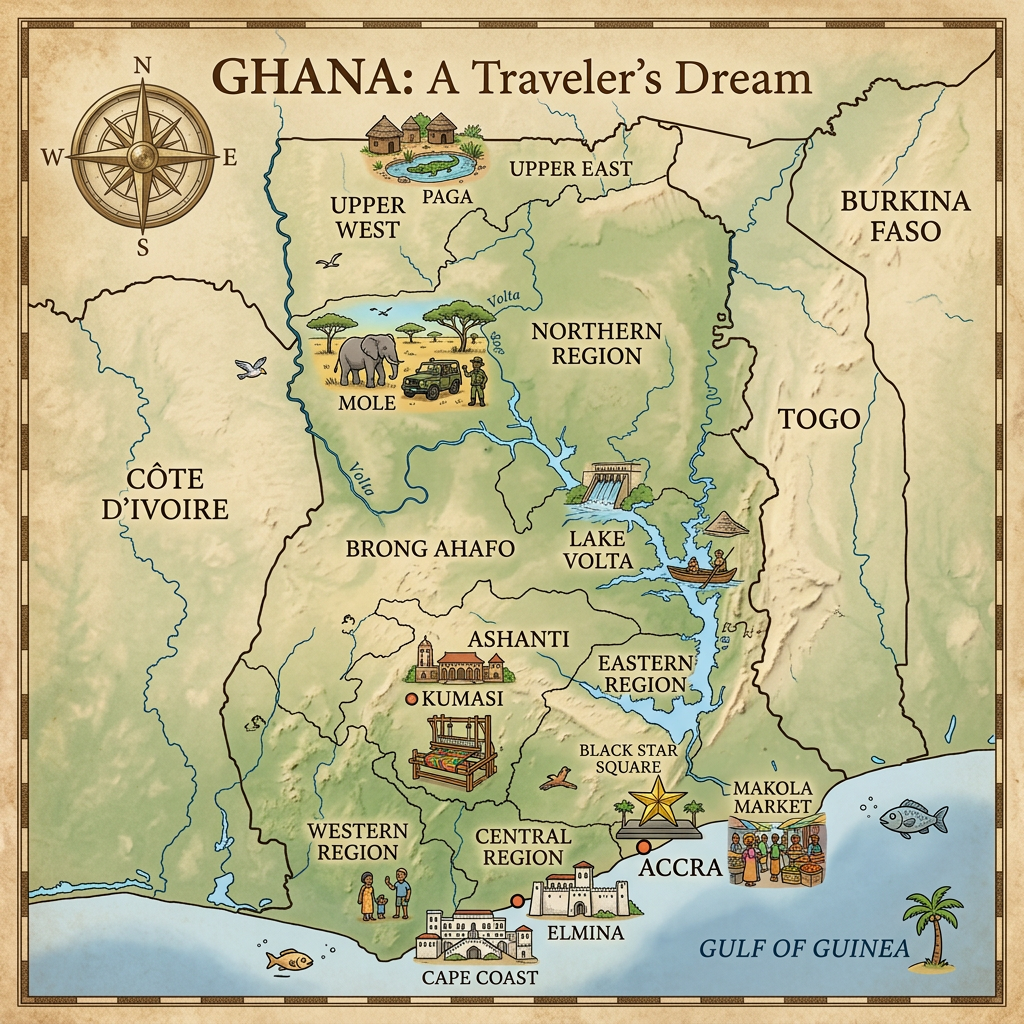
What you need to know about Ghana ?
The State of Ghana is a constitutional republic located in West Africa.
- The area of its territory is 238,540 km².
- The population is estimated at around 34.1 million inhabitants in 2025.
- The capital and largest city is Accra, the political and economic center of the country.
- The official language is English, but many local languages such as Twi, Ewe, and Dagbani are widely spoken.
Ghana is a member of several international and regional organizations, including the G24, the APO, the ADB, ECOWAS, CEN-SAD, ZPCAS, INBAR, and the CIR.
The international dialing code for Ghana is +233.
Table – Ghana: geographical and demographic information
| Item | Key Information |
|---|---|
| Total area | 238,533 km² |
| Capital | Accra |
| Neighboring countries | Ivory Coast, Burkina Faso, Togo |
| Coastline | ~560 km on the Atlantic Ocean (Gulf of Guinea) |
| Estimated population | ~34 million inhabitants (2025) |
| Population density | ~142 inhabitants/km² |
| Relief | Sandy coasts, plains, plateaus, some mountains in the east |
| Climate | Tropical: humid in the south, drier in the north |
| Official language | English |
| Economic resources | Gold, cocoa, oil, timber |
| Special feature | First sub-Saharan African country to gain independence (1957) |
Additional points on the map of Ghana
- Located in West Africa, Ghana has a maritime frontage on the Atlantic.
- Its physical map shows an alternation of plains, plateaus, and tropical forests.
- The country shares its borders with Ivory Coast, Burkina Faso, and Togo.
- Accra, its capital, is a coastal city and a major port on the Gulf of Guinea.
- Ghana is one of the largest cocoa producers in the world.
Colors of Ghana
The flag of Ghana is a rectangular flag composed of 3 horizontal stripes colored red, yellow, and green from top to bottom. In the center, there is a black five-pointed star. The red symbolizes the blood of martyrs during the struggle for independence, the yellow symbolizes Ghana’s wealth, the green symbolizes natural resources, and the star represents Marcus Garvey’s Black Star Line company.

Best places to visit in Ghana?
Accra
The capital, Accra, is a dynamic city ideal for vacationers. You can discover there:
- the Labadi Beach, very popular,
- the National Museum of Ghana, rich in historical and cultural treasures,
- the Kwame Nkrumah Memorial, dedicated to the father of independence,
- the National Theatre,
- as well as the Dubois Centre, devoted to Pan-African history.
Kumasi
Former capital of the Ashanti kingdom, Kumasi is a major center of traditional culture. It is renowned for:
- its central market and jewelry shops,
- the Manhyia Palace Museum, tracing the history of the Ashantis,
- numerous local craft workshops.
It is one of the country’s most important tourist destinations.
Cape Coast
Former colonial town, Cape Coast still bears the marks of European dominations, notably Portuguese. Visitors can see:
- the Cape Coast Castle, listed as a UNESCO World Heritage site,
- several colonial buildings,
- the Kakum National Park, with its famous canopy walkway,
- as well as beautiful beaches.
Tamale
Located in northern Ghana, Tamale is a major cultural and religious center. Visitors can discover:
- the Great Mosque of Tamale,
- the lively and colorful central market,
- traditional villages nearby, offering an immersion into local cultures.
Takoradi
A coastal city and port, Takoradi is known for its proximity to Sekondi, with which it forms a large metropolitan area called Sekondi-Takoradi. The city also serves as a convenient starting point for exploring Ghana’s western coast and boasts fine sandy beaches. It is recognized for its strategic role as a commercial and export hub.
Where is Ghana located on the world map?
Ghana is an African country located in the Gulf of Guinea on the African continent. Ghana’s neighbors are Burkina Faso, Togo, and Ivory Coast. These countries border it respectively to the North, East, and West. The country also borders the Atlantic Ocean to the South via its southern part.

Climate of Ghana
The Ghanaian climate is tropical with a hot and dry coastline and a humid and hot western section. The climate is divided into two seasons: a dry season and a wet season. Rainfall occurs in the north between April and October and in the south between March and November.
There is also the influence of the Harmattan, which affects the northeast of Ghana, reducing humidity in the northern section. Year-round temperatures range between 24 and 30°C. Rainfall is low, ranging between 78 and 216 cm annually.
Administrative division Ghana
The Ghanaian territory is divided into 10 regions, which are further subdivided into 110 districts. Here are the 16 regions of Ghana:
- Ashanti Region
- Brong Ahafo Region
- Central Region
- Eastern Region
- Greater Accra Region
- Northern Region
- Upper East Region
- Upper West Region
- Volta Region
- Western Region
Economy Ghana

The Ghanaian economy is a strong and industrialized economy with an industrial predominance. The tertiary sector is dominated by automobile and shipbuilding construction. There is also the oil industry as well as digital technology. Here are some economic data:
- Currency: Cedi
- Nominal GDP: 67.077 billion USD
- Purchasing Power Parity GDP: 204.813 billion USD
- Annual GDP growth rate: 6.1% nominal and 5.9% in Purchasing Power Parity
- GDP per capita nominal: 2,223 USD
- GDP per capita Purchasing Power Parity: 6,956 USD
- Inflation rate: 9.7%
- Unemployment rate as % of active population: 11.9%
- Population below poverty line: 30.5%
Population and linguistic data
The Ghanaian population numbers 29,340,248 inhabitants with an annual demographic growth rate of 2.16%. Its fertility rate is 3.96 children per woman and the birth rate is higher than the death rate, standing at 30.2 ‰ compared to 6.8 ‰.
The life expectancy of a Ghanaian at birth is 67.4 years and the average age of the population is 21.2 years, indicating an extremely young population. The male/female sex ratio is 97%. The languages used in the country are English (as the official language), Akan, Moshi-Dagomba, Ewe, Ga.
The dominant ethnic groups of Ghanaians are Akan (44%), Moshi-Dagomba (16%), Ewes (13%), Ga (3%), Gurma (1%), Europeans and Others (1.5%). The dominant religions are Christianity (63%), Islam (16%), Indigenous beliefs (21%).
FAQ – Ghana map: 3 questions
Ghana is located in West Africa, on the coast of the Atlantic Ocean, between Ivory Coast, Burkina Faso, and Togo.
The capital is Accra, a large coastal city.
The country has a coastline on the Gulf of Guinea, fertile plains, plateaus, and a tropical climate.
