
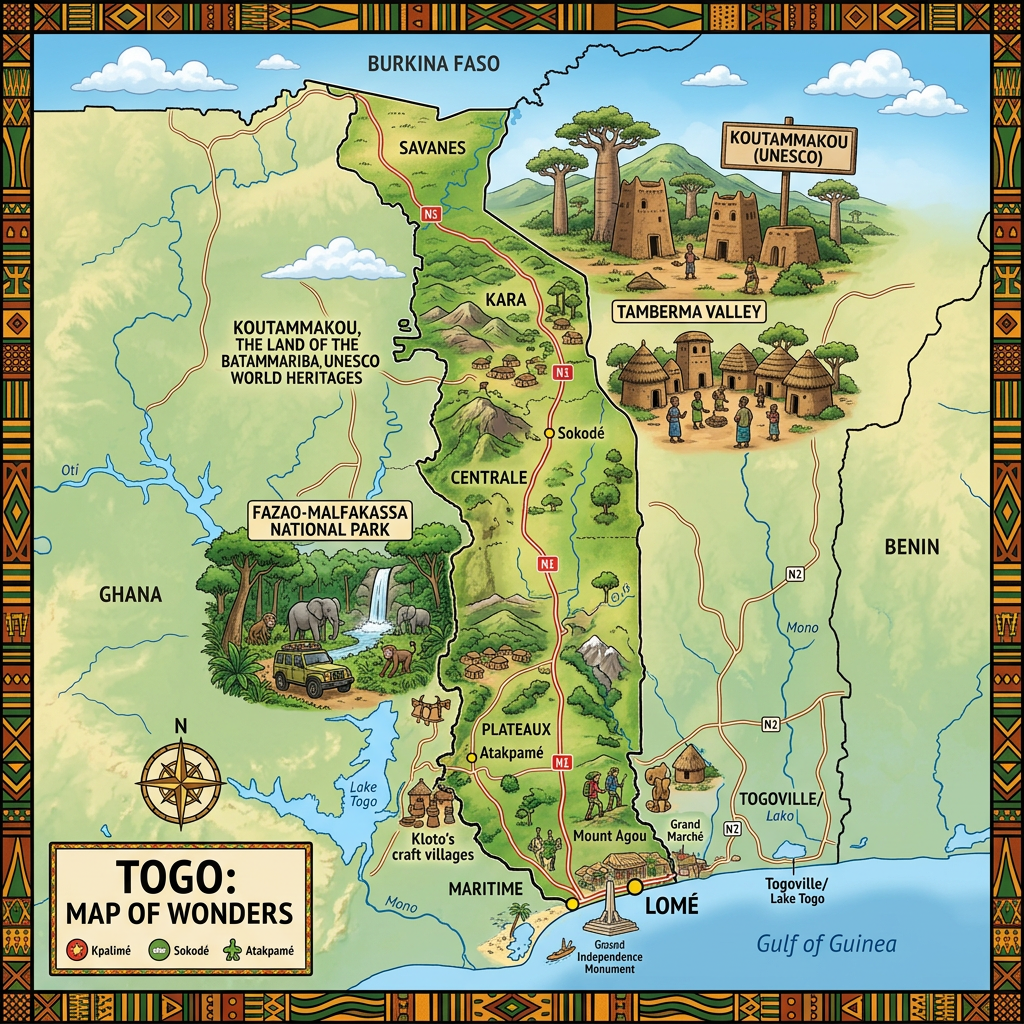
What you need to know about Togo ?
Togo, officially known as the Togolese Republic, is a sovereign country located in West Africa. It covers an area of 56,785 km² and has an estimated population of around 10 million inhabitants in 2026. Its capital and largest city is Lomé. Togo is a member of the Economic Community of West African States (ECOWAS), the West African Economic and Monetary Union (WAEMU), and the Organisation of Islamic Cooperation (OIC). Its international calling code is +228.
Colors of Togo
The Togolese flag is a rectangular flag. It is composed of 5 horizontal stripes, 3 green and 2 yellow, alternating. In the upper left corner, there is a red square with a white 5-pointed star.
The colored stripes represent the 5 regional subdivisions of the country. The red square symbolizes the honesty and patriotism of the Togolese people. In contrast, the star represents existence, clarity, peace, and sovereignty.

Best places to visit in Togo?
Lomé: The capital of Togo is both a port city and a commercial city. It is also the main producing area of cocoa, cotton, and coffee in the country. There is also a university as well as a prestigious hotel.
Sokodé: It is a port city but also a place where artisans gather. It is also a commercial city through which products transit towards Ghana and Benin. It is one of the cities that mainly contribute to increasing added value for the country’s finances.
Togoville: It is a city considered the best tourist attraction in the country. You will see various lakes, old cathedrals reflecting colonization, as well as beautiful beaches.
Where is Togo located on the world Map?
On the world map, Togo is located in Africa, more precisely in the western section of continental Africa, in the Gulf of Guinea. Its neighbors are Ghana, Benin, and Burkina Faso. These countries border it respectively to the west, north, and west. The country borders the Atlantic Ocean to the south.

Climate of Togo
Togo has a tropical climate. The southern part of the country has two rainy seasons, one long and one short. The annual rainfall is 890 mm, but the coasts are less humid than the rest of the country.
There is a strong influence of the harmattan during the winter season, and in the northern section, the annual rainfall is 1200 mm. Temperatures throughout the year range between 23 and 32°C in the south and between 18 and 38°C in the north.
Administrative division of Togo

The Togolese territory is divided into 5 administrative regions, which in turn are divided into 30 prefectures. Here are the 5 regions:
- Centrale
- Kara
- Maritime
- Plateaux
- Savanes
Economy of Togo
The Togolese economy is one of the least performing in the world. It is essentially an agricultural economy as this sector produces 42% of the GDP.
- Official currency: West African CFA Franc (XOF)
- Nominal GDP: approximately USD 10.3 billion
- Annual GDP growth rate: approximately 5.3%
- GDP per capita (nominal): approximately USD 1,000
- Population living below the poverty line: approximately 43%
- Inflation rate: approximately 2.8%
- Government expenditure: approximately USD 3.3 billion
Population and linguistic data of Togo
Togo has approximately 10 million inhabitants in 2026. Its annual population growth rate is estimated at 2.3%, with a birth rate of around 31‰ and a death rate of about 6‰.
Life expectancy at birth is approximately 62 years. The country’s sex ratio is relatively balanced, with about 98 men for every 100 women.
The country’s official language is French, while the main national languages include Ewe and Kabiyè, along with Tem (Kotokoli), Mina, Moba, Ife, Gourma, and several other local languages. Regarding religion, the population is predominantly Christian (around 43%), followed by followers of traditional African religions (around 35%) and Muslims (around 22%).
FAQ – Togo map: Geographic and demographic information
Togo is located in West Africa between Ghana and Benin, with a coastline along the Gulf of Guinea. It also shares a northern border with Burkina Faso.
Togo has a population of approximately 9.7 million people in 2025. A large part of the population lives in the southern part of the country, particularly around the capital city, Lomé.
Togo covers an area of approximately 56,785 km². Despite its relatively small size, it features a wide variety of landscapes, ranging from coastal plains to plateaus and mountains.
