
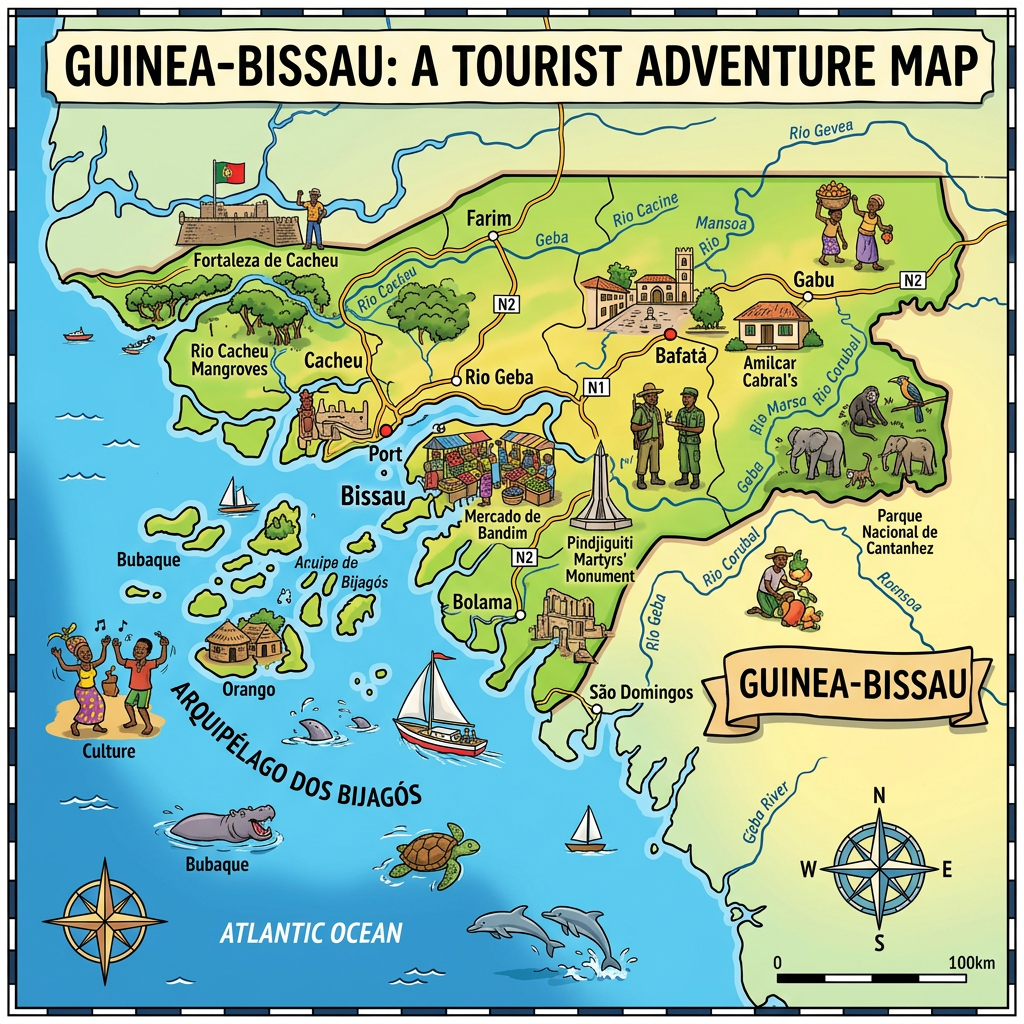
Located on the west coast of Africa, Guinea-Bissau often attracts attention for its tumultuous history and cultural diversity. This small country in West Africa shares its borders with Senegal to the north and Guinea to the east and southeast. Despite its modest size, it presents a mosaic of cultures, an official Portuguese language inherited from colonization, and current events marked by frequent political developments. Diving into the Guinean universe allows one to understand a unique nation shaped by distinct challenges and impressive resilience.
Table – Guinea-Bissau: geographical and demographic information
| Element | Key Information |
|---|---|
| Total area | 36,125 km² |
| Capital | Bissau |
| Neighboring countries | Senegal, Guinea (Conakry) |
| Coastline | 350 km on the Atlantic Ocean (Bijagos Archipelago) |
| Estimated population | ~2.2 million inhabitants (2025) |
| Population density | ~60 inhabitants/km² |
| Relief | Sandy coasts, mangroves, inland plains |
| Climate | Tropical, dry season (Nov.-May) and rainy season (Jun.-Oct.) |
| Official language | Portuguese (creole widely spoken) |
| Economic resources | Cashew nuts (major export), fishing, agriculture |
Additional points on the map of Guinea-Bissau
- Guinea-Bissau is a small West African country, landlocked between Senegal and Guinea, with access to the Atlantic.
- The map reveals the Bijagos Archipelago, composed of more than 80 islands, classified as a biosphere reserve.
- Its capital Bissau is located on the coast, near the estuary of the Geba River.
- The country is very lightly industrialized and mainly depends on agriculture.
- Guinea-Bissau is known for its cultural diversity, marked by several ethnic groups and local languages.

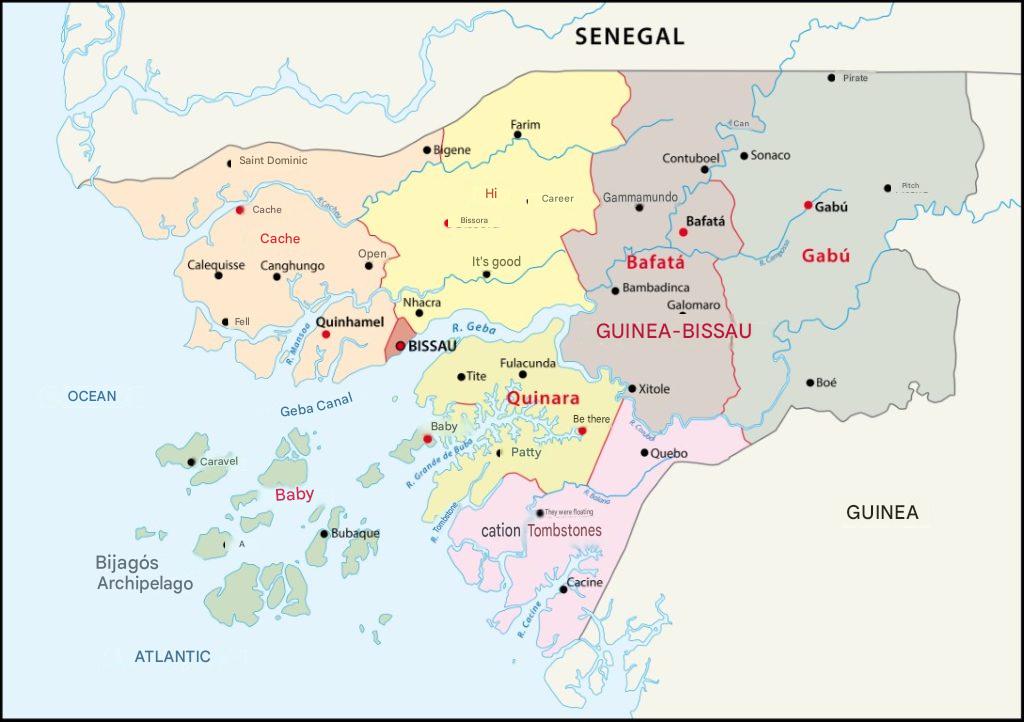
The map of Guinea-Bissau illustrates a small West African country, bordered by the Atlantic Ocean. It highlights its borders with Senegal to the north and Guinea to the south and east. Its coastline is marked by the Bijagos Archipelago, an exceptional natural area. The capital Bissau concentrates most of the economic and administrative activities.
A colonial heritage and a path to independence
Guinea-Bissau was under Portuguese domination for several centuries. This colonial heritage is reflected in the Portuguese language, used as the official language despite the presence of many local dialects. Colonized since the 15th century, it experienced various phases of exploitation and resistance that shaped its current identity.
The independence movement intensified over time, culminating in the 1960s with the formation of the African Party for the Independence of Guinea and Cape Verde (PAIGC). After a long armed struggle, Guinea-Bissau proclaimed its independence in 1973, although Portugal only recognized this fact in 1974. This colonial history continues to influence the country’s society and politics.
The administrative divisions of Guinea-Bissau
Despite its small area, this territory is made up of different provinces and regions. Each has its own economic and cultural particularities, shaped by the majority ethnic groups and the local geography. The coastal regions, especially those near the capital Bissau, show a more developed urban dynamic than the sometimes landlocked interior areas.

The administrative structures are regularly reformed according to changes in government. There is then a redrawing of the regional divisions to optimize local management or, sometimes, to respond to specific political logics. These adjustments can generate confusion or tensions at the local level.
Population and demographic diversity
The population of Guinea-Bissau is estimated at nearly two million inhabitants. This demographic diversity is based on various ethnic groups such as the Balantas, Mandingas, or Fula, each preserving its own linguistic and cultural specificities.
Although the Portuguese language remains the official link, Creole, blending African and Portuguese influences, dominates daily communication. The literacy rate evolves slowly, a consequence of variable access to education depending on the regions.
The capital Bissau: cultural and political crossroads
The city of Bissau constitutes the nerve center of the country. It is full of lively markets and central administrations, while representing the main scene of political debates. Its strategic port facilitates both legal commercial exchanges and some illicit trafficking from which the region suffers.
Bissau also attracts many young people coming from the surrounding countryside in search of better opportunities. This internal migration often causes disorderly urban development, accentuating the contrasts between popular neighborhoods and better-equipped sectors.
Political instability and recurring coups d’état
Since independence, Guinea-Bissau has faced regular political instability. Several coups d’état have marked its recent history, affecting governance and hindering sustainable economic development. This institutional fragility encourages repeated challenges to the authorities in place and a generalized climate of distrust.
Political rivalries, the absence of a lasting national consensus, and external interference explain this chronic instability. At each regime change, there are restructurings of the state apparatus and significant administrative reshuffles.
This political instability directly influences the daily life of the population. Multiple transitions destabilize essential public services such as education and health. International aid becomes a lifeline in several sectors, but its management sometimes raises questions.
This situation also prevents the emergence of long-term planning, thus limiting economic growth and discouraging major investments. Many talents leave the territory, seeking professional stability abroad.
Natural borders and relations with neighboring countries
Surrounded by Senegal and Guinea, Guinea-Bissau constantly exchanges with these neighbors. Cross-border movements shape economic as well as social life, facilitating the flow of goods and people despite weak infrastructure.

These porous borders nevertheless favor certain illegal traffics. Security collaboration therefore remains crucial to prevent conflicts or limit the illegal flow of goods. Diplomatic relations experience ups and downs, influenced by political developments within the three countries.
The Guinean economy between agriculture and global challenges
Mostly rural, the national economy depends mainly on agricultural production, notably cashew nuts which represent the main export. Many inhabitants still live from subsistence farming, while the formal sector employs relatively few people.
Artisanal fishing is among other important resources, benefiting from a rich coastline. But this activity suffers from the consequences of overexploitation and illegal fishing, weakening an essential pillar of the local social fabric.
The geographical position of Guinea-Bissau, between Africa and Latin America, attracts international networks involved in cocaine trafficking. These groups use the country as a transit point, exploiting political instability and the limited resources allocated to security forces.
This phenomenon presents considerable risks for internal stability and tarnishes the country’s image internationally. Several measures have been discussed to strengthen border control and collaboration with international agencies, but results remain mixed given the scale of the problem.
News and new challenges for Guinea-Bissau
In recent years, Guinean news has been marked by new attempts at political reform aimed at establishing greater stability. However, the charged political climate slows the implementation of these reforms. Recent elections sought to restore trust in institutions, but disputes persist regarding their transparency.
At the same time, citizen mobilizations are emerging, demanding better representation and increased access to social rights. Issues related to environmental protection are also among current concerns, notably in the face of rising climate change which already impacts rural life.
- Colonial heritage and notable independence
- Strong cultural and linguistic diversity
- Political instability and multiple coups d’état
- Challenges related to drug trafficking
- Border issues with Senegal and Guinea
FAQ – Guinea-Bissau map: 3 questions
Guinea-Bissau is located in West Africa, between Senegal and Guinea, on the Atlantic Ocean coast.
The capital is Bissau, a coastal city on the estuary of the Geba River.
The country is made up of plains, mangroves, and the Bijagos archipelago, known for its biodiversity.
