
What you need to know about Somalia ?
Somalia is a country located in the Horn of Africa, in the eastern part of the continent. It is also called the Federal Republic of Somalia. The area of its territory is 637,657 km² and its population is estimated at 19,300,000 inhabitants in 2025, indicating an average density of about 31 inhabitants per km².
The capital is Mogadishu, which is also the largest city in the country.
The official languages are Somali and Arabic, while English is also used in certain administrative and educational fields.
The current currency in the country is the Somali Shilling. The capital of the country is Mogadishu and the official languages spoken in the country are Somali and Arabic.
Table – Somalia: geographical and demographic information
| Element | Key Information |
|---|---|
| Total Area | 637,657 km² |
| Capital | Mogadishu |
| Bordering Countries | Djibouti, Ethiopia, Kenya |
| Coastline | ~3,300 km on the Indian Ocean and the Gulf of Aden |
| Estimated Population | ~19 million inhabitants (2025) |
| Population Density | ~30 inhabitants/km² |
| Relief | Arid plateaus, savannas, coastal plains |
| Climate | Arid and semi-arid, high temperatures |
| Official Language | Somali, Arabic |
| Economic Resources | Livestock, fishing, bananas, incense, offshore gas/oil potential |
| Special Feature | Country with the longest coastline in continental Africa, located in the Horn of Africa |
Additional points on the map of Somalia

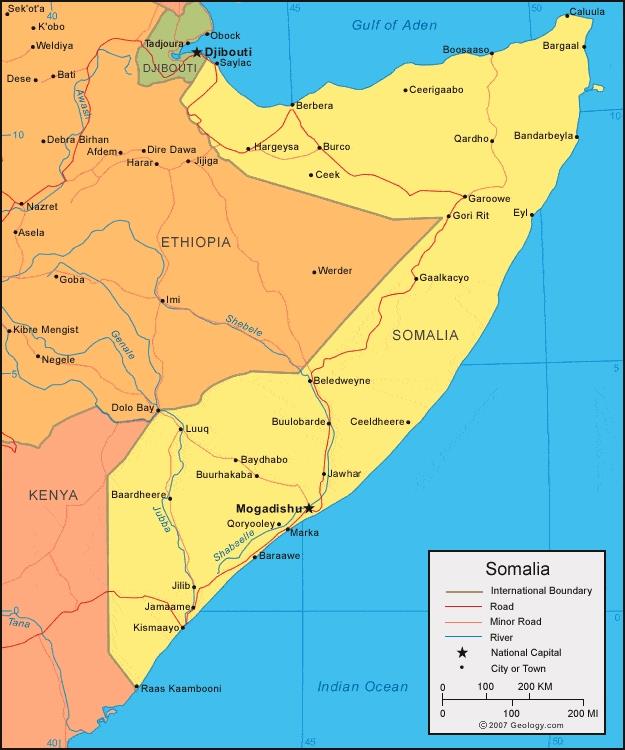
- Somalia is located at the easternmost tip of the continent, in the Horn of Africa.
- It has a very extensive coastline on the Gulf of Aden and the Indian Ocean.
- The country shares its borders with Djibouti to the northwest, Ethiopia to the west, and Kenya to the southwest.
- Its capital, Mogadishu, is a large port city on the Indian Ocean.
- Somalia is known for its vast arid areas and its strategic role on global maritime routes.
The map of Somalia illustrates a country in the Horn of Africa, bordered by Djibouti to the northwest, Ethiopia to the west, and Kenya to the southwest. With its long coastline on the Indian Ocean and the Gulf of Aden, Somalia occupies a strategic position on maritime routes.
Colors of Somalia

The flag of Somalia is a rectangular flag with a sky blue background and a white 5-pointed star in the center. The flag was inspired by the colors of the United Nations flag. Currently, the blue field symbolizes the Indian Ocean or the sky, and the 5-pointed star represents unity, meaning the unity of the 5 regions where Somalis live.
Main islands and best places to visit in Somalia

Mogadishu
Capital of Somalia, Mogadishu is a historic city that retains traces of its prosperous past. It was an important commercial center for Arabs and Persians between the 8th and 10th centuries. Today, the city blends remnants of Islamic architecture, bustling markets, ancient mosques, and modern seaside hotels. Its beaches, such as Liido Beach, attract many visitors.
Hargeysa
With about 800,000 inhabitants, Hargeysa is a major commercial and industrial center in northern Somalia. Its climate is semi-arid with warm temperatures year-round. It is a dynamic city featuring colorful markets, murals, and the regional museum that traces the history of the area. The best time to visit is between November and February, when the heat is more bearable.
Merca (Marka)
Located south of Mogadishu, Merca has about 520,000 inhabitants. It was once Somalia’s agricultural granary and an important commercial port. Today, the city is mainly known for its beautiful beaches and banana plantations. It is a favored destination for its coastal landscapes and a calmer atmosphere than the capital.
Bosaso
Bosaso, in the Puntland region, is a strategic port city overlooking the Gulf of Aden. It stands out as an important commercial hub and attracts visitors with its markets, beaches, and surrounding mountainous landscapes. It is also a gateway to the Somali hinterland.
Kismayo
Located in the south of the country, Kismayo is known for its beaches, port, and mangroves. It is a city rich in history, formerly influenced by Arab sultanates. Today, it is a popular destination for its natural setting and local culinary specialties, especially seafood dishes.
Climate of Somalia
Somalia has a tropical climate but not scorching, and there is little seasonal temperature variation. In lowland areas, the average temperature ranges from about 24 °C to 31 °C (75 °F to 88 °F). The plateau region is cooler, the southwest warmer. Periodic winds, the southwest monsoon (June-September), and the northeast monsoon (December-March) influence temperature and rainfall. Rain falls in two seasons: heavy rains from March to May and light rains from September to December. Average annual rainfall is estimated at less than 28 cm (11 inches). Droughts are not uncommon.
Administrative division of Somalia

The Somali territory is currently divided into 13 administrative regions, also called Gobollo or Gobol. There are also 5 regions not controlled by Somaliland that are claimed by the Territorial Administration.
Regions and districts
- Banaadir
- Gedo
- Jubbada Dhexe
- Jubbada Hoose
- Shabeellaha Dhexe
- Shabeellaha Hoose
- Bari
- Galguduud
- Hiiraan
- The bay
- Mudug
- Nugaal Region
- Bakool
Claimed regions
- Wdal Region
- Woqooyi Galbeed Region
- Sanaag Region
- Sool Region
- Somalia Economy
- Togdheer Region
Population and language Data
Somalia currently has 11,259,029 inhabitants with a demographic growth rate of 2.08%. The fertility rate is 5.7 children per woman. The birth and death rates are respectively 39.3 ‰ and 12.8 ‰. Life expectancy at birth is only 53.2 years, and the average age is 18.2 years, reflecting an extremely young population.
The sex ratio is 101 men per 100 women. The country records a negative migration rate of -5.6%, mainly due to political instability and forced displacements.
The languages spoken are mainly Somali (national language), but also Arabic, English, and to a lesser extent, Italian.
The population is predominantly composed of Somalis (85%), followed by Bantus (1%) and other ethnic groups (14%).
Economy of Somalia
The Somali economy remains fragile and poorly diversified, marked by the consequences of civil war and prolonged institutional collapse. It is mainly based on:
- agriculture and livestock, which represent the basis of subsistence,
- remittances from the diaspora, essential for the national economy,
- as well as emerging sectors such as telecommunications, fishing, trade, and construction.
The country has strong maritime and agricultural potential, but its development remains hindered by political instability, lack of infrastructure, and dependence on imports.
Economic data (2025 – updated estimates):
- Nominal GDP: 8.5 billion USD
- GDP at purchasing power parity (PPP): 25.9 billion USD
- Annual GDP growth rate: 2.8%
- Nominal GDP per capita: 420 USD
- GDP per capita at PPP: 1,280 USD
- Inflation rate: 6.5%
- Human Development Index (HDI): 0.361 (low)
- Unemployment rate: 11.8% of the active population
- Public debt: 72% of GDP
- Foreign exchange reserves: about 35 million USD
Main trading partners:
- Exports: livestock, bananas, fish, and incense mainly to Oman, Saudi Arabia, United Arab Emirates, Yemen, Pakistan.
- Imports: food products, textiles, machinery, and manufactured goods from China, India, Turkey, Kenya, and Ethiopia.
FAQ – Somalia map
Somalia is in the Horn of Africa, between Djibouti, Ethiopia, and Kenya, with a large coastline.
The capital is Mogadishu, on the southeastern coast of the country.
An arid country with vast plateaus, a long coastline, and strategic importance in the Indian Ocean.
