
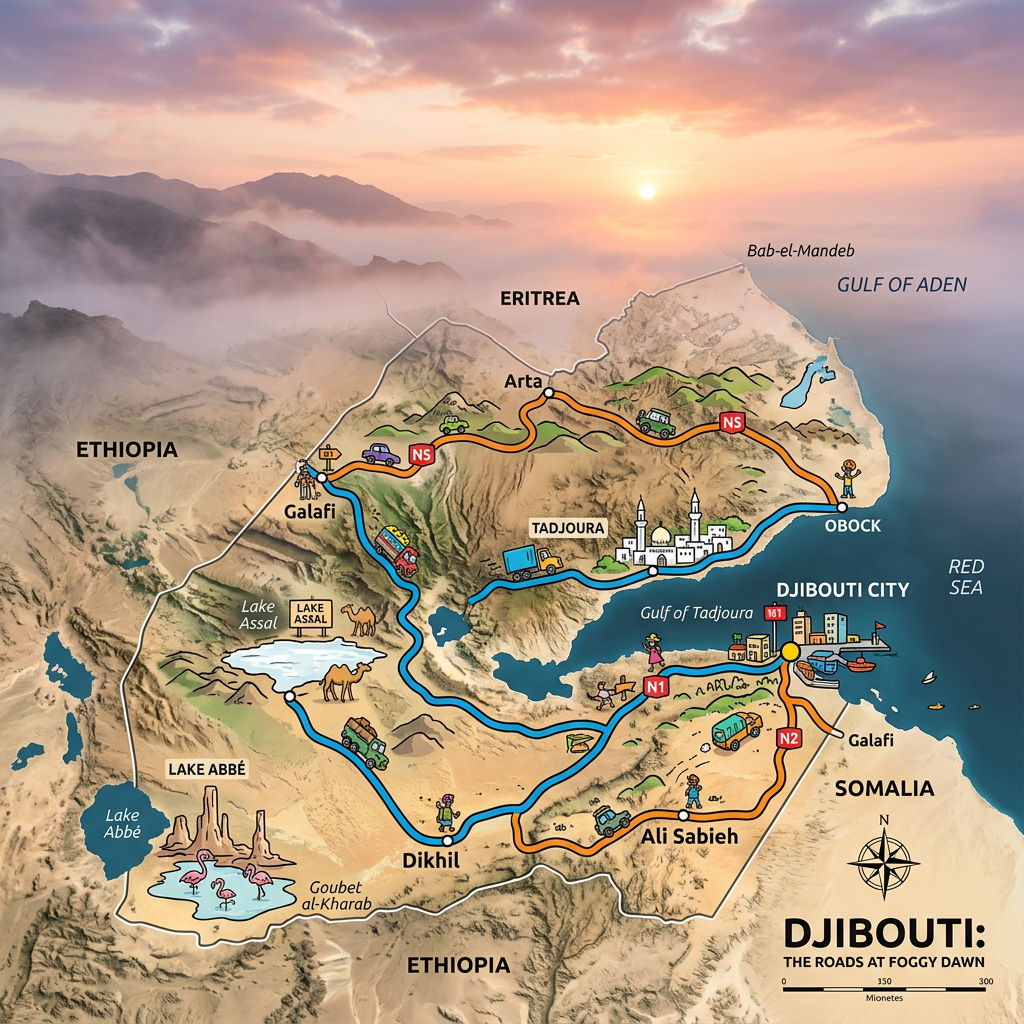
What you need to know about Djibouti ?
Djibouti is a constitutional republic, officially called the Republic of Djibouti.
- The area of its territory is 23,200 km².
- The population is estimated at about 1.12 million inhabitants in 2025.
- The capital and largest urban area is Djibouti City.
The country is a member of several regional and international organizations, including COMESA, the AfDB, and CEN-SAD.
The international telephone code of Djibouti is +253.
Table – Djibouti: geographical and demographic information
| Element | Key Information |
|---|---|
| Total Area | 23,200 km² |
| Capital | Djibouti |
| Neighboring Countries | Eritrea, Ethiopia, Somalia |
| Coastline | About 370 km on the Red Sea and Gulf of Aden |
| Estimated Population | ~1.2 million inhabitants (2025) |
| Population Density | ~52 inhabitants/km² |
| Relief | Volcanic massifs, desert plains, Lake Assal (-155 m) |
| Climate | Arid and very hot, with low rainfall |
| Official Languages | Arabic, French |
| Economic Resources | Strategic port, military bases, services, regional trade |
| Special Feature | Control of the Bab-el-Mandeb Strait, a strategic global maritime passage |
Additional points on the map of Djibouti
- Djibouti is located in the Horn of Africa, at the crossroads between the Red Sea and the Indian Ocean.
- The physical map highlights Lake Assal, the lowest point in Africa.
- The country occupies a strategic position on the Bab-el-Mandeb Strait, a key passage for global maritime trade.
- The capital, Djibouti City, concentrates most of the population and economic activities.
- Several foreign military bases are established there, strengthening its geopolitical role.
Colors of Djibouti
The Djiboutian flag is rectangular with a blue stripe above a green stripe. On the hoist side is a white isosceles triangle with a red five-pointed star at the center of the triangle. It is a flag reflecting the sky, the earth, and peace. The red represents the struggle for independence.

Main cities and best places to visit in Djibouti?
Djibouti: it is a city intended for excursionists who can now enjoy the hinterland or the beachfront beaches. You can enjoy charming restaurants, hotels, and bars. It is also the birthplace of modern cultural attractions and the 1980s.
Tadjoura: it is a coastal city that was formerly a trading port. Ideal for walks, you will see beautiful beaches and a city adorned with lime-colored houses and countless mosques.
Ali Sabieh: It is a trading town with street markets, food stalls, and protected sites. It is a town left in a wild state to allow tourists to engage in various activities: windsurfing, surfing, etc…
Where is Djibouti located on the world map?
The map of Djibouti highlights a small country in the Horn of Africa, bordered by Eritrea to the north, Ethiopia to the west and south, and Somalia to the southeast. Its coastline on the Gulf of Aden and the Red Sea gives it major geostrategic importance.

Djibouti climate
The Djiboutian climate is homogeneous: there are long hot seasons and short rainy winters. Temperatures range between 32 and 41°C in summer and between 15 and 20°C in winter.
The eastern region experiences temperature instability throughout the year, and as one moves inland, winter becomes increasingly cold with subzero temperatures.
Precipitation most often occurs in the afternoons during the winter seasons. Winter lasts from September to April and summer from May to August, and sometimes from April to September.
Djibouti administrative division
The Djiboutian territory is subdivided into 6 administrative regions:
- Ali Sabieh
- Arta
- Dikhil
- Djibouti
- Obock
- Tadjourah
These 6 administrative regions are further subdivided into 20 administrative districts:
- Moulhoule District
- Ali Sabieh District
- Khor Angar District
- As Eyla District
- Adailou District
- Balho District
- Galafi District
- Dadda’to District
- Dikhil District
- Ali Adde District
- Djibouti District
- Dorra District
- Mousa Ali District
- Obock District
- Lake Asal District
- Randa District
- Arta District
- Tadjoura District
- Holhol District
- Yoboki District

Djibouti economy
The Djiboutian economy benefits from its strategic position on the Red Sea, at the crossroads of global maritime routes. However, the country has an arid territory, which is not very favorable to agriculture, and the local workforce remains largely unskilled. Economic activity therefore mainly relies on:
- port transit and logistics services destined for Ethiopia and the region,
- foreign military bases that generate significant revenue,
- as well as the beginning of diversification in telecommunications and infrastructure.
Economic Data (2026)
- Currency: Djiboutian Franc (DJF)
- Nominal GDP: ~4.1 billion USD
- GDP (PPP): ~7.5 billion USD
- Annual GDP growth: ~6%
- GDP per capita (nominal): ~3,600 USD
- GDP per capita (PPP): ~6,500 USD
- Inflation: ~3%
- Population below poverty line: ~20–23%
- Unemployment rate: ~26–28% (but much higher among youth)
Population and linguistic data of Djibouti
- Total population (2025): ~1.12 million inhabitants
- Population growth rate: ~2%
- Birth rate: ~23 ‰
- Death rate: ~6 ‰
- Life expectancy: ~64 years (62 years men, 66 years women)
- Sex ratio: ~103 men per 100 women
- Median age: ~22 years (very young population)
Main ethnic groups
- Somalis (Issa): ~60%
- Afars: ~25%
- Arabs (Omanis, Yemenis/ta’izz-adenis): ~10%
- Minorities: French, Ethiopians (Amharas), Greeks and others: <5%
Languages
- Official: Somali, Afar, French
- Widely used: Arabic (notably Yemeni dialect)
Religion
Sunni Islam: practiced by more than 95% of the population
FAQ – Djibouti map: 3 Questions
Djibouti is located in the Horn of Africa, between Eritrea, Ethiopia, and Somalia, on the edge of the Red Sea and the Gulf of Aden.
The capital is Djibouti City, the economic and political center of the country.
The country is characterized by its volcanic landscapes, Lake Assal, its arid climate, and its strategic position on Bab-el-Mandeb.
