
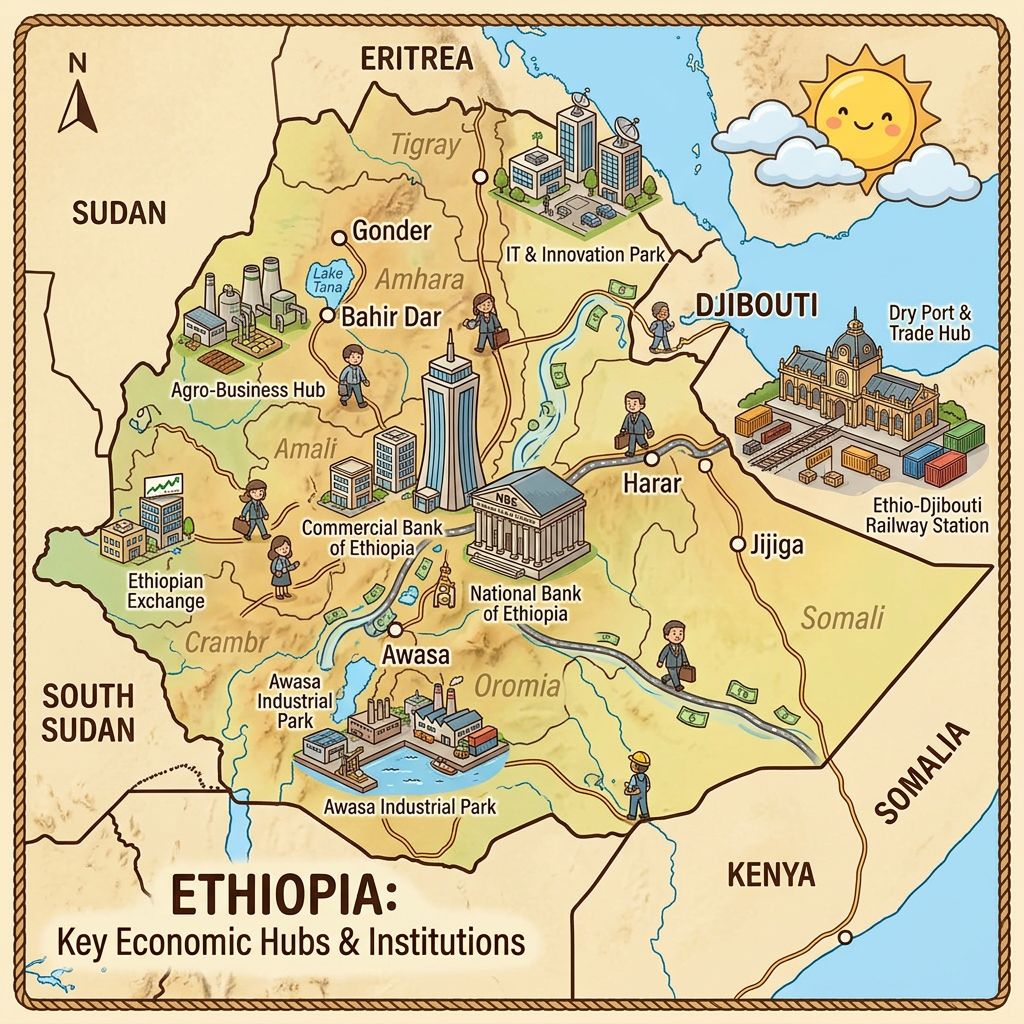
A pivotal country of the Horn of Africa, Ethiopia alternates temperate highlands and arid Rift zones. The map is key to connecting a northern itinerary (Lalibela, Gondar, Lake Tana) and an eastern one (Harar, Danakil), while accounting for altitude, rains, and roads.
What you need to know about Ethiopia ?
Ethiopia, officially called the Federal Democratic Republic of Ethiopia, is a landlocked country in the Horn of Africa.
Its territory covers an area of about 1,127,127 km², making it the 10th largest country in Africa.
The Ethiopian population is estimated at 126 million inhabitants in 2024, making Ethiopia the 2nd most populous country on the continent, after Nigeria.
Its capital, Addis Ababa, is also the largest city in the country and an important diplomatic center housing the headquarters of the African Union and many international organizations.
The official language is Amharic, although the country has more than 80 ethnic groups and recognized regional languages, such as Oromo, Tigrinya, and Somali.
The international telephone code for Ethiopia is +251 (not +261, which corresponds to Madagascar).
| Element | Details |
|---|---|
| Official Name | Federal Democratic Republic of Ethiopia |
| Capital | Addis Ababa |
| Population | ~120 million inhabitants, ethnolinguistic mosaic |
| Area | ~1,104,000 km² |
| Relief & Hydrography | Abyssinian highlands, Rift Valley, Danakil Depression, sources of the Blue Nile (Lake Tana) |
| Climate | Highland tropical on the plateaus, arid in the east (Afar/Somalia), rainy seasons vary by region |
| Languages | Amharic (administrative), numerous regional languages (Oromo, Tigrinya, Somali, etc.) |
| Currency | Ethiopian Birr (ETB) |
| Major Cities | Addis Ababa, Dire Dawa, Mekele, Gondar, Bahir Dar, Awasa |
| Economy | Agriculture (coffee), livestock, floriculture, hydroelectricity, services |
| Points of Interest | Rock-hewn churches of Lalibela, Simien Mountains, Lake Tana & Blue Nile, Danakil, Harar |
| Access | Flights via Addis Ababa (ADD), good domestic networks of Ethiopian Airlines, improving roads |
| Advice | Consider altitude, distances, and rainy seasons; check local conditions by region |
Colors of Ethiopia
The Ethiopian flag is rectangular and consists of 3 horizontal stripes. From top to bottom: Green, yellow, and red. In the center of the flag, there is a blue disc with a pentagram with 5 rays inside.

To set your bearings and prepare your itinerary, start with Ethiopia (map). View neighboring countries with Kenya, Sudan, South Sudan, Eritrea, Djibouti, and Somalia. Finally, place the whole in its continental context via the overview Africa.
Best places to visit in Ethiopia

Addis Ababa
Political and economic capital of the country, Addis Ababa is a vibrant metropolis that combines modernity and African traditions.
Located at over 2,300 meters altitude, it houses many cultural sites such as the National Museum of Ethiopia, where you can admire the skeleton of Lucy, one of the oldest hominids discovered.
The city is also a major diplomatic center, hosting the headquarters of the African Union, cultural institutes, craft markets like the Merkato, and a rich gastronomy reflecting the country’s diversity.
Axum
Axum is one of the oldest cities in Africa and the historical cradle of the Aksumite civilization.
Listed as a UNESCO World Heritage Site, it houses many monumental obelisks, the Axum stele, the legendary Church of St. Mary of Zion (which, according to tradition, would house the Ark of the Covenant), as well as fascinating archaeological sites.
History enthusiasts will discover the treasures of the Axum Archaeological Museum, including the famous Gobedra Lioness.
Dire Dawa
The second largest city in the country, Dire Dawa stands out for its harmonious urban organization and peaceful atmosphere.
It is a gateway to the east of the country and a strategic starting point to explore the Harar mountains, the Awash valley, and the traditional markets of the region.
Its colonial architecture, tree-lined streets, and colorful buildings give it a unique charm.
Lalibela
Nicknamed the “Jerusalem of Africa”, Lalibela is world-renowned for its rock-hewn churches, built in the 12th century.
This major spiritual site, listed as a UNESCO World Heritage Site, is a place of Orthodox Christian pilgrimage and a unique architectural marvel worldwide.
Among the most famous, the church of Bieta Giyorgis (Saint George), carved in the shape of a cross, attracts thousands of visitors every year.
Gondar
Former imperial capital, Gondar is nicknamed the “Camelot of Africa” for its medieval castles and royal buildings.
The Fasil Ghebbi royal complex, listed by UNESCO, testifies to the grandeur of 17th-century Ethiopia.
The city is also known for its churches adorned with frescoes, such as Debre Berhan Selassie, and for its lively cultural atmosphere.
Where is Ethiopia located ?

On the world map, the Ethiopian State is located in Africa. More precisely, it is situated on the Horn of continental Africa, in the northeastern section. Its neighbors are Somalia, Sudan, Kenya, as well as Djibouti.

Climate in Ethiopia
The climate in Ethiopia is varied, it changes according to the topography: In the north, there is a temperate climate with temperatures ranging between 20 and 25°C (July-August) and above 25°C (March-May). The rainy season occurs between March and May. In the southwest, there are frequent rains starting from March. In the southeast and the rest of the country, the climate is semi-arid desert. Temperatures reach 49°C during the months from May to November and rainfall is low.
Administrative division of Ethiopia

The Ethiopian territory is divided into regional states and chartered cities (at the same level) (10 regions or Kililoch and 2 chartered cities). Then, there are zones (numbering 68) and finally Woreda (equivalent to districts) which in turn are divided into municipalities or Kebele.
Regional states:
- Afar
- Amhara
- Benishangul-Gumuz
- Gambela
- Harari
- Oromia
- Somali
- Southern Nations, Nationalities, and Peoples’ Region
- Tigray
- Sidama
Chartered cities:
- Addis Ababa
- Dire Dawa

Economy of Ethiopia
The Ethiopian economy is mainly based on agriculture, which still employs more than 65% of the active population. This sector, dominated by the production of coffee, cereals, legumes, and oilseeds, remains vulnerable to recurring droughts, food shortages, and political tensions.
For several years, the country has embarked on a policy of economic diversification and industrial transition, supported by massive investments in infrastructure, hydropower, and industrial zones.
This strategy has enabled rapid economic growth, making Ethiopia one of the most dynamic countries in Africa over the past decade.
Key economic data (2024-2025 estimates)
- Official currency: Ethiopian Birr (ETB)
- Nominal GDP: 80.9 billion USD
- GDP at purchasing power parity (PPP): 200.2 billion USD
- Annual GDP growth: approximately 10.9%
- GDP per capita (PPP): 2,200 USD
- Inflation rate: 9.9%
- Population below poverty line: 29.6%
- Unemployment rate: 17.5%
Thanks to projects such as the Renaissance Dam, the modernization of the Addis Ababa–Djibouti railway network, and the development of special economic zones, Ethiopia is establishing itself as a future industrial hub of the Horn of Africa.
Population and linguistic data of Ethiopia

The Ethiopian population is estimated at around 126 million inhabitants in 2024, with a population growth rate of 2.8%.
The birth rate is 36 ‰, while the death rate reaches 7.5 ‰.
The life expectancy at birth is about 66 years, and the median age is 18 years, indicating a very young and rapidly growing population.
Linguistic distribution
- Amharic: 32.7%
- Oromo: 31.6%
- Tigrinya: 6.1%
- Somali: 6.0%
- Gurage: 3.5%
- Sidama: 3.5%
- Other regional languages: 16.6%
Amharic is the official language of the federal state, but many regional languages enjoy recognized status in autonomous provinces.
Ethnic distribution
- Oromos: 35.3%
- Amharas: 26.2%
- Somalis: 6.0%
- Tigrayans: 5.9%
- Sidamas: 4.3%
- Gurages: 2.7%
- Welaytas: 2.3%
- Other ethnic groups: about 17%
This great cultural and linguistic diversity is one of the major characteristics of Ethiopia, which remains one of the few African countries to have never been colonized, while preserving a strong national identity.
FAQ: Ethiopia map
Prefer an Ethiopia map with contour lines and main road axes to estimate travel times between highlands, Rift, and Danakil.
Yes, an Ethiopia map showing Lalibela, Gondar, Bahir Dar, and Lake Tana makes it easier to organize the stages and air connections.
Use an Ethiopia map detailing Rift towns (Awasa, Shashamene) and lake areas to combine nature and culture.
Yes, downloading an offline Ethiopia map and planning GPS points is recommended in Danakil or sparsely covered areas.
Thematic maps clearly show the gradient between cooler highlands and hot, arid lowlands, useful for equipment planning.
