
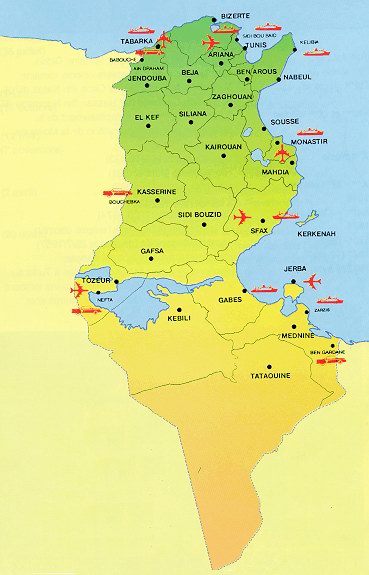
Tunisia is a country in North Africa bordered by the Mediterranean Sea. Officially called the Tunisian Republic, it is organized as a semi-presidential republic with a unicameral legislature.
What you need to know about Tunisia ?
Its capital and main urban area is Tunis. The area of Tunisian territory is 163,610 km² and its population is estimated at about 12 million inhabitants in 2025.
Tunisia thus ranks 92nd worldwide by area and 78th by population.
Table – Tunisia: Geographical and demographic information
| Element | Key information |
|---|---|
| Total area | 163,610 km² |
| Capital | Tunis |
| Neighboring countries | Algeria, Libya |
| Coastline | ~1,300 km on the Mediterranean Sea |
| Estimated population | ~12.6 million inhabitants (2025) |
| Population density | ~77 inhabitants/km² |
| Relief | Atlas Mountains in the northwest, plains and high plateaus in the center, Sahara Desert in the south |
| Climate | Mediterranean in the north, semi-arid in the center, desert in the south |
| Official language | Arabic (French commonly used) |
| Economic resources | Tourism, agriculture (olives, dates), phosphate, oil |
| Particularity | Most northern country in Africa |
Additional points on the map of Tunisia
- Tunisia is located in North Africa, on the Mediterranean coast.
- Its map shows a contrasting relief: mountains in the north, plains in the center, and the Sahara in the south.
- Tunis, the capital, is located near the Gulf of Tunis.
- The coastline is dotted with well-known seaside resorts such as Hammamet, Sousse, or Djerba.
- Its strategic position at the crossroads of Europe, Africa, and the Middle East makes it a historical crossroads.
Neighboring countries of Tunisia
The map of Tunisia illustrates a country in North Africa, bordered by Algeria to the west and by Libya to the east. Its coastline stretches along the Mediterranean, offering dynamic coastal cities and major tourist sites such as Djerba or Hammamet. Tunis, its capital, is an essential political, economic, and cultural center.
The colors of Tunisia
The flag of Tunisia is a red flag with a red disc in its center containing a five-pointed star enclosed within a crescent moon.

The crescent moon and star represent Islam while the red color represents the blood shed during the struggle against the Ottomans and the Spanish. The white color, on the other hand, represents peace and prosperity.
The best places to visit in Tunisia

Map of Tunisia

Tunis
Also called Medina, the city of Tunis is the capital of the country. It offers magnificent contemporary architecture as well as old buildings reflecting French colonization. The old city of Tunis indeed has more than 700 ancient buildings dating back to the 16th century.
In those old times, the city of Tunis was a place of learning and a cradle of Tunisia’s physical and cultural wealth.
You will then see the remains of the civilization of yesteryear which are: the Madrass fountains, the palaces and the gates of the Medina as well as the Bar Bhab and the Bar Jedid.
Ghar Al Milh
This city is also called Porto Farina because of its coastal location and the lagoons nearby. Formerly, this city was one of the main ports of the country along with Tunis and Bizerte. It was also a refuge for Berber pirates until the arrival of the British in 1655.
Currently, the port of Ghar Al Milh has become silted up and is only famous because of the Ottoman ruins and remains that once stood there.
Matmata
The city of Matmata is especially famous because the first Star Wars Saga films were shot there. But in addition, there are the troglodytes that were discovered in 1967 in the southern part of the city which today has become the main attraction. Some troglodytes even descend up to 30 feet.
Descent systems have now been created to facilitate the visit of these monuments which formerly required earthen steps and rope ladders.
Financial map of Tunisia
The Tunisian economy is based on the primary sector, notably market gardening crops (wheat, olives, dates, and citrus). The industrial sector is based on the exploitation of mineral resources as well as phosphate production and, incidentally, hydrocarbons.
There are also textile industries and agro-food processing industries that contribute to increasing exports. Tunisia’s economic partners are European countries such as Germany, France, Italy, and China. Here are some economic data about Tunisia:
- Current Currency: Tunisian Dinar
- GDP in nominal terms: 39.96 billion USD
- GDP in purchasing power parity: 137.7 billion USD
- Annual GDP growth rate: 2%
- GDP per capita in purchasing power parity: 11,900 USD
- Inflation rate: 5.3%
- Population below the poverty line: 15.5%
- Unemployment rate as % of active population: 15.5%

Climate map of Tunisia
The Tunisian climate is a Mediterranean type climate for a large part of the territory except for the southern part where the climate is arid. This climate is then characterized by a cool, moderately humid winter with temperatures ranging between 8 and 15°C.
Summer, on the other hand, is warmer with temperatures oscillating around 22 and 35°C. August is the hottest month where temperatures can reach 40°C.
The northern Tunisian coast also displays a Mediterranean climate. This is characterized by a very sunny and hot summer.
However, summer temperatures are quite high in the capital, which can even reach 34°C in August.
Rainfall is quite low during the sunny and hot months, especially between October and April. Winters are cool with daytime temperatures reaching an average of 15°C.
If you follow the eastern coasts, temperatures gradually increase accompanied by abundant rainfall and a high duration of sunshine.
Temperatures at the beginning of the year can reach 18°C. The interior areas can display an extremely hot climate during the summer periods with temperatures that can reach 40°C.
Demographic, demolinguistic and administrative map of Tunisia

Demographics
Currently, the population of Tunisia amounts to 11,721,177 inhabitants with a demographic growth rate of 0.85%. This translates to a birth rate of 1.59% and a mortality rate of 0.64%.
On the other hand, the fertility rate in the country is 2.06 children per woman.
The life expectancy of a Tunisian at birth is 76.3 years and the average age in the country is 32.7 years which indicates a young population. The male/female ratio in Tunisia is 99%.
Tunisians are mainly composed of Arab-Berbers, Europeans, and Jews. The religions in the country are Islam, Christianity, and Judaism.


Administrative divisions of Tunisia
The Tunisian territory is subdivided into 24 governorates which in turn are subdivided into 264 districts also called delegations or Mutamadiyat. These are further subdivided into Municipalities and sectors (shaykhats or imadats)
Here are the governorates of Tunisia
- Ariana
- Béja
- Ben Arous
- Bizerte
- Gabès
- Gafsa
- Jendouba
- Kairouan
- Kasserine
- Kebili
- Kef
- Mahdia
- Manouba
- Medenine
- Monastir
- Nabeul
- Sfax
- Sidi Bouzid
- Siliana
- Sousse
- Tataouine
- Samar
- Tozeur
- Tunis
- Zaghouan
Demolinguistic data


Compared to other Maghreb countries which are Morocco and Algeria, the population of Tunisia is quite linguistically homogeneous. Indeed, more than 92% of the population are Arabic speakers. Minorities speak Berber and French.
Tunisian Arabic is a variety of dialectal Arabic, but the native language is also called Berber Arabic, or Amazigh. Here are the languages used in the country:
- Tunisian Arabic (92.4%)
- Libyan Arabic (2.6%)
- Algerian Arabic (2.3%)
- Arad Bedouin (0.4%)
- Chaouia (0.4%)
- Jerid Bedouin (0.4%)
- Jedba Arabic (Djerbi) (0.2%)
- Lebanese Arabic (0.2%)
- Gafsa Bedouin (0.2%)
FAQ – Tunisia map: 3 questions
Tunisia is located in North Africa, between Algeria and Libya, on the Mediterranean coast.
The capital is Tunis, located in the northeast of the country.
The country combines mountains in the north, plains and high plateaus in the center, and the Sahara in the south.
