
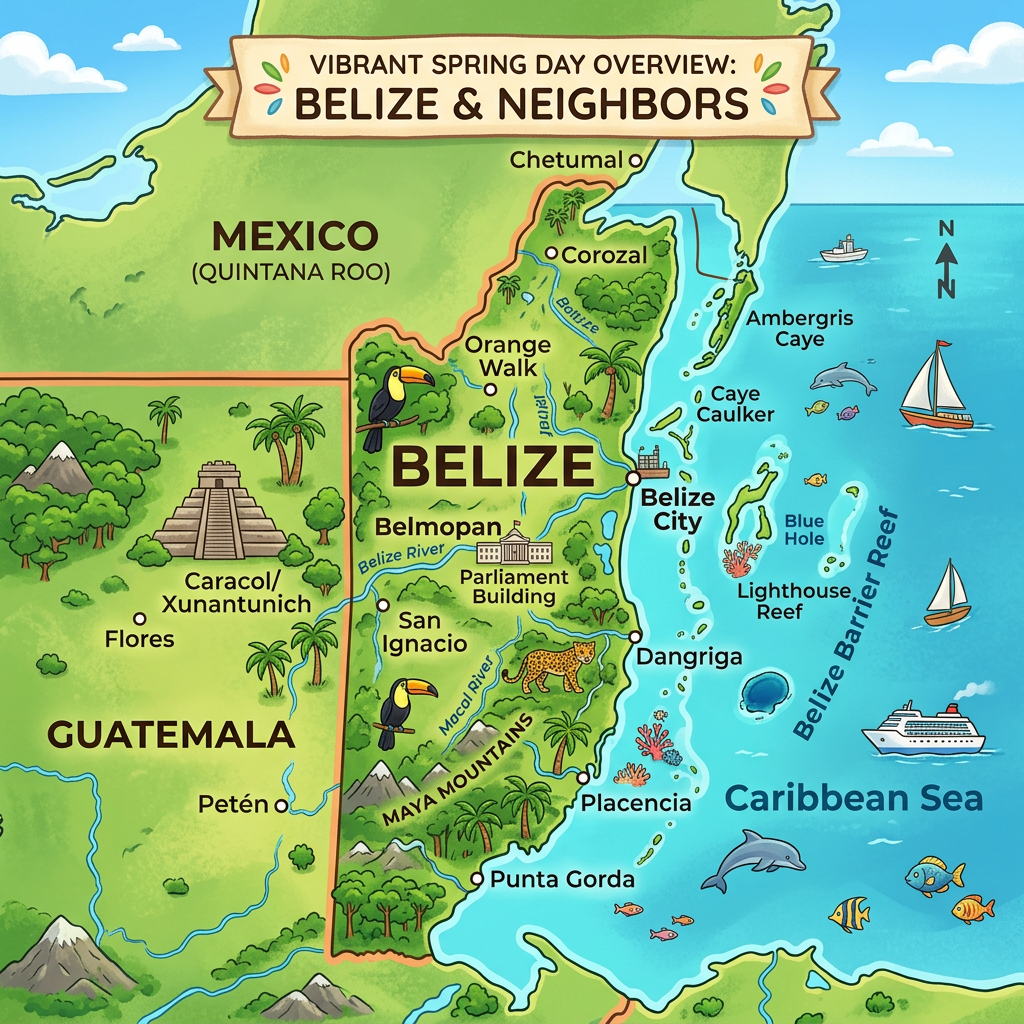
Venturing into the heart of Belize becomes much more tangible with a good geographical map in front of you. This small Central American country, often little known, holds a diversity of landscapes and places to visit that surprise as much by their beauty as by their cultural richness.
Whether one wishes to explore iconic tourist sites, chart a route among the national parks, or understand how the administrative districts are organized, it all starts with a careful look at the map of Belize. The discovery can quickly turn into a passion for this territory bordered by the Caribbean Sea and crossed by rivers and streams with translucent waters.
Table – Belize: Geographic and demographic information
| Element | Key Information |
|---|---|
| Total area | 22,966 km² |
| Capital | Belmopan |
| Former capital | Belize City |
| Neighboring countries | Mexico, Guatemala |
| Coastline | ~386 km on the Caribbean Sea |
| Estimated population | ~450,000 inhabitants (2025) |
| Population density | ~19 inhabitants/km² |
| Relief | Coastal plains, Maya mountains, cayes and atolls |
| Climate | Humid tropical, rainy season and hurricanes |
| Official language | English (Spanish and Creole widely spoken) |
| Economic resources | Tourism, fishing, agriculture (sugar cane, citrus) |
| Special feature | The only English-speaking country in Central America, known for the Belize Barrier Reef |
Reading a map of Belize: understanding its geography and specifics
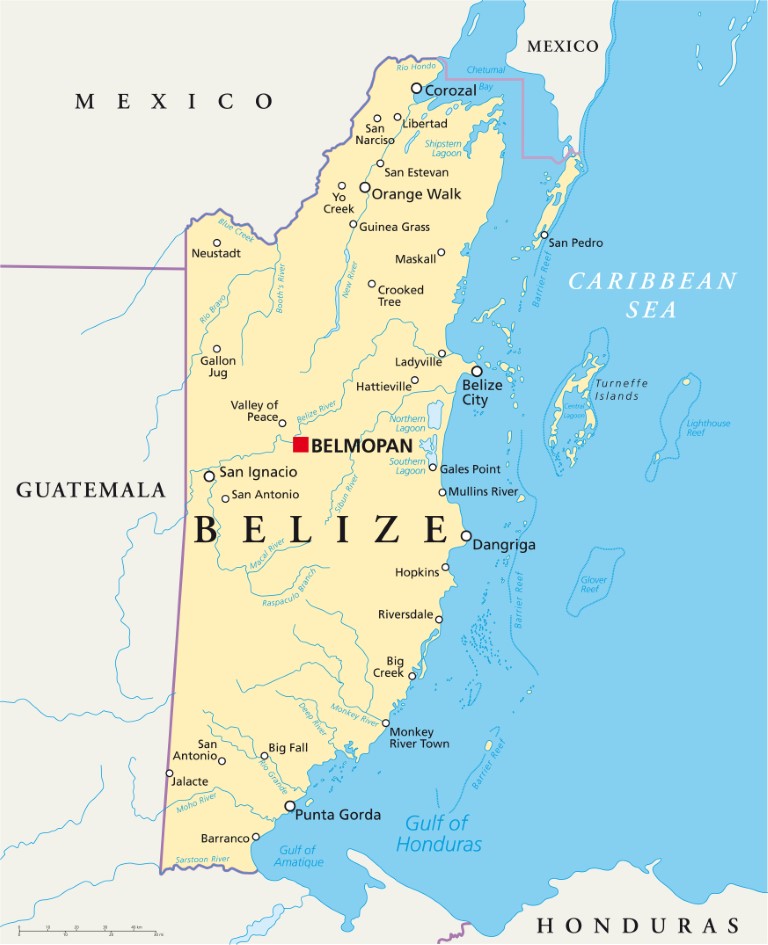
Examining a geographical map of Belize allows you to quickly spot the main traffic routes, the location of its capital Belmopan, or the distribution of protected natural areas. The details inscribed on the map of Belize highlight not only the cities of Belize but also the organization of each administrative district. These elements help to better understand the country as a whole.
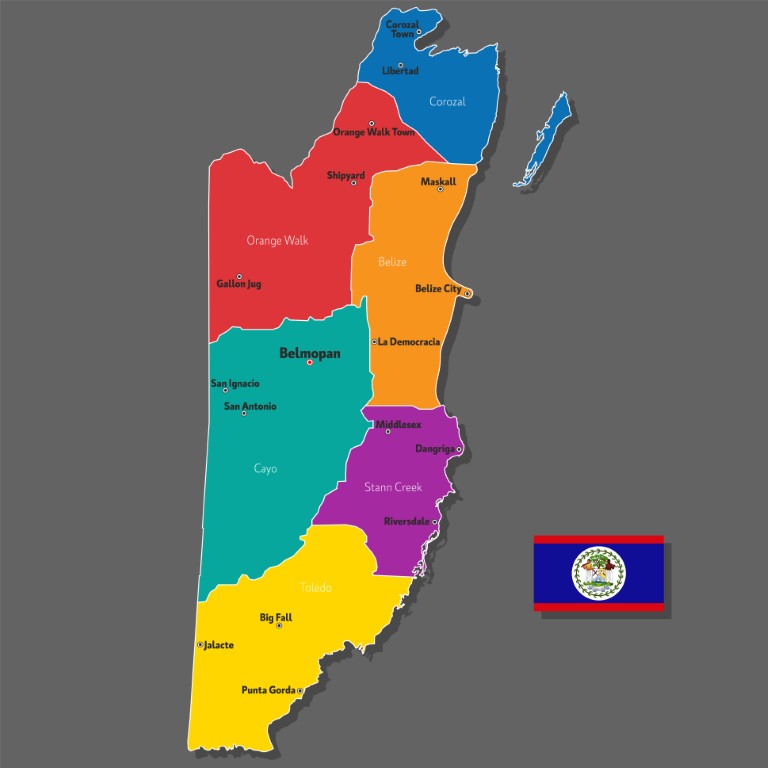
By observing the map, one notices that the country is divided into six distinct administrative districts. Each has its own attractions, ranging from paradisiacal beaches to vast forest reserves. The layout of the main roads and routes sheds light on travel possibilities, especially between urban areas and remote sites. For many, it is the beginning of an adventure through still preserved lands.
The map of Belize shows a Central American country, bordered to the north by Mexico and to the west and south by Guatemala. Its coastline on the Caribbean Sea is famous for its coral reef and numerous islands, making Belize a major tourist destination.
Additional points on the map of Belize
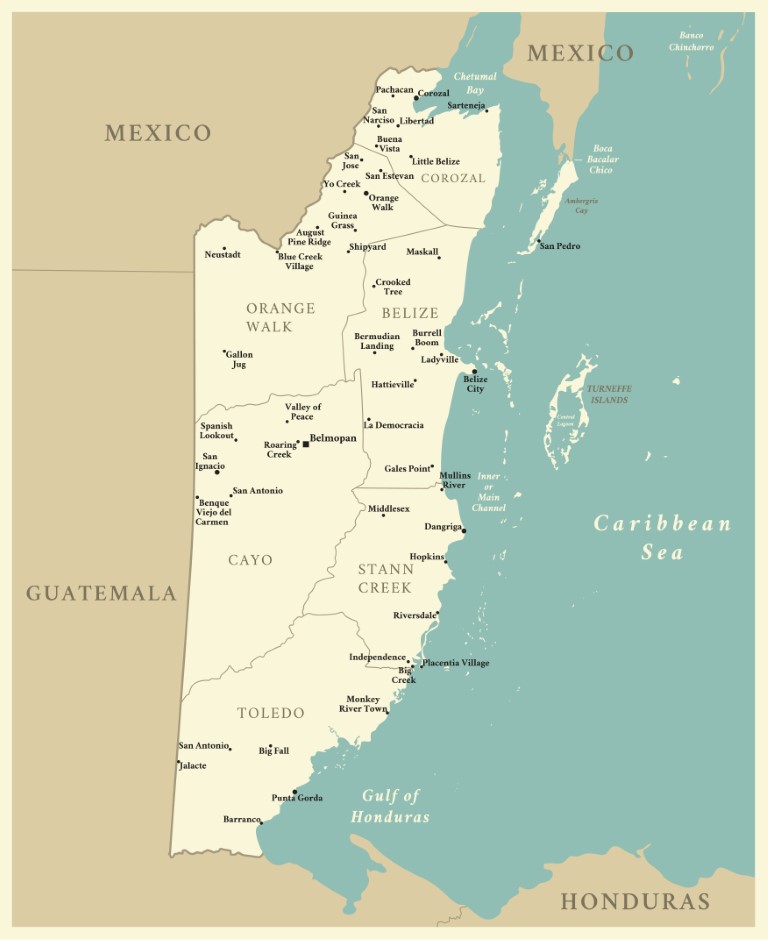
- Belize is located in Central America, between Mexico to the north and Guatemala to the west and south.
- Its Caribbean coast is famous for the Belize Barrier Reef, the second largest in the world.
- The territory includes numerous islands (cayes) and inland tropical forests.
- Belmopan is the administrative capital, while Belize City remains the largest city and main port.
- The culture is a blend of Creole, Maya, Spanish, and British influences.
What are the key territories on the Belize map?
Belize shows remarkable diversity, noticeable when studying its topography on a detailed geographic map. From the Caribbean coast to the interior of the country, each area attracts for a particular reason, whether it is natural riches, local cultures, or popular beach activities.
The capital Belmopan and its surroundings
Much less known than some neighboring capitals, Belmopan stands out as the administrative center of the country. This modern city, established inland since the 1970s, offers an ideal base to explore the entire region, especially via the main roads and routes that converge there. On the Belize map, the capital appears as a major crossroads, connecting north, south, and east, thus facilitating access to the various surrounding districts.
Around Belmopan, there are many varied places to visit, such as the Maya ruins of Xunantunich or the botanical garden of the Cayo district. Visitors also enjoy the immediate proximity of numerous rivers and streams that cross this central area and irrigate forests, crops, and traditional villages.
The major cities of Belize: key points on the map
Besides Belmopan, other cities of Belize attract attention. Belize City, now no longer the capital but the largest urban area, is among the must-locate places on a geographic map of the country. Located on the east coast, it serves as a gateway for coastal exploration and allows easy access to marine attractions, such as the impressive barrier reef.
San Ignacio, Orange Walk, and Dangriga are also positioned at different points on the Belize map, each offering privileged access to lush swamps, wildlife reserves, or archaeological sites. Their locations facilitate organizing targeted excursions, using the main roads often drawn in straight lines on road maps.
Roads, main routes, and administrative organization

Navigating through Belize requires a good understanding of its road network structure and the layout of its administrative districts. A geographic map clearly shows the main arteries, useful for organizing a trip without surprises and fully enjoying all the major tourist sites.
Decoding the main roads and routes
The Belize map reveals three main essential axes that structure internal travel: the Northern Highway, the Western Highway, and the Southern Highway. Connecting the main cities of Belize, these roads offer a direct link between the administrative center, the coastal regions, and the wild hinterland. Venturing off the beaten path, secondary roads provide access to isolated villages or natural areas sometimes hiding real treasures.
Traveling on these main roads is relatively simple. That said, it is still recommended to travel with an updated map of Belize to avoid missing any important junctions. Some routes cross sparsely populated areas where signage can be rare, making a sense of direction essential and sometimes favoring unexpected encounters with the local wildlife.
Organization into administrative districts
The administrative division of Belize largely influences the management of public services, environmental preservation, and tourism development. On the map, six administrative districts clearly stand out: Corozal, Orange Walk, Belize, Cayo, Stann Creek, and Toledo. Each has its own specificities, both economically and culturally.
This directly impacts trip planning. A nature lover will prefer to explore the national parks of the Cayo district, while enthusiasts of water activities will find their happiness in Stann Creek, with its palm-lined shores and exceptional marine life.
Nature and national parks: where the map comes alive
Browsing a geographical map of Belize is also exploring its natural treasures. Several protected areas cover its territory, supporting the country’s reputation as one of the most committed in Central America to biodiversity conservation. The national parks and reserves shown on the Belize map invite you to leave the classic routes to experience something authentic.
Remarkable national parks
The Mountain Pine Ridge National Park tops the list of places to visit during a trip to Belize. Known for its pine forests, waterfalls, and sacred caves, it attracts hikers, spelunkers, and naturalists. Further south lies the Cockscomb Basin Wildlife Sanctuary National Park, world-renowned for hosting the highest concentration of wild jaguars on the continent.
On a detailed map, these vast green spaces sharply contrast with urbanized areas and suggest the multitude of possible routes to observe endemic fauna and flora. Further east, several coastal reserves protect mangroves, lagoons, and reefs, marking the natural border with the sea.
Rivers and streams crisscrossing the landscape
Watercourses play a key role in daily life in Belize. The New River, the Belize River, and the Rio Grande are among the rivers and streams invariably represented on all Belize maps worthy of the name. They serve as natural landmarks and sometimes determine routes during hikes or trips in traditional dugout canoes.
Exploring these rivers is also like going back in time: many major tourist sites, such as the Maya ruins of Lamanai, are only accessible via these waterways. Traveling this way allows you to observe the diversity of the riparian vegetation, colorful birds, and to occasionally encounter some fishermen settled since dawn.
What are the tourist sites and places to visit in Belize?
Along the roads and trails, the geographical map of Belize serves as a valuable guide to discover the iconic sites scattered from north to south. Between archaeological remains and tropical panoramas, every corner hides a story, a curiosity, or a breathtaking view.
- Xunantunich: a Maya site accessible from San Ignacio, perfect for combining culture and spectacular views over the valley.
- Lamanai: pyramid accessible only by boat, immersing visitors in the mysterious atmosphere of the jungle.
- Hol Chan Marine Reserve: a paradise for snorkelers and divers, located near the coral reefs, teeming with multicolored fish.
- Placencia: a popular seaside resort with a relaxed atmosphere and beaches ideal for unwinding after a land journey.
- Caracol: an imposing Maya complex nestled deep in the forest, accessible only after several kilometers on forest tracks.
Planning these visits is an art of skillfully handling the map of Belize. Identifying these destinations helps optimize each trip and vary discoveries according to desires. Beyond classic routes, the plans invite those who dare to take detours to savor the unexpected, between raw nature, welcoming villages, and millenary heritage.
FAQ – Belize map
Belize is located between Mexico and Guatemala, with a coastline on the Caribbean Sea.
The capital is Belmopan, but the largest city remains Belize City.
A small tropical country with dense forests, mountains, a Caribbean coastline, and a vast coral reef.
